




By Walter Ulloa
For Variety
HAGÅTÑA (The Guam Daily Post) — About 80 people packed the room for the second of two events in the Commonwealth of the Northern Mariana Islands. The first occurred late last year. The second took place earlier this month. Attendees heard scientists detail the largely unknown dangers of deep-sea mining.
Researchers issued stark warnings as the federal comment period neared its close. They cautioned that operations could contaminate the region’s seafood and destroy barely explored ecosystems.
The forum, organized and hosted by Northern Marianas College and the Guam Green Growth Initiative, brought University of Hawaii researcher Jeffrey Drazen to present findings from a test mining discharge.
“In the near field, right near the discharge point, the copper concentrations get up to above six times background, and they cross this toxicity threshold,” Drazen said. “So, they’re likely toxic to animals.”
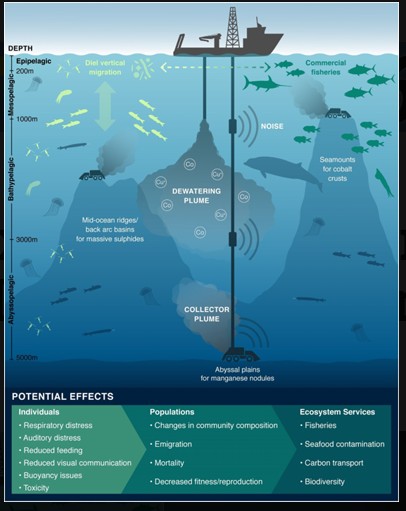
The mining operation Drazen studied ran just 36 hours in 2022. Commercial operations would run nearly year-round, potentially 270 days or more, discharging roughly 50,000 cubic meters of muddy seawater daily, equivalent to about 1,000 20-foot shipping containers worth of contaminated water.
Drazen’s team tested the mining effluent on organisms routinely used by the EPA to assess industrial discharge toxicity. In 29% of experiments, survival rates dropped for rotifers exposed for 48 hours. For larval fish exposed for seven days, 25% showed reduced survival and 50% experienced stunted growth.
“The effluent is toxic in its most concentrated form,” Drazen said.
Companies seek polymetallic nodules and ferromanganese crusts containing cobalt, nickel, and other battery metals from depths between 4,000 and 6,000 feet. These minerals take millions of years to form, creating hard substrate habitat critical for deep-sea organisms.
Drazen’s research revealed that 53% of plankton at the test discharge depth feed on organic detritus drifting from surface waters. Another 60% of fish species and 85% of individual fish at that depth eat that plankton, creating a tightly coupled food web.
When mining floods these depths with inorganic particles, plankton mistake the worthless sediment for food. They consume it, fill their guts with material containing no nutrition, and potentially starve while their stomachs are full.
Mining discharge would flood those depths with inorganic mud containing no nutrition, potentially diluting food resources and disrupting the entire chain. The impacts could reach commercial fisheries because harvested species, such as swordfish, tuna, and marlins, dive to those depths to feed.
“These food webs are linked across the ocean depths,” Drazen said.
Sean Macduff, superintendent of the Mariana Trench Marine National Monument, showed images from a May 2025 expedition aboard the research vessel Nautilus. The photos revealed sediments, nodules, and creatures living on seamounts the size of Oahu, most unknown to science.
Macduff displayed photos from a robotic vehicle that descended nearly a mile deep and traveled less than a mile across the seafloor over seven hours. The images showed glass sponges, brittle stars, sea cucumbers that swim, and rocks covered in organisms scientists couldn’t identify.
He showed a rock his team collected and later cut in half, revealing striations of minerals deposited over millions of years.
The minerals build up at rates measured in millimeters per million years, making them effectively non-renewable on any human timescale.
Kelsey McClellan, natural resources management program coordinator at Northern Marianas College, said the tight timeline troubled her from the start. She learned about the Bureau of Ocean Energy Management’s request for information through environmental networks about five days after BOEM opened the 30-day comment period in November.
“BOEM didn’t give anybody in the government administration notice,” McClellan told The Guam Daily Post. “There was the press release that BOEM released about 48 hours prior to opening up the federal register. But other than that, there was no heads up.”
The lack of notice forced organizers to mobilize during Thanksgiving and Christmas. BOEM granted a 30-day extension after the governors of Guam and the CNMI requested 120 additional days, but McClellan said the timeline remained insufficient.
“The timing of this didn’t really facilitate community engagement,” she said.
McClellan estimated the Jan. 8 forum drew 80 to 90 participants, following a Dec. 3 event that attracted 109 people.
The Jan. 8 forum is part of a broader community education drive on deep-sea mining risks in the Marianas, mirroring recent Post coverage of similar events, such as the Dec. 3 CNMI forum and a Jan. 7 Guam workshop by Guam Green Growth and partners that continues even after BOEM closed the RFI comment period on Jan. 13 ChST.
The forums drew educators, fishermen, traditional practitioners, government officials, and students, reflecting broad community concern about the proposal’s impacts on island life.
Lauren Swaddell from the Blue Nature Alliance explained during the event that anonymous submissions won’t be considered, and template letters count as single comments regardless of how many people submit them.
For American Samoa’s request for information earlier in 2025, activists claimed over 76,000 comments, but BOEM counted only 1,085 as unique after filtering out form letters, duplicates, and anonymous submissions, according to Swaddell.
She urged attendees to write personal comments before the Jan. 12 comment deadline explaining specific concerns about cultural practices, fishing grounds, navigation routes, or potential health impacts.
Galvin Deleon Guerrero, president of Northern Marianas College, opened the forum with a story about Super Typhoon Yutu in 2018. He recalled his autistic daughter asking repeatedly if they would be OK as winds battered their house.
“I felt incredibly helpless,” Leon Guerrero said. “It was at that moment that I resolved that I’m never going to ever feel that helpless ever again.”
He urged attendees to reject helplessness about deep-sea mining.
“We need to stop feeling helpless,” Leon Guerrero said. “This is within our control.”
Jun Coleman, a traditional navigator with the 500 Sails organization, referenced his brother who has descended to the Mariana Trench with submersible pilot Victor Vescovo.
Coleman said Vescovo, who has visited major ocean trenches, advises leaving the deep sea unexplored.
At the earlier CNMI forum, traditional navigator Cecilio Raiukiulipiy warned that mining operations could disrupt ocean currents critical for navigation and marine migration patterns throughout the Pacific.
Austin Shelton, director of the University of Guam Center for Island Sustainability and Sea Grant, closed the January forum by urging attendees to flood BOEM with comments before the impending deadline.
“Be the typhoon,” Shelton said. “Flood this place with comments.”
McClellan told the Post that attendees at both forums strongly opposed mining.
“Our community, or the folks that attended the workshop, were very against deep-sea mining and really recognized the potential harm that it could have,” she said.
The deadline for BOEM’s request for information expired at 11:59 p.m. EST on Jan. 12, or 2:59 p.m. ChST on Jan. 13. The federal docket at regulations.gov under docket number BOEM-2025-0351-0001 showed 37,464 comments received, with 1,681 posted publicly.
Activists and advocates collected more than 60,000 petitions, letters, and comments opposing the proposal, according to a webinar held the day of the deadline.
