






By Bryan Manabat
[email protected]
Variety News Staff
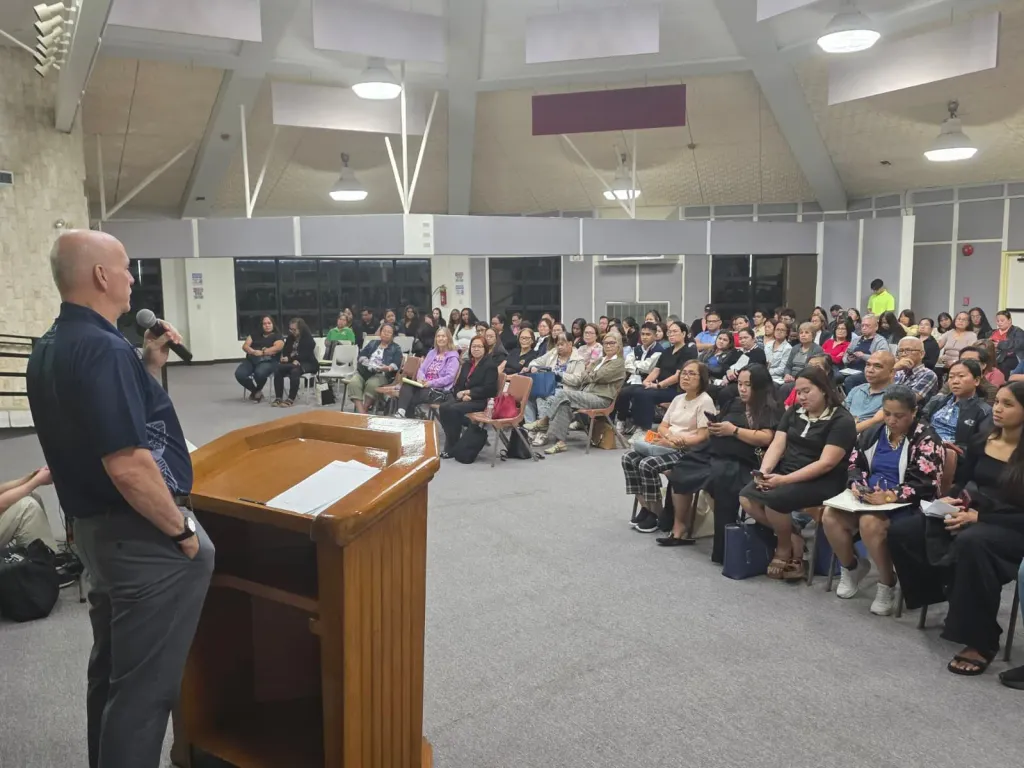
MORE than 120 accounting professionals, business owners, and tax practitioners attended the Commonwealth Board of Accountancy’s tax update seminar on Wednesday, Feb. 4, at the multi‑purpose center.
CBOA member David Burger, CPA provided a comprehensive presentation on major federal tax law changes and their application under the CNMI’s mirror‑code system.
Burger also discussed some of the key provisions of the federal “One Big Beautiful Bill/Act.”
Individual tax changes
Burger highlighted increases to the standard deduction, giving more taxpayers a larger “automatic” deduction even if they do not itemize. “For many people, this alone will simplify their filing and reduce their taxable income,” he said.
A new personal exemption for seniors — individuals 65 or older by year-end — will also be temporarily available. “If both spouses qualify, the combined benefit is even higher,” Burger said, noting that both provisions include income-based phase-outs and sunset dates.
The child tax credit rises to $2,200 per qualifying child, up from $2,000. “The refundable portion will now adjust annually for inflation,” he said. “But the income limits still matter, so not everyone will see the full benefit.”
The long-standing $10,000 cap on state and local tax deductions will be temporarily loosened. “This gives some breathing room to taxpayers with high state income or property taxes,” Burger said. “But it’s temporary — it goes back to the old cap later.”
Mortgage interest deduction rules remain intact for up to $1 million in qualifying acquisition debt. Casualty loss deductions are extended and clarified, with the CNMI explicitly treated as a “state” for disaster-related purposes.
On gambling losses, Burger said, “You can still deduct losses up to your winnings, but under the new act only a %age of those losses will actually count. Heavy gamblers will feel that change.”
New deductions for workers
Several new or enhanced deductions target service workers and middle-income earners. These include a deduction for properly reported tips and a separate deduction for the “overtime premium” portion of wages.
“These are targeted benefits,” Burger said. “They’re capped and phase out at higher incomes, but for typical workers, they can make a real difference.”
Employers will eventually need to track overtime separately on Form W-2. “That’s not required in the first year,” Burger said, “but employers should be preparing for it.”
Interest on certain qualifying vehicle loans may also become deductible if the vehicle meets strict criteria. “This is not a blanket deduction,” he said. “The rules are technical, and the vehicle has to meet very specific standards.”
The “Trump Account”
Burger discussed the Child Tax Saver Account, commonly referred to as the “Trump account.” He described it as “essentially an IRA for minors,” allowing up to $5,000 per year in contributions to qualifying low-fee mutual funds or ETFs.
“The idea is long-term savings for children,” Burger said. “Contributions can be excluded from the child’s taxable income, and when the child turns 18, the amounts come out tax-free.”
He also noted a pilot program that treats eligible children as having made a $1,000 tax payment refunded directly into the account. “It’s a government-seeded contribution,” he said.
However, Burger stressed that the CNMI and Guam do not automatically adopt this provision. “Because we follow the Internal Revenue Code on a mirror basis, Section 538 does not apply here unless the local tax authority elects to adopt it,” he said. “As of today, there is no Trump account benefit for CNMI or Guam taxpayers.”
Business tax provisions
The act restores and makes permanent 100% bonus depreciation for qualifying property beginning in 2026. “This is a major incentive for capital investment,” Burger said.
Section 179 expensing limits are increased, and a special 100% bonus depreciation rule is added for certain qualified production or manufacturing property. Domestic research and experimental expenditures can again be fully deducted in the year incurred. “Software development is explicitly included,” he said. “That’s a big shift back to pre‑2022 treatment.”
The business interest deduction limitation is loosened by revising the definition of adjusted taxable income. “This change allows more interest to be deducted, especially for capital-intensive businesses,” Burger said.
Updates to the qualified business income or QBI deduction maintain the 20% structure, but thresholds are more generous, particularly for specified service trades. “There is now a small minimum QBI deduction,” Burger said.
Family-oriented credits and benefits
Enhancements were also made to employer-provided paid family and medical leave credits. “Even if no employee actually takes leave in a given year, certain insurance-based arrangements can still qualify,” Burger said.
Adoption credits now include a partially refundable component, and employer-provided child-care credits and limits are expanded. Dependent care assistance programs receive higher tax-free benefit ceilings, and the child and dependent care tax credit is strengthened.
“These changes collectively help working families,” Burger said. “Dual-earner households and single parents will especially feel the impact.”
Clean-energy incentives scaled back
Several clean-energy and efficiency incentives are curtailed. “A lot of the clean-vehicle credits end earlier than expected,” Burger said. “Some cut off as early as September 2025.”
Residential clean-energy credits, including rooftop solar, and energy-efficient home improvement credits also end for projects placed in service after 2025. Commercial building and new home construction incentives face similar cutoffs.
Outbound remittances
One locally significant provision is a new 1 % tax on certain outbound remittances under Section 4475.
“Every qualifying transfer of funds sent abroad is subject to the tax, and the remittance provider has to collect and remit it,” Burger said. “They are responsible for tracking and filing quarterly reports.”
Given the volume of remittances in the CNMI economy, Burger said residents and businesses should pay close attention. “People need to understand how this works before it takes effect.”
Staying current
Burger urged practitioners to stay updated and exercise caution when applying new provisions, especially those not automatically adopted under the mirror code.
“Don’t assume everything applies here,” he said. “When in doubt, ask the tax authority. These rules are changing fast, and local adoption matters.”
Bryan Manabat was a liberal arts student of Northern Marianas College where he also studied criminal justice. He is the recipient of the NMI Humanities Award as an Outstanding Teacher (Non-Classroom) in 2013, and has worked for the CNMI Motheread/Fatheread Literacy Program as lead facilitator.
