



By Ulysses Torres-Sabuco
[email protected]
Variety News Staff
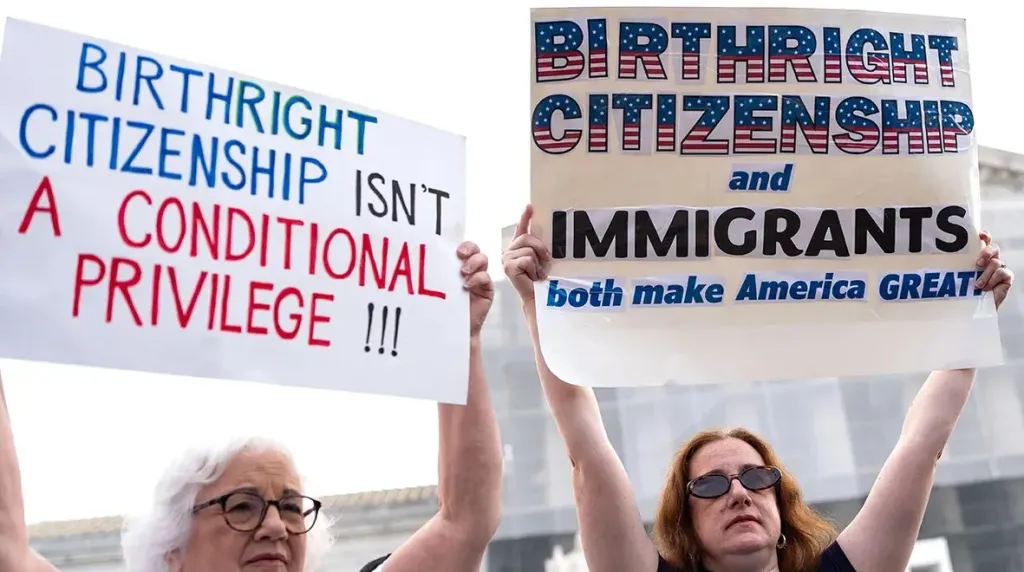
A CLOSELY watched birthright citizenship case is set for argument before the U.S. Supreme Court on Wednesday, April 1, in Washington, D.C. (early Thursday morning, April 2, Saipan time) with potential implications for the Northern Mariana Islands and other U.S. territories.
At issue is whether President Donald Trump’s executive order seeking to deny automatic U.S. citizenship to some children born on U.S. soil can stand, specifically, those born to parents who are either undocumented or lawfully but only temporarily present in the United States. The case, Trump v. Barbara, asks whether the order complies with the Citizenship Clause of the 14th Amendment and 8 U.S.C. § 1401(a), the federal law that codifies it.
If upheld, the policy could affect children born not only in the 50 states and Washington, D.C., but also in U.S. territories such as the CNMI, Guam, Puerto Rico, and the U.S. Virgin Islands.
For the Northern Marianas, the case raises questions for future children born in the Commonwealth to parents who are undocumented, or who are here legally but temporarily, including workers, visitors, or others without permanent immigration status.
Under the executive order, those children would not automatically be recognized as U.S. citizens at birth.
Almost everyone born in U.S. territories is automatically granted U.S. citizenship at birth. The 14th Amendment applies fully to incorporated territories, while statutory citizenship applies in unincorporated territories such as the Northern Mariana Islands, Guam, Puerto Rico, and the U.S. Virgin Islands.
The question carries particular local relevance in the CNMI, where a significant portion of the workforce has, for years, consisted of foreign nationals employed under temporary immigration classifications most notably the CNMI-Only Transitional Worker or the CW-1 program.
Created after federal immigration law was extended to the Commonwealth in 2011, the CW-1 program allowed employers to continue hiring foreign workers during the transition from the CNMI’s former local immigration system to the U.S. federal system. The number of permits has steadily declined over time, from 22,417 at the start of the program in fiscal year 2011 to 14,500 in fiscal year 2022, under a federally mandated phaseout that is scheduled to bring the program to an end by 2029, with the final transition extending into early fiscal year 2030.
The presence of foreign workers in the CNMI predates the CW-1 system, dating back to the garment industry boom of the 1990s and early 2000s, when thousands of contract workers lived and worked in the islands under the former local immigration system.
That long-running program helped shape the CNMI’s modern labor force — and, over time, many CW-1 workers and other foreign nationals established families in the islands. Some married, settled for years, and had children born in the Commonwealth. If the court ultimately narrows birthright citizenship, children born in the CNMI to parents who are lawfully present only on a temporary basis — including some foreign workers — could become part of that legal uncertainty.
Territories file brief ahead of hearing
Ahead of the hearing, 21 current and former elected officials and judges from the U.S. Virgin Islands, Puerto Rico, Guam, American Samoa, and the Northern Mariana Islands filed an amicus brief urging the Supreme Court to consider the consequences of leaving territorial citizenship questions unresolved.
Among those listed as amici are former Delegate Gregorio Kilili C. Sablan and former Rep. Sheila J. Babauta.
The brief argues that although the case before the court may not directly resolve the separate legal question of whether birthright citizenship fully extends to U.S. territories under the 14th Amendment, the court’s reasoning could shape how that issue is approached in the future.
“Over the last 125 years, the Supreme Court has avoided answering whether people born under the sovereignty and jurisdiction of the United States have a right to be recognized as U.S. citizens under the Fourteenth Amendment,” said Neil Weare, co-director of Right to Democracy and counsel of record for the brief. “As a result, presidents and congresses from both parties have claimed the power to unilaterally deny people born in U.S. territories recognition as citizens — even people who have been recognized as U.S. citizens their entire lives.”
Weare said the territories’ experience should serve as “a stark object lesson” as the justices consider whether the executive branch can alter the long-settled understanding of the Citizenship Clause.
Trump administration’s position
The Trump administration argues that the 14th Amendment has been interpreted too broadly and that birthright citizenship was never intended to apply automatically to every child born on U.S. soil, regardless of a parent’s immigration status.
In Executive Order 14,160, titled “Protecting the Meaning and Value of American Citizenship,” the administration says the Citizenship Clause has always excluded persons born in the United States who are not “subject to the jurisdiction thereof.” The administration’s position is that this phrase should be read more narrowly than it has been under current practice.
The executive order applies to children born in the United States if, at the time of birth, the mother is either unlawfully present or lawfully but temporarily present, and the father is not a U.S. citizen or lawful permanent resident.
The order has not taken effect and remains blocked by lower court rulings.
Questions beyond the mainland
For residents of the Northern Marianas and other territories, the case is being watched not only as an immigration dispute, but also as a constitutional question with possible downstream effects in places where citizenship has long existed within a distinct territorial framework.
“This is a question about the exercise of power under the U.S. Constitution — can the President or Congress simply decide to exclude groups of people they do not want to be considered U.S. citizens?” said Adi Martínez Román, also co-director of Right to Democracy. “The U.S. Constitution regulates the power of government and protects its subjects from abuse. Therefore, the Supreme Court can and should answer that question in the negative.”
Martínez Román said the court’s long avoidance of the issue in the territories has created “uncertainty and confusion” when it comes to self-determination and decolonization.
That concern carries particular weight in the CNMI, where citizenship, immigration, and federal authority intersect in ways not found in the states.
