




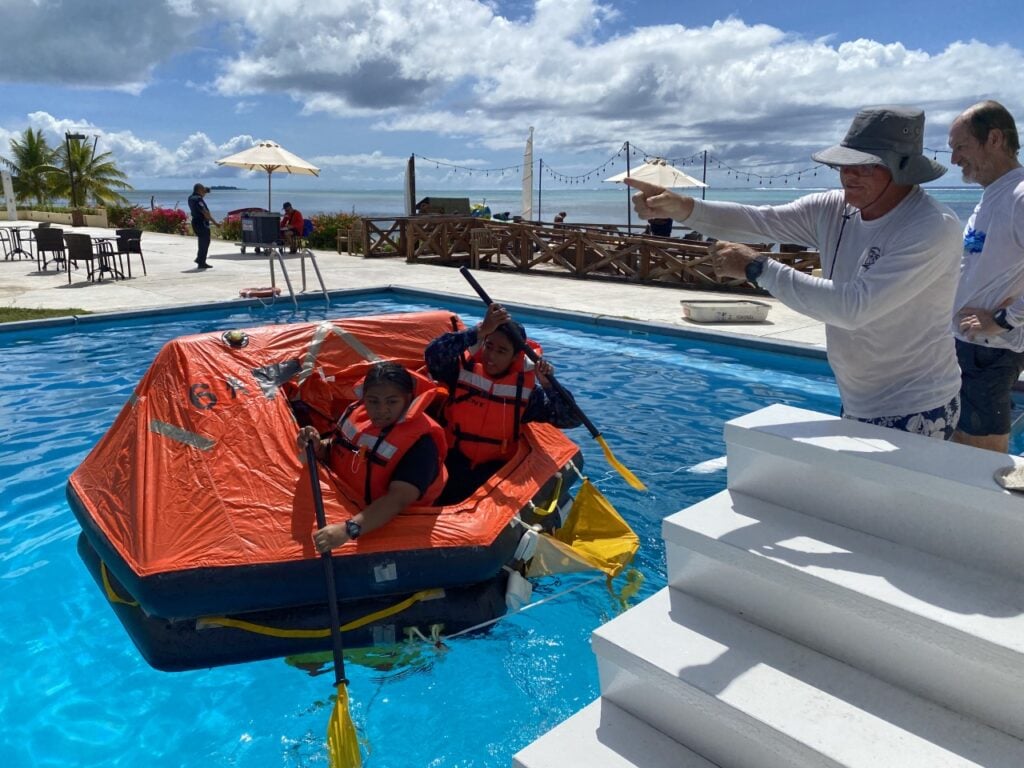
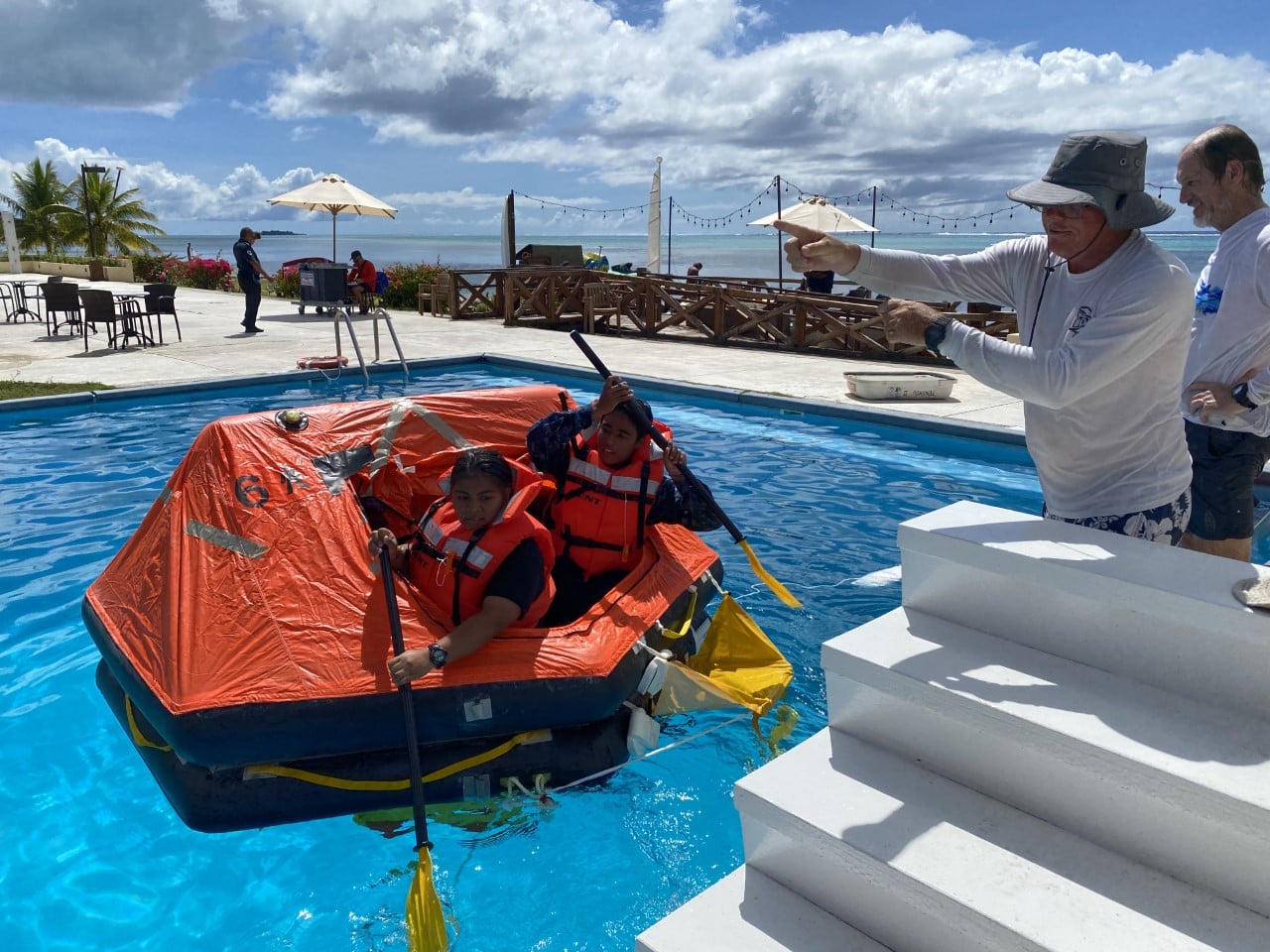
Students from Kagman High School paddle a lifeboat as part of personal survival training conducted by Captains Michael Bacher and David Johansen.
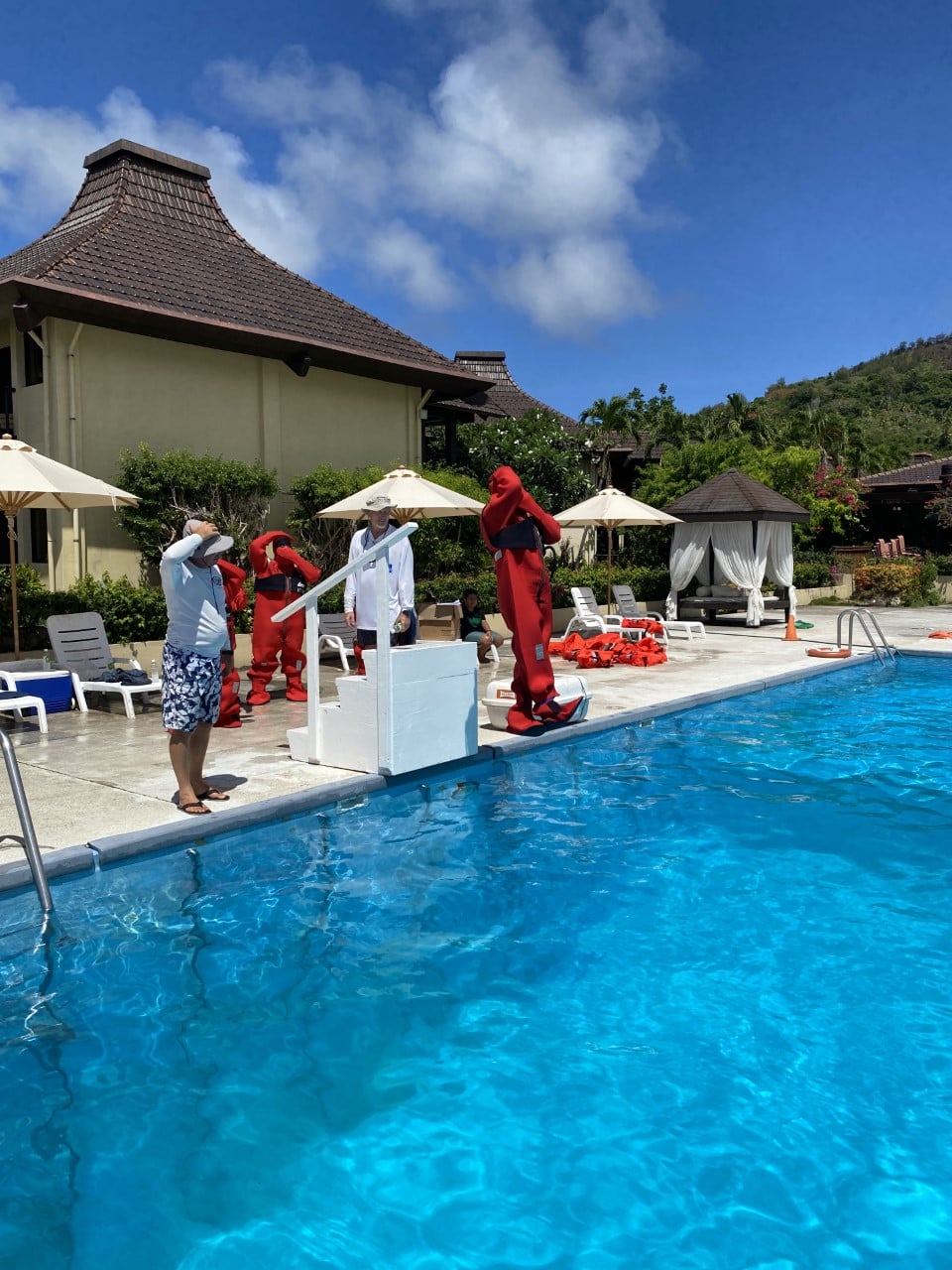
As part of personal survival training, a Kagman High School student donned an immersion suit before jumping into a pool at Aqua Resort Club.
THE Western Pacific Maritime Academy will conduct training sessions for community members and public school students from mid-November to early December, according to Michael Bacher, the academy’s executive director.
The Basic Training: Personal Survival Techniques class is set for Nov. 11-12 at the NMTech facility in Lower Base, and at Aqua Resort Club.
Bacher said the course will teach participants how to survive “extreme emergencies” such as loss of a vessel. During the hands-on portion of the class, participants will get practical training with emergency gear in and out of the water.
The Basic Training: Basic Fire Fighting Course will be held on Nov. 18-19, also at NMTech, with an offsite practical training segment held at a Department of Fire and Emergency Medical Services property.
Both courses cost $600.
As for public school students, the Western Pacific Maritime Training Academy will also conduct classes on Rota and Tinian. Courses for public school students are covered by PSS.
Bacher said he sees the Western Pacific Maritime Academy as a “workforce placement program for the maritime trades” and as a “provider for the strategic sealift needs of the nation.”
He said there is a “tremendous” need for sailors in the commercial and military sealift industries.
For example, in 2018, the U.S. Merchant Marines indicated they were “2,500 persons short for manning [vessels],” he added.
“Because of the tremendous shortage of mariners, we have seen a tremendous amount of pressure on wages in the maritime sector,” Bacher said. “An entry level mariner on a seagoing vessel can earn upwards of $5,000 to $7,000 a month.”
He said through a partnership with PSS, the Western Pacific Maritime Training Academy “develops, certifies, and trains mariners to be able to take an entry level job on a ship immediately upon graduation.”
Moreover, through the academy workforce development program, community members in the Marianas can have access to the same training, which can enable them to enter the maritime industry, he added.
“One of the workforce placement programs that we have found success with is the Military Sealift Command,” Bacher said. “When a mariner joins the Military Sealift Command, they become a federal employee and you get all of the benefits that a federal employee gets.”
He said those who choose to work in the commercial shipping industry have the benefit of not being geographically tied to the ship they work on.
They can live in the CNMI, and through private maritime placement services, local mariners can be sent to a ship, work there for a few months, and then return to the Marianas, he added.
“So that means that a mariner who loves the CNMI, loves his family, or has to take care of aging parents….can live right here at home,” Bacher said. “We will help you with the resources to find work.”
For more information, contact [email protected] or call (670) 789-1636.
