






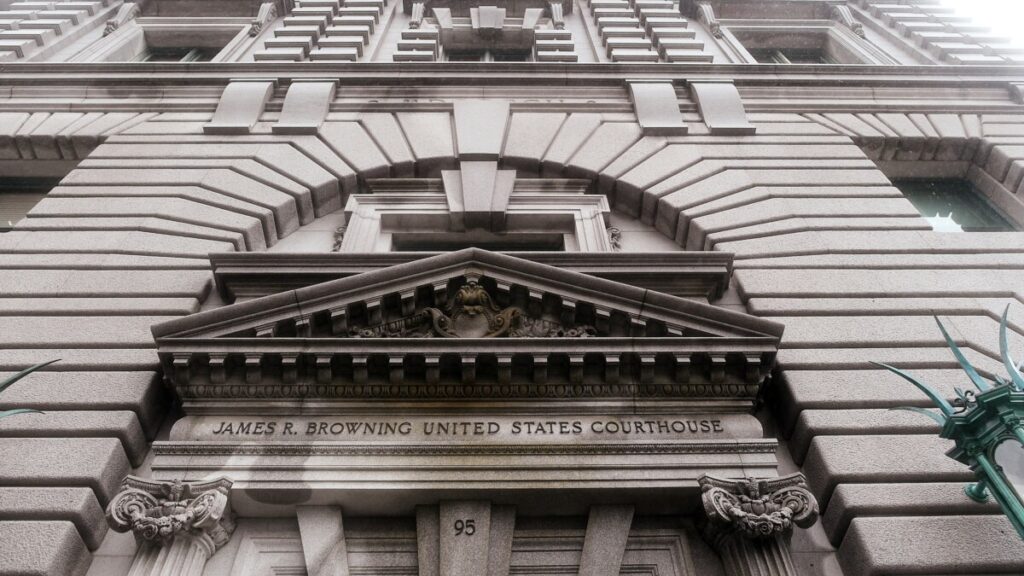
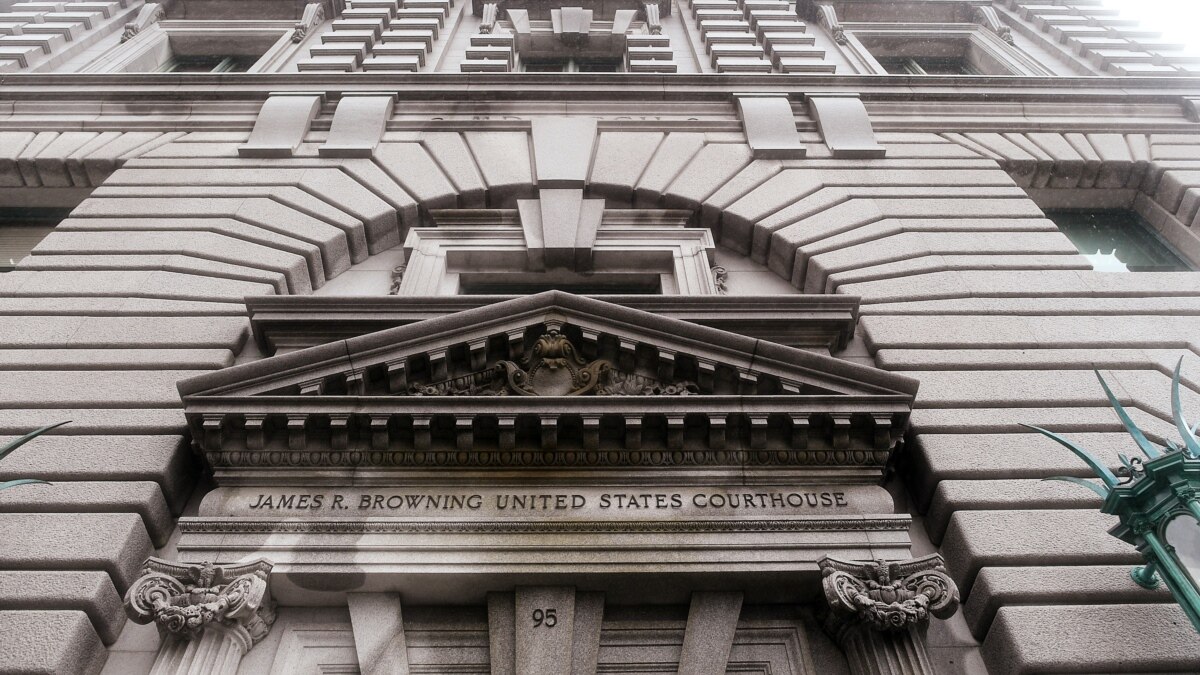
The James R. Browning U.S. Court of Appeals Building, home of the Ninth U.S. Circuit Court of Appeals, is pictured in San Francisco, California, Feb. 7, 2017.
THE U.S. Court of Appeals for the Ninth Circuit has affirmed the conviction of Lili Zhang Tydingco on the charge of unlawfully harboring a non-citizen.
In July 2022, a jury, for the third time, found Tydingco guilty of one count of harboring a minor alien.
During the trial, Assistant U.S. Attorneys Garth Backe and Albert Flores Jr. appeared for the federal government and called five witnesses, including the minor who has turned 18 years old since then.
On Jan. 18, 2023, Chief Judge Ramona V. Manglona of the District Court for the NMI sentenced Tydingco to 90 days in prison and ordered her to pay a $100 special assessment fee.
On Jan. 30, 2023, Tydingco’s attorney, Bruce Berline, filed a notice of appeal.
Ninth Circuit Judges Consuelo Callahan, Andrew Hurwitz and Holly A. Thomas reviewed the district court’s evidentiary rulings and admission of evidence.
On June 20, 2024, the Ninth Circuit judges affirmed the district court’s ruling.
Interview
Customs and Border Protection Officer Ronald Muna had testified that he conducted an interview with Tydingco when she first brought the noncitizen minor into Saipan.
In her appeal, Tydingco said this testimony was inadmissible because it was based only on CBP records that Muna had reviewed rather than on his personal recollection of the interview.
Muna testified that his interview account was based on his own memory. Although he acknowledged “weaknesses” in his recollection of the interview, the “strength of his memory does not present an issue of admissibility but rather one of credibility and the proper weight to be accorded his testimony. Such are jury functions,” the Ninth Circuit judges said.
Tydingco also said that Muna’s testimony violated the Confrontation Clause because some of her interviews with him were conducted through an interpreter, who was not called to testify.
But as Tydingco acknowledges, “we already decided when reviewing her second trial that her interpreted statements during her interview with Officer Muna were admissible,” the Ninth Circuit said.
“We found that Tydingco was fluent in English and therefore could have corrected any mistranslation,” the Ninth Circuit added.
Tydingco also argued that the admission of her signed written statement violated the Confrontation Clause because there was insufficient evidence that the translation of her statements was reliable.
“Here, the interpreter who translated Tydingco’s statements had no motive to distort them; the same interpreter was used without issue both when Tydingco initially drafted her statement and when she returned to the police station to review it; and Tydingco identifies no particular translation errors the interpreter made,” the Ninth Circuit said. “Additionally…, Tydingco’s English fluency means that she could have corrected any error the interpreter made.”
The district court therefore did not err in finding that the interpreter acted only as a language conduit, the Ninth Circuit stated.
Tydingco had also challenged the admissibility of CBP Officer Trisha Aguon’s testimony regarding the electronic records of Tydingco and the noncitizen minor’s entry into the United States.
Officer Aguon said the records showed that Tydingco was forwarded to a secondary inspection upon arrival with the minor, and that Tydingco presented a return ticket to China that had been purchased for the minor.
Tydingco said Officer Aguon had no ability to testify to these matters as a lay witness because she had no personal memory of the events reflected in these records.
But according to the Ninth Circuit, even if Officer Aguon’s testimony about these records was inadmissible, any error was harmless.
“Officer Aguon’s testimony that Tydingco was forwarded to a secondary inspection likely had minimal impact, as Officer Muna permissibly testified about conducting the secondary inspection. And Officer Aguon’s testimony that Tydingco presented a return ticket was corroborated by both Officer Muna and Officer Aguon’s permissible testimony that CBP consistently checks passengers arriving in Saipan on the Conditional Parole Program for return tickets. Additionally, Officer Aguon was subject to extensive cross-examination in which she acknowledged that she had no memory of the events about which she testified and admitted that the records could have been mistaken,” the Ninth Circuit stated.
It added that the testimony that Tydingco challenges “therefore likely did not impact the jury’s verdict.”
Tydingco also said that the admissible evidence was insufficient to support the jury’s verdict.
“On our review of Tydingco’s first trial, however, we held that the evidence we find admissible today was sufficient to support her conviction,” the Ninth Circuit said.
Tydingco likewise argued that the district court erred in failing to instruct the jury that the term “harbor” as used in 8 U.S.C. § 1324(a)(1)(A)(iii) requires active concealment and a deliberate attempt to facilitate a noncitizen’s unlawful presence in the United States.
“As Tydingco recognizes, our decision in Tydingco I, 909 F.2d at 302–03, expressly rejected this argument, and there have been no intervening decisions that undermine this holding. Tydingco I therefore forecloses Tydingco’s challenge to the jury instructions,” the Ninth Circuit said.
In June 2016, Tydingco and her husband, Francisco Muna Tydingco, were convicted of harboring a 10-year-old girl they brought from China in 2013.
The jury found Mrs. Tydingco guilty of harboring an alien and Mr. Tydingco guilty of aiding and abetting his wife.
On Dec. 9, 2016, Mrs. Tydingco was sentenced to 10 months’ imprisonment while Mr. Tydingco was sentenced to 21 months’ imprisonment.
The Tydingcos appealed to the U.S. Court of Appeals for the Ninth Circuit, which remanded their conviction to the district court for a new trial. The Ninth Circuit judges said the jury could have convicted the defendants of an invalid theory.
On May 10, 2019, the U.S. government opted not to pursue the charge against Mr. Tydingco and asked the federal court to dismiss the case against him.
But the U.S. government refiled a superseding indictment against Mrs. Tydingco, charging her with harboring an illegal minor alien.
In September 2019, following two and a half hours of deliberation, jurors found Mrs. Tydingco guilty of one count of harboring a minor alien.
On June 17, 2020, Judge Manglona sentenced Mrs. Tydingco to 90 days imprisonment for harboring a minor alien.
The defendant appealed to the U.S. Ninth Circuit Court of Appeals which, in Feb. 2022, once again reversed her conviction and remanded the case to the District Court for the NMI.
According to the Ninth Circuit, the district court abused its discretion in admitting a sham-marriage and witness-tampering testimony during the trial.
