

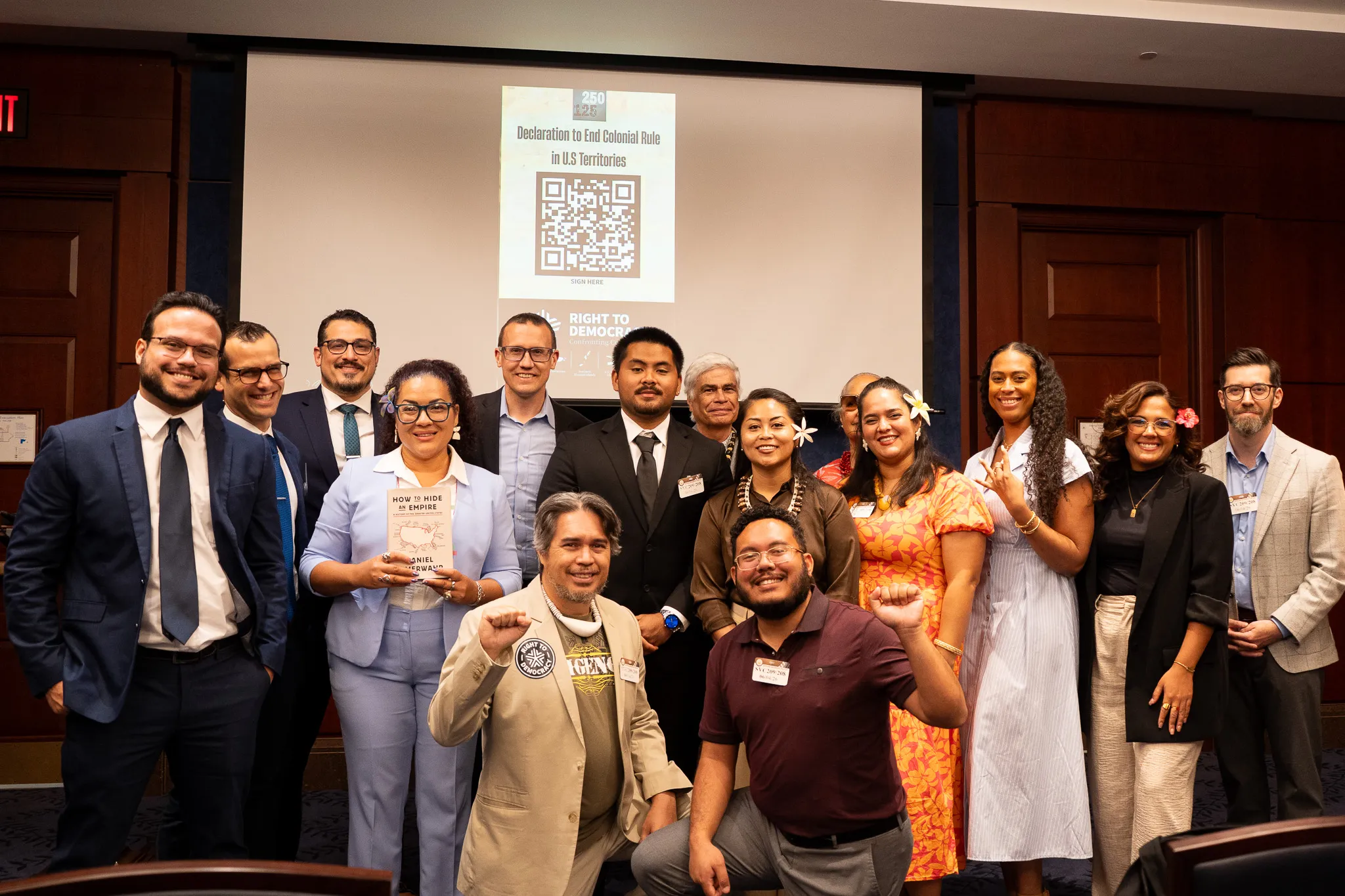






Titled “Imminent Change,” the report was presented by an eight-member group from the political science class of NMC instructor Sam McPhetres.
The report noted that in the post-9/11 era, the CNMI, because of its exemption from federal immigration law, posed a significant national security and homeland security concerns for the U.S.
The report also mentioned the risk of human trafficking or smuggling of foreign nationals from the CNMI into Guam by boats.
“Federalization is the result of the CNMI’s ineffective governance of local immigration and labor laws,” the report stated. “Now we are faced with no option but to comply.”
As to whether federalization is good or bad for the CNMI, the report said there were “mixed reactions.”
“To the U.S. government, it is a resounding yes — better border protection, standardized minimum wage, uniformity in immigration rules,” the report stated, but added that federalization for nonresident workers “is an entirely different animal that offers no job security.”
Worse is the scenario that federalization creates for the business industry, the report added.
The private sector remains heavily dependent on nonresident workers.
“At a glance…the magnitude of our reliance on foreign nationals is staggering,” the report stated. “Ideally, residents in the past decades should have been trained or transitioned into these jobs. That has not happened.”
The report noted the limited number of programs that will train residents and support placing them in the positions currently occupied by nonresident workers.
Moreover, residents prefer to work for the government, which pays much more.
Citing data from the Office of Public Auditor, the report noted that the number of nonresident work permits issued annually dropped from 39,000 in 2000 to no more than 29,000 in 2006.
“This number of permits issued on an annual basis shows the CNMI’s sustained reliance on a foreign workforce and the lack of a diversified, skilled local labor pool,” the report stated, adding that each year, an estimated 400 high school and college students seek either full-time or part-time employment in the commonwealth.
According to the report, the CNMI hosted 3,709 nonresident workers in 1980; 23,263 in 1990; 31,357 in 1995; and 39,089 in 2000.
This dependence on guest workers has to be addressed, the report stated. “How we address it and the way in which it is implemented is no longer our choice. Ironic that we have our leaders fighting federalization when there is no other option.”
‘Same old data’
Three lawmakers who were the guest panelists in the presentation expressed their desire to see “more updated data” regarding local labor and immigration.
Senate President Pete P. Reyes, R-Saipan, said the alarming local unemployment rate was the main factor why he supported the passage of Public Law 15-108, the controversial CNMI labor reform measure.
Reps. Tina Sablan, Ind.-Saipan, and Rep. Ed T. Salas, R-Saipan, cited importance of obtaining “updated and latest” figures.
House legal counsel Jeffery Warfield inquired about the details and data that supported the statements of one of the report’s sources, former Interior Deputy Secretary David Cohen.
Irene Tantiado, leader of the United Workers Movement, NMI, discussed how nonresidents will be affected by federalization.
According to group members Emil Romolor, Abigail Sarmiento, and Roque Pulido, federalization promises “changes” that they believe are positive for the CNMI.
“The way things are going right now…there seems to be no direction. At least when federalization comes in, we will only have one path and one straight law,” Romolor told Variety.
