






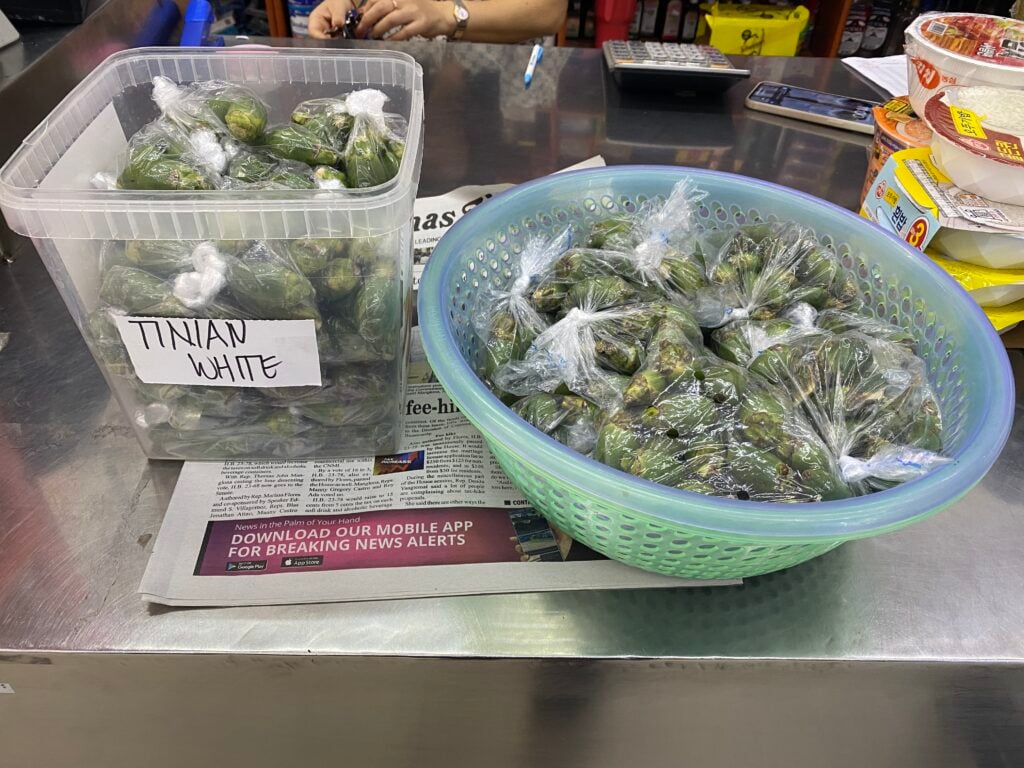
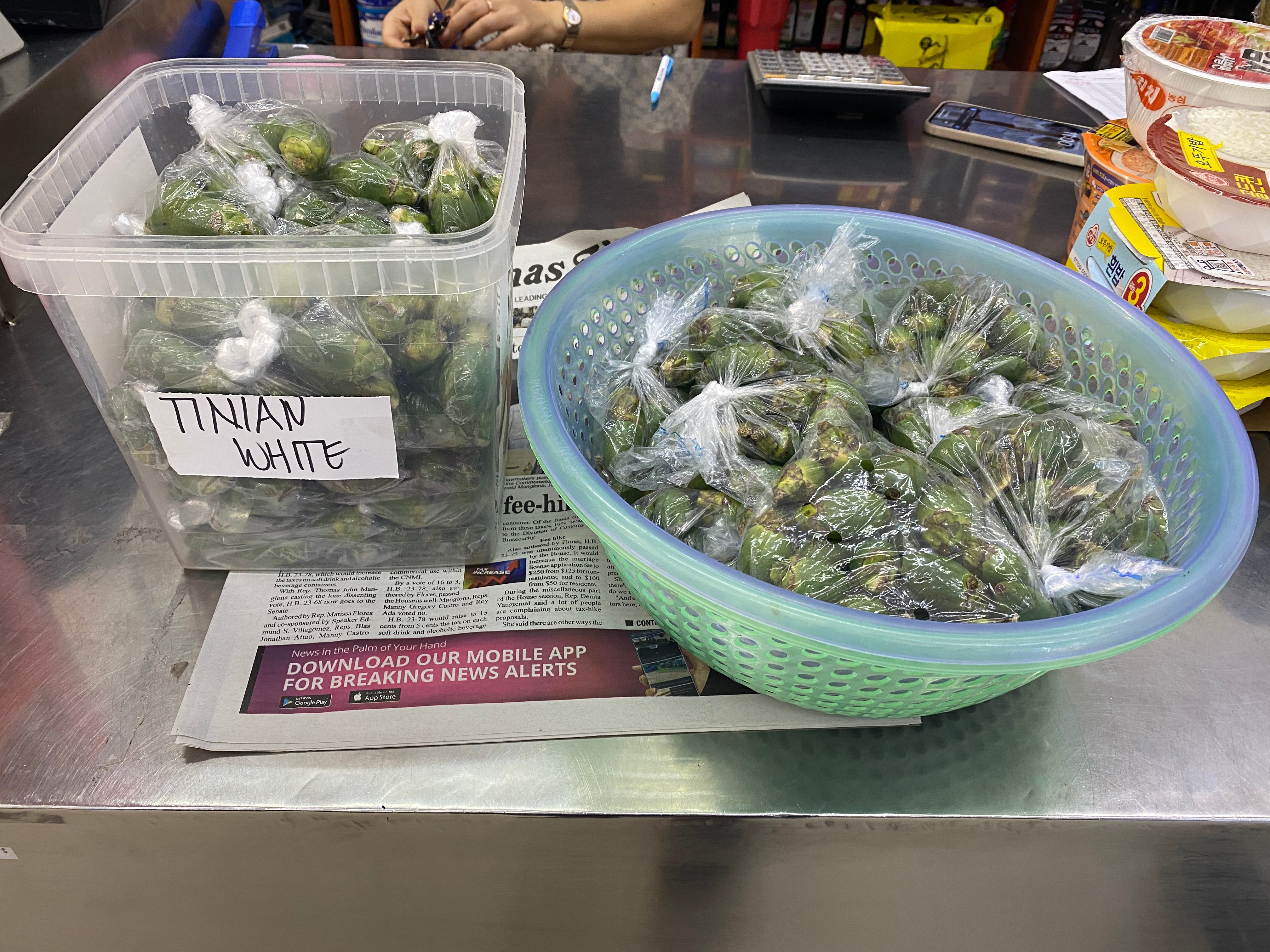
Two baskets of pugua await customers inside a store in Koblerville. The pugua on the right is imported from Yap, and under H.B. 23-41 it would be subject to a tax. The pugua on the left is from Tinian, and would not be subject to a tax.
VARIETY on Wednesday spoke to Saipan residents about how their pugua, or betel nut, consumption would be affected by House Bill 23-41, a proposal to tax imported pugua and åfuk or lime.
The bill would impose a $5 excise tax on each pound of imported betel nut, and a 10-cent excise tax on every ounce of imported lime mix.
Introduced by Rep. Marissa Flores, H.B. 23-41 would appropriate 50% of the tax collections to the Health Network Program or medical referrals, specifically for oral cancer patients’ stipends; and 10% to the Customs and Biosecurity Division for its operations.
Melani Wennio said she prefers Yapese pugua to local red pugua, also called ugam.
She said ugam produces a stronger stimulus when chewed with mamå’on, or the related betel nut paraphernalia such as åfuk, pupulu, also known as pepper leaf, and cigarette.
“The difference [is] if I chew the Saipan pugua it burns my mouth. When I chew Yap [pugua] it doesn’t burn my mouth,” she said.
Wennio does not support the legislation.
“If they’re going to raise the tax for the Yap betel nut, think about the [distributors],” she said. “It’s enough they’re paying for cargo. Now to raise [the tax] higher, it might affect the betel nut [price, which] will go higher.”
M.N., who declined to be identified, said she chews ugam or local betel nut, which she purchases from a store.
Unlike Wennio, she prefers local betel for its stronger sensation and its different qualities.
“The difference is in size, shape, and the taste too,” she said. “[Ugam] is juicier than the Yap betelnut. A lot of them that comes in are dry.”
H.B. 23-41 would not apply to pugua and åfuk from the CNMI.
M.N. said although her preference is for ugam, she still chews Yap pugua from time to time. She also uses åfuk from Rota.
“I go through five bags a day due to stress levels,” she said, speaking in general about her consumption of pugua. “If they do tax [Yap pugua], I’ll wind up chewing two bags a day or less.”
She does not support taxing imported pugua.
“I think [a tax] is kind of ridiculous because they already raised the price [of pugua],” she said. “It was $1 before, then it became $1.25. To be honest I hope they tax the alcohol more than the pugua.”
James Garang is originally from Yap. He chews Yap pugua, specifically the products distributed by Sablan Betel Distributors and Leah’s Betel Nut.
“For those that work they can keep up and still buy their chew, but for those that don’t work they’re not going to feel good about [a tax],” Garang said.
He chews around 30 to 40 pieces of pugua a day. Aside from Yap pugua, he also chews local white pugua. He does not chew ugam because it is “too strong.”
He “guarantees” he will slow down on chewing if the pugua tax is enacted. But he also has a backup plan.
“Where I stay it has pugua because I live in a place that’s like a ranch. So I’ll stop buying chew. I’ll chew [pugua] from the house instead of buying the Yap pugua,” he said.
Ms. L., who owns a store in Koblerville, does not want a tax imposed on imported pugua.
“Customers say ‘why very expensive?’ so of course no need tax,” she said.
She said the two biggest sellers are ugam or Yap pugua. Both are popular, but “no one likes expensive [things].”
According to H.B. 23-41, which is now pending in the Senate, “The Legislature…finds that [the proposed tax] would be a great financial opportunity for our Commonwealth to exploit such avenue to gain much needed additional revenues.”
