





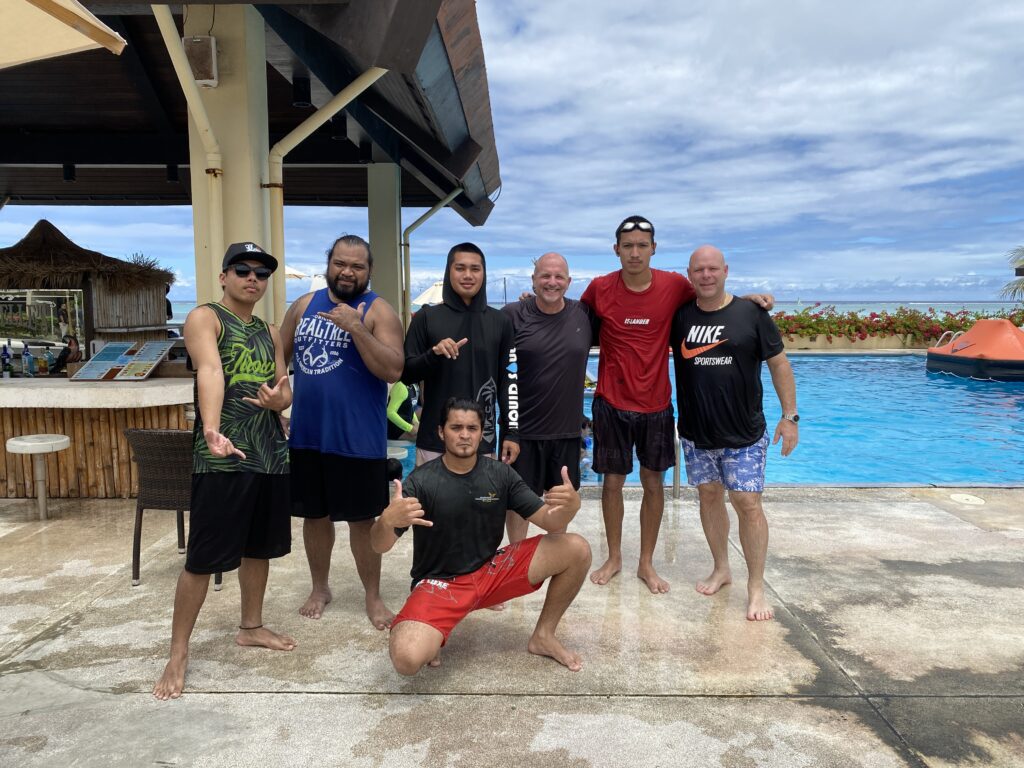
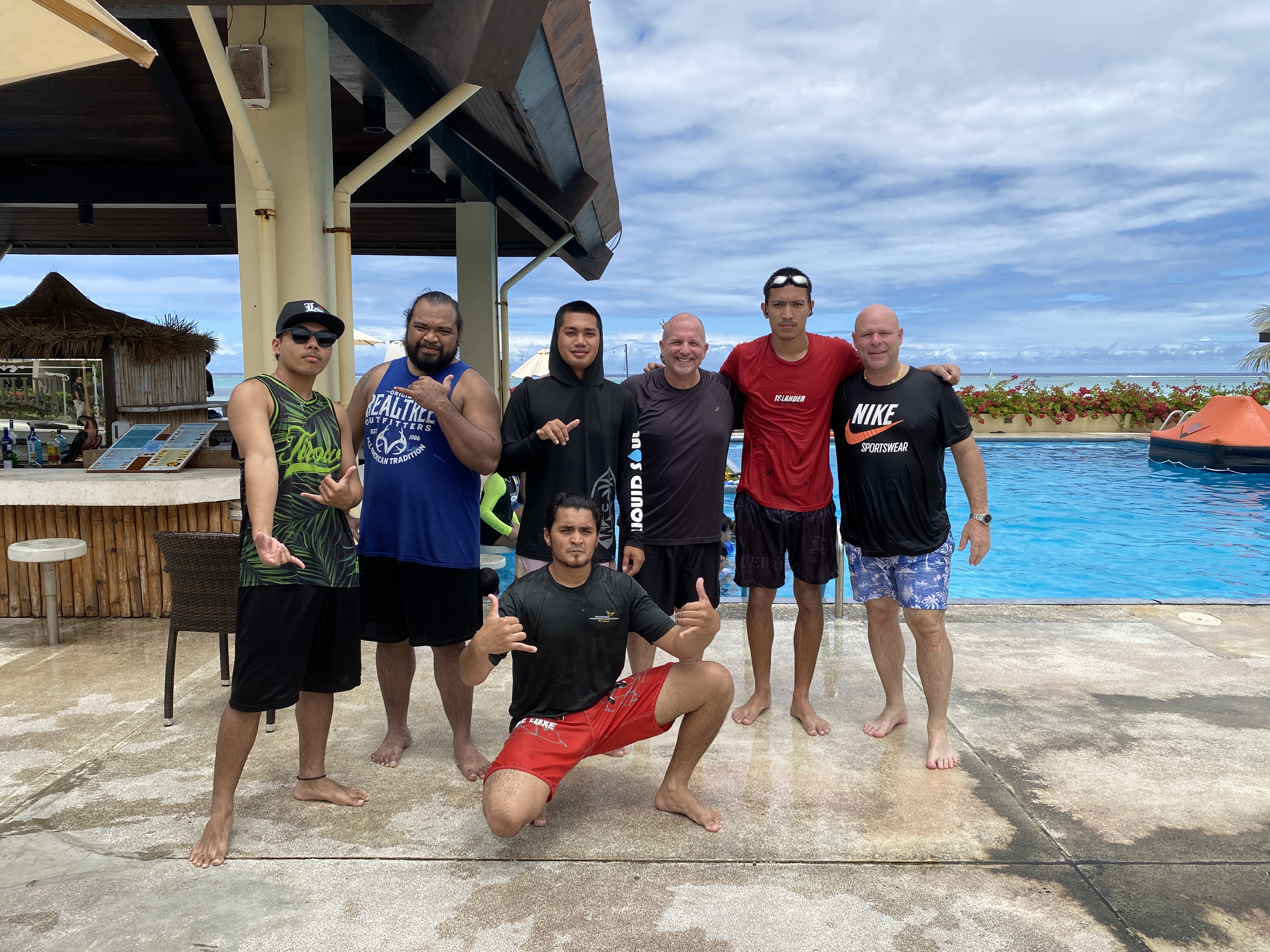
Western Pacific Maritime Academy students Robert Smith, front row; back row, Schneider Lanzo, second left, Christian Alepuyo, third left, and David Meyers, fifth left at the Aqua Resort Club swimming pool where they are undergoing training on Wednesday, March 27.
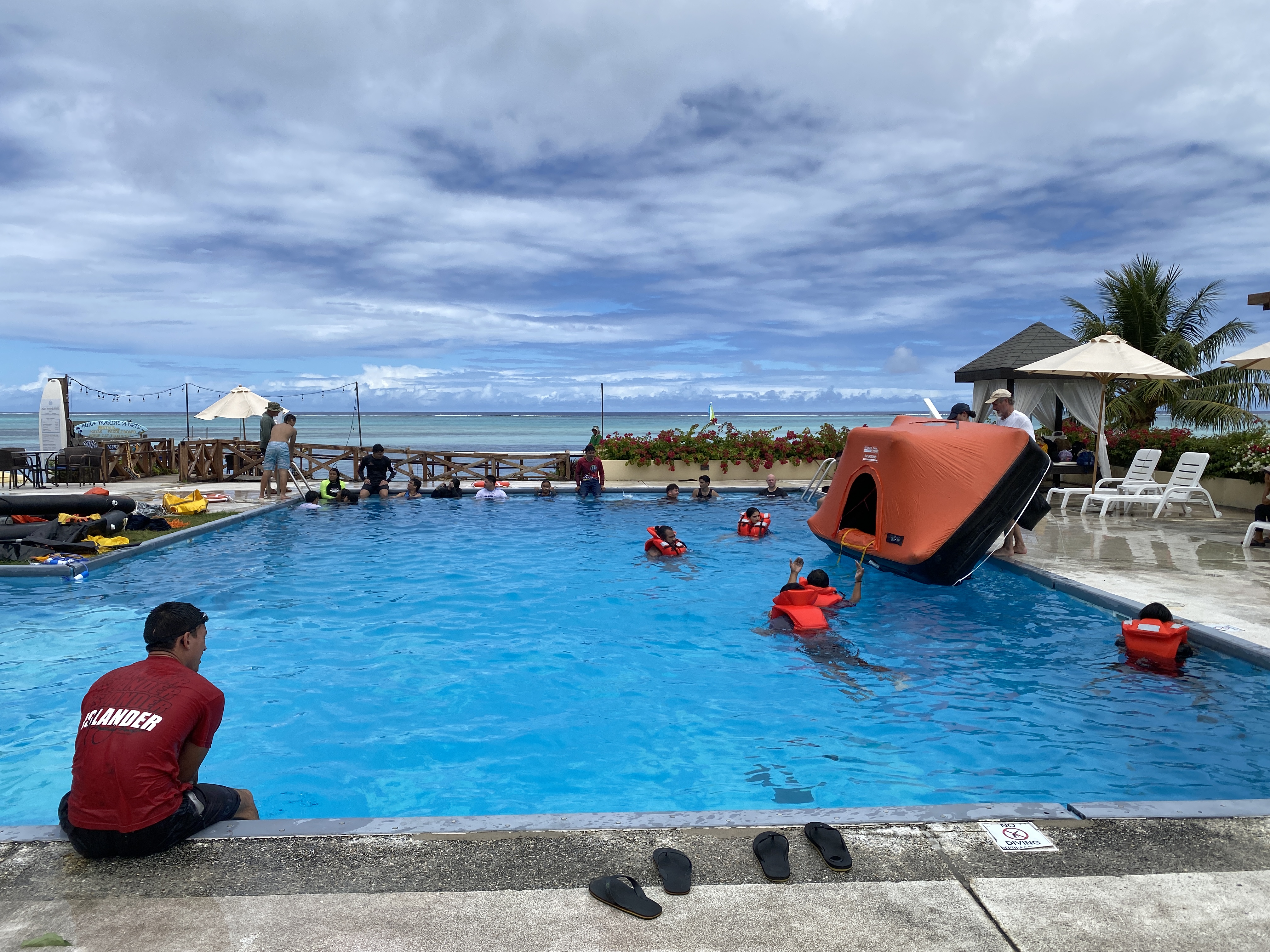
Western Pacific Maritime Academy students donning life vests wait in the Aqua Resort Club swimming pool for the start of their capsize drill on Wednesday, March 27.
WESTERN Pacific Maritime Academy’s training director, Captain Dave Johansen, said the tuition of their seven maritime students is paid by the Workforce Investment Agency.
According to WPMA’s Facebook page, a basic training course —which includes first aid training, safety and social responsibility training, survival techniques, and basic firefighting — costs $1,500.
WIA students also undergo basic training and a course on vessel personnel with designated security duties, which costs an additional $275.
Variety spoke to Johansen and some of the students while they were undergoing personal survival technique training at Aqua Resort Club’s swimming pool.
Schneider Lanzo said he has already taken a number of courses with WPMA that were funded by WIA.
WPMA “make it easier for some of us to get our sea time and get what we need out there done,” Lanzo said, adding that he was referred to WIA and WPMA by a friend working on a commercial ship.
“I’m pushing this as far as I can,” he said. “That’s my goal — to make a career out of this.”
Robert Smith, 23, said he currently works in the maritime industry and has a transportation worker identification credential. However, he still needs training before he can be a merchant mariner.
Smith said he was willing to pay to travel to San Diego in order to undergo training, but thanks to WIA and WPMA he didn’t need to.
He said WIA has been a “big help.”
“If I didn’t actually find it [I would have] probably spent like $10,000,” he said. “If I didn’t know about the class here on Saipan, I would have tried to go to San Diego to take the class. [Without WIA and WPMA] I guarantee a lot of people would be having a hard time trying to get aboard a vessel.”
Smith said due to the current economic state of the CNMI, he has fewer opportunities. He wants to be in the merchant maritime industry to see the world. “I’m tired of seeing the reef,” he added.
Christian Alepuyo, 22, said being a merchant mariner is “a good way for me to explore the world.”
He also wants to use the extended leave time afforded to merchant mariners to come back to Saipan. “There’s no place like home,” he said.
Alepuyo would like to work for months at a time on a ship, take a month or two off on Saipan, and then return to work.
He is currently a boat crew member. The transition to a career on the open ocean is a natural one, he said.
“I have family that told me about the WIA funding and when I heard about it, I figured it would be a good opportunity and it’s readily available here,” he added.
“I work on the water already and in order for me to upgrade myself I saw the opportunity here and took action,” he said.
David Meyers, 21, missed out on a WPMA training opportunity last year, but this year he utilized WIA funds to begin his maritime trade journey.
He said it is a “great opportunity” for him. Without WIA, “I would have had to work hard, more than just a regular job to save up on time,” he said. “I’m happy that WIA was able to pull through with me.”
He added, “I got time to go and do some days, some months, some years [on a ship] and come back with good money.”
In an earlier interview, WPMA’s executive director, Captain Michael Bacher, told Variety that workforce needs in the maritime trades were creating improved wages for sailors.
“Because of the tremendous shortage of mariners, we have seen a tremendous amount of pressure on wages in the maritime sector,” Bacher said. “An entry level mariner on a seagoing vessel can earn upwards of $5,000 to $7,000 a month.”
Captain Johansen, for his part, said with WPMA training, students can directly work at sea.
“They can immediately go and apply for a job with either the Seafarers Union of the Pacific or the Seafarers International Union and go work, right now, on a ship, as soon as the Coast Guard recognizes their merchant mariner credential,” Johansen said. “We help them go essentially from zero to hero in that regard.”
He said WPMA’s course costs cover the expenses of document processing, to include certifications, and communicating with the Regional Examination Center of the Coast Guard in Honolulu.
“I can tell you that there are shortages in maritime personnel and some people are having to go longer and longer on a ship,” he said. “What we’re looking for is to get all these guys plugged into jobs and help [sailors] that have been [out] there for a long time to come home and get their rest and relaxation.”
