





The looming election has also put a spotlight on the Marshall Islands diplomatic recognition of Taiwan, with some political observers suggesting that if current pro-Taiwan President Hilda Heine loses, a switch to China could follow. In a nationally broadcast New Year’s message, Heine told the country that they should not forget Taiwan and the partnership enjoyed for over 20 years. But the diplomatic battle for allies between China and Taiwan, and the bigger geo-political competition in the Pacific between China and the United States is taking a back seat to the last-minute frenzy of lobbying and meetings by members of parliament seeking a solution to leadership divisions in parliament.
In the lead-up to vote, the question of who will be the next president has had no easy answer. The Marshall Islands Journal headlined its January 3 edition, “Who will win?” accompanied by four photographs of incumbent President Heine, former Presidents Kessai Note and Christopher Loeak, and Speaker Kenneth Kedi — all of whom are in contention for the presidency.
But even this does not encompass the full number of parliamentarians who have been mentioned as potential candidates for the top office as political leaders debate multiple coalition scenarios to reach the magic number of 17 votes needed to form a new government in the 33-seat parliament.
Heine’s group has the largest bloc of votes, estimated at 14. While the opposition group, led by Kwajalein Senator and paramount chief Michael Kabua, has an apparent majority, it has at least three factions none of which have indicated any interest in compromise that complicates maintaining a majority going into Monday’s election.
Because there are no political parties in the country, members of parliament often shift sides in coalitions of convenience. Every government since 2008 has been cobbled together from various factions, none of which held a majority of votes in the parliament. This year’s line up is by far the most challenging for Heine’s and Kabua’s camps attempting to identify 17 votes.
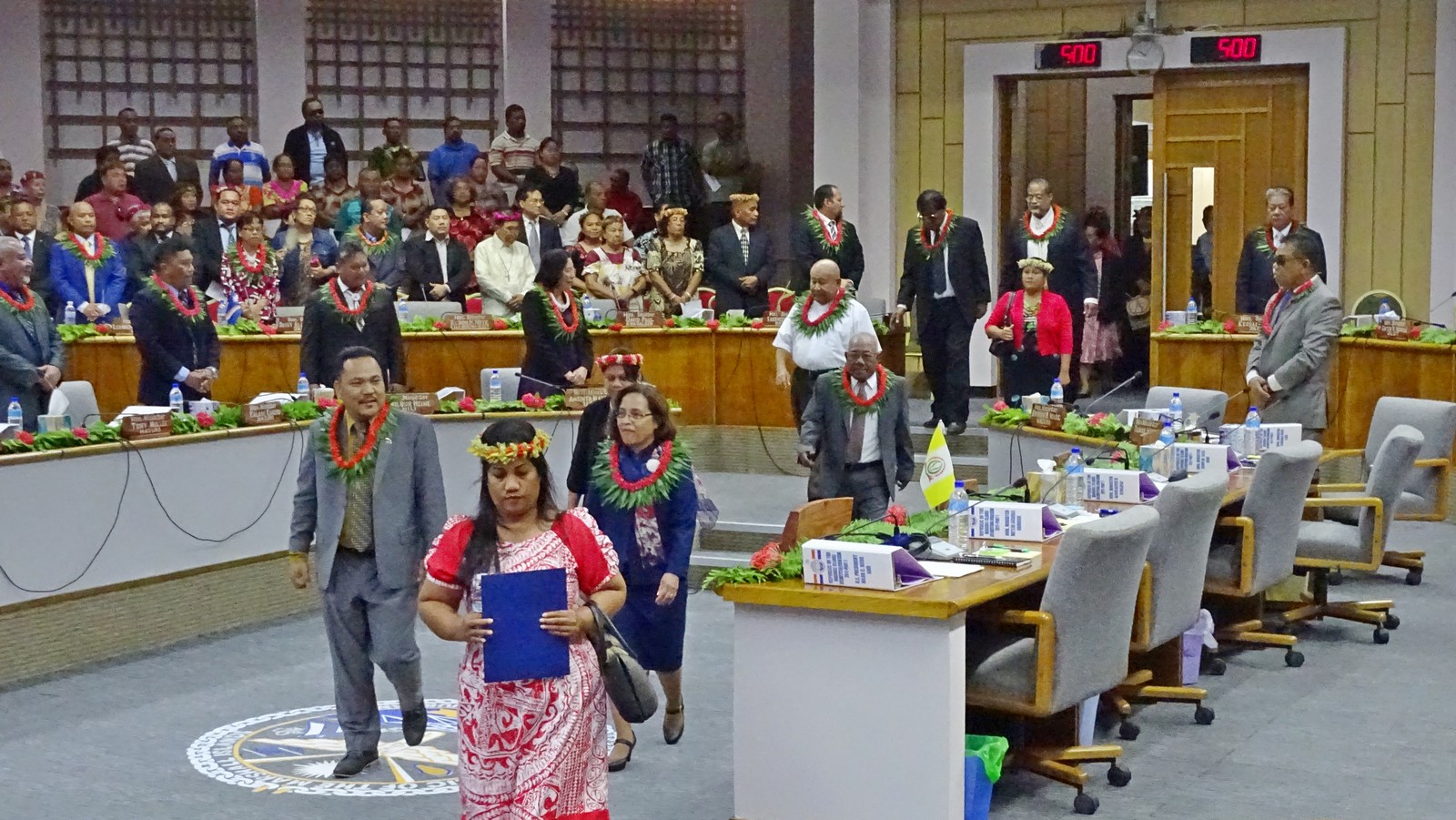
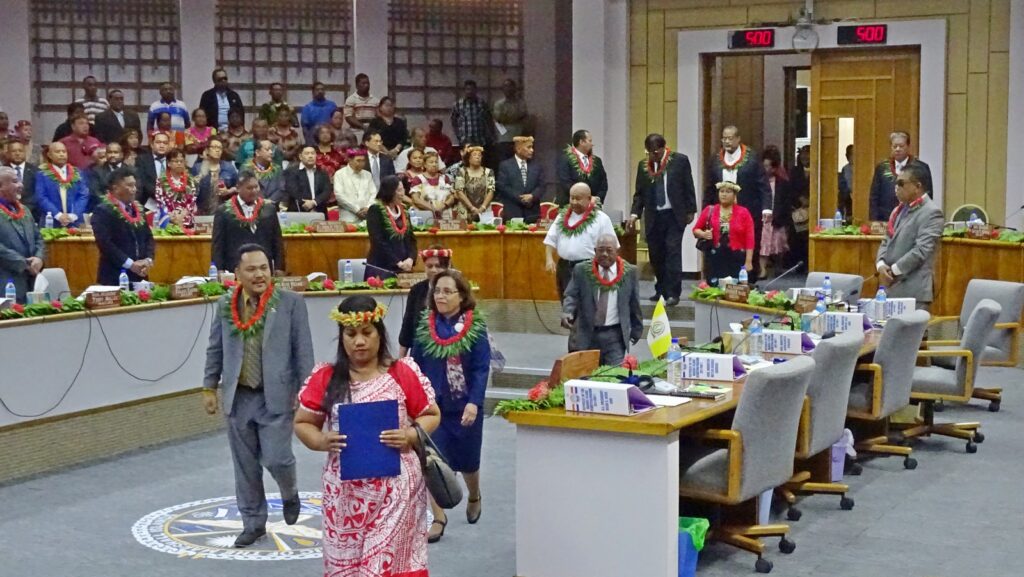
In this file photo from 2017, Marshall Islands President Hilda Heine, center black dress, enters the parliament chamber flanked by Speaker Kenneth Kedi for the start of a new session. Photo by Hilary Hosia
It is apparent that Kabua’s team has a majority of votes based on the November 18 election results. But what that means for the January 6 vote is uncertain, as the presidential election in January 2016 proved. At that time, the group backing Kwajalein Sen. Alvin Jacklick for president clearly had the numbers. But on the day of the vote a couple of last-minute defections through skillful maneuvering by Kabua led to the election of Casten Nemra by the razor-thin margin, 17-16.
Although the new Nitijela lineup appears to give Kabua’s team the upper hand, there are three Nitijela members in his camp actively seeking the vote: former Presidents Loeak and Note and Speaker Kedi.
The three potential camps within Kabua’s team could complicate getting to the 17-vote majority needed, and could offer Heine’s team an opening.
There is also reportedly discussion by both camps of attempting to secure long-serving MP David Kabua, oldest son of the founding President Amata Kabua, as a candidate who could possibly break the stalemate between rival candidates as a middle-of-the-road leader acceptable to most factions.
In the meantime, Heine remains very much in the mix even though the loss of several members of her group in the November 18 election reduced her support in parliament. Still, if Heine’s team remains together, her camp represents the biggest group in the parliament with a solid negotiating position to bring in a handful of additional MPs to form a government. Whether this also includes the option of Heine offering up the helm in exchange for her team to return to power remains a question that won’t be answered until January 6.
Many options for forming a government by the various factions are currently in play in the political world of the Marshall Islands. Until the 33 votes are counted and a winner announced on January 6, the question of who will be the next president of the Marshall Islands will likely remain a mystery — as well as the geopolitical issues that may hang in the balance.
