





HAGÅTÑA (The Guam Daily Post) — While the comment deadline has passed for the U.S. Department of Labor’s proposed change for salaried workers, local human resource and business organizations are hoping more time will be granted to provide Guam-centric information to guide the change. At the same time, they ask that the proposed change be implemented in phases instead of all at once, which they argue would lead to detrimental effects for Guam.
USDOL is proposing to raise the federal minimum threshold for salaried workers up to $1,059 per week, or more than $55,000 in annual salary. That means employees will need to be paid that much to be exempt from minimum wage and overtime pay requirements within the Fair Labor Standards Act (FLSA).
The federal labor department is proposing to implement this change 60 days after the publication of a final rule. Comments on the proposed rule were due Nov. 7.
At this time, the threshold for salaried workers in the 50 states and the District of Columbia is $684 per week, or about $35,500 in annual salary.
Guam set at 2004 level
However, Guam, Puerto Rico, the U.S. Virgin Islands, and the Commonwealth of the Northern Mariana Islands were exempted from that floor and instead use the 2004 level of $455 per week, or about $23,600 annual salary.
With the proposed threshold change, USDOL is looking to equally apply the proposed salary threshold to Guam and other territories. American Samoa will be the exception, as that territory is subject to special minimum wage rates.
The change in the salary floor amounts to a 133% increase for affected territories, compared to 55% for states and Washington, D.C.
In the narrative for the proposal, USDOL acknowledged that this upward spike “may lead to larger impacts” in the territories.
“Unfortunately, data are not available to conduct a full analysis of impacts in the territories. Therefore, the department applied reasonable assumptions to the available data to estimate the number of affected workers in the territories,” USDOL stated.
As reported, the Guam Department of Labor was essentially caught off guard by the proposed rule and hadn’t provided information to USDOL because it didn’t know about it.
The information available
GDOL Chief Economist Gary Hiles submitted comments on the proposed change, although he specified that they were his observations and not necessarily those of his employer.
From his comments, it appears certain information is lacking, even within existing local labor data.
“We do not have information specifically on salaried workers on Guam, however, our Guam Current Employment Statistics June 2023 report shows 18.6% of private sector employees are classified as supervisory non-production workers,” Hiles stated.
The data set that USDOL used to measure the impact of the proposed threshold change did not include information on the territories, but federal authorities did identify data sources that contained pertinent information on the territories.
Hiles said USDOL’s estimate of the number of affected persons appeared reasonable for Guam but lacking information on hours of overtime worked by salaried workers, local officials are unable to precisely determine the financial impact for those individuals and employees “although estimates can be made.”
“Other federal data sources for the territories not included on your (USDOL) list of sources for the territories include the Economic Census of Island Areas, which provides total payroll compensation and employment figures by industry. The Bureau of Economic Analysis (BEA) produces the Gross Domestic Product reports for the Territories. The U.S. Census of Population and Housing collects information on earnings and occupations although data at this level of detail and cross-tabulation is not published, but it potentially could be extracted from the Census Bureau,” Hiles commented.
Extend comment period to provide market data
The Guam Hotel & Restaurant Association, the Society for Human Resource Management’s Guam chapter and The Employers Council all requested an extension on the comment period to gather and provide Guam-specific market data. GHRA and SHRM requested 60 days, while The Employers Council wanted 90 days.
“This change … really does affect all industries across all sectors, and it’s regardless of business size,” GHRA President Mary Rhodes told The Guam Daily Post.
To gather some idea of how Guam businesses will be affected, the local SHRM chapter conducted a survey of its members regarding the impact of the proposed threshold change.
“We asked them also to tell us what would their strategies include, … how it would impact the bottom line for them and what that would mean,” SHRM Guam Chapter President Yolanda Padrones said.
According to Padrones, most businesses said the impact on labor costs would be severe. About 44 businesses participated in the survey with about 48% being small businesses.
“The impact to labor costs, we asked what it would mean, rating from ‘insignificant’ to ‘severe.’ Fifty-three percent indicated that it was going to have a ‘severe’ impact to their business. And the annual expense ranged from $100,000 all (the) way up to greater than $1 million, depending on their size,” Padrones said.
Employers indicated they would move salaried employees to non-exempt positions, increase wages to meet the new threshold, restructure jobs, delay hiring or promotions, and some would reduce staff and hours, according to Padrones.
Tiered approach
With the change in the salary threshold being so drastic for Guam, all three organizations prefer a methodology more suited for the territories.
For SHRM Guam and GHRA specifically, that is a phased-in or tiered approach that would see Guam first go up to the current threshold of about $35,500 in annual salary.
SHRM Guam stated in comments to USDOL that it is not opposed to raising the floor for Guam but to do so at more than double the current level “will have distinctly negative” consequences for local employees.
The threshold applied on the island is about 20 years old now.
Hiles noted in his comments that a person making minimum wage on Guam, at $9.25 per hour, with no overtime, would make around $462 a week. That is above the threshold.
“Clearly, the current $455 threshold fails to meet the intended exemption to overtime pay. The exemption was not intended to exclude minimum wage workers from overtime pay, as it now appears to do,” Hiles stated.
National organizations comment
Local organizations weren’t the only voices to comment on the proposed change in relation to the territories, and some national organizations support the intent to apply the change across the board.
The American Federation of Teachers, for example, said workers in the territories should not be subjected to lower thresholds than their mainland counterparts.
“The AFT also represents many state and local government employees in Guam who are salaried and, because of artificially low overtime salary thresholds, have remained outside of federal overtime protections. Under this proposed rule, either they would get overtime compensation when they need to work more than 40 hours a week or their employers would be incentivized to limit their workweek to 40 hours,” the AFT commented to USDOL.
“We see this as a positive development and commend the department for its proposal to revise overtime regulations so that workers in U.S. territories are not put at a disadvantage,” the organization added.

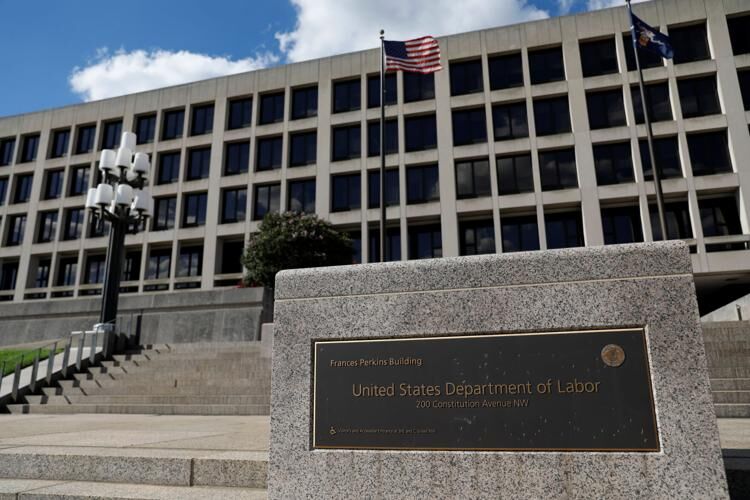
The U.S. Department of Labor office in Washington, D.C., on Aug. 30, 2020.
