






GOVERNOR Arnold I. Palacios on Thursday appeared before a U.S. Senate committee to testify in support of U.S. Congressman Gregorio Kilili Camacho Sablan’s H.R. 560 or the Northern Mariana Islands Population Stabilization Act which proposes CNMI-only permanent residency status to qualified long-term foreign workers in the Commonwealth.
Palacios also asked U.S. lawmakers to consider amending the NMI U.S. Workforce Act by repealing the “touchback” provision that requires foreign workers on CW-1 permits to “exit” the CNMI after three renewals of their permits.
The governor also shared the challenges facing the CNMI.
He said the Commonwealth government’s finances were “in complete disarray” when he was sworn in on Jan. 9, 2023, “We do need help,” he added, but “I am not here to ask for bailouts or handouts.” Instead, “I am asking for open dialogue and meaningful partnership with our federal government. We need technical assistance to help us build our own capacity to ensure fiscal discipline, compliance, and accountability and get our financial house in order. We need fixes in federal policy to help us move hundreds of millions of federal dollars in stalled projects. We need congressional support to help stabilize our economy and population, and to strengthen crucial social safety nets.”
Chaired by Sen. Joe Manchin III, D-West Virginia, the Senate Committee on Energy & Natural Resources also heard the testimonies of other territorial governors.
Multiple fronts
“We in the CNMI are grappling with crises on multiple fronts,” Palacios told the U.S. senators. “A government in fiscal disarray, an economy still struggling from the impacts of Covid, and several unprecedented typhoon disasters that preceded the pandemic, infrastructure and assistance that are woefully unprepared for the climate crisis and a shrinking population as citizens leave our islands for greener pastures.”
Against this “backdrop of vulnerabilities,” the governor noted the “geo-political challenges presented by China in our islands and the region.”
“The people of the Northern Marianas are proud American citizens, and critical partners in national security and peace in the region,” he added. “But we are also vulnerable, struggling to stay afloat in a sea of immense challenges. And I am here to appeal to you, and to all of our federal partners, to support the Commonwealth’s efforts to reach stable ground and ultimately thrive — fiscally, economically, and socially. The interests of the Marianas in getting our government’s financial house in order, shoring up our economy, strengthening our infrastructure, and stabilizing our population are inextricably linked with the interests of our nation and our allies in a secure and peaceful Indo-Pacific.”
Population loss
Palacios said the CNMI’s “ability to recover economically is made even more challenging with a declining population. A major part of our struggle to carry out critical infrastructure and development projects is a shortage of labor and serious uncertainties affecting the stability of the Commonwealth’s workforce.”
He said he is “strongly” supporting Congressman Kilili’s legislation, H.R. 560, the Northern Mariana Islands Population Stabilization Act, “which would encourage approximately 1,600 long-term foreign workers living in our islands since 2015 to remain in the Marianas by offering them a Commonwealth-only permanent status.”
Population stability in the Marianas is also a matter of national concern, the governor added. “As Congressman Sablan has stated, ‘The population loss in our islands and resulting loss of economic viability not only hurts all of us, but also has implications for the U.S. strategic position in the Western Pacific. With increasing competition for dominance from China, the United States needs to be strengthening our position in the region, not shrinking in significance. That legislation [H.R. 560] fits into that larger strategic imperative.’ ”
As for the “touchback” provision in the NMI U.S. Workforce Act, Palacios noted that the CW program’s end “is just around the corner in 2029, and we recognize the diminishing number of CW permits every year. Given the context of an overall shrinking population, the needs of the Marianas and the region for stability, and the re-introduction of Congressman Sablan’s H.R. 560, I ask for your support in repealing the touchback provision that requires CW workers to exit the Commonwealth for at least 30 days prior to the submission of their third renewal petition.”
Palacios said repealing the touchback provision “would not be so urgent if the permit processing from both U.S. Labor and U.S. Citizenship and Immigration Service were more timely and efficient. Currently, processing times for CW-1 permits are so delayed that employers wait months after the petition start date to receive the necessary approvals to secure entry of the CW-1 permit holder to the CNMI. As a result, a large proportion of workers will be required to depart all at the same time without a clear timeline for their return, and at a time when businesses are attempting to regain normalcy in operations. The touchback provision’s disruptions to families, businesses, and the overall economy cannot be overstated. For businesses reliant upon a set number of employees, the touchback requirement necessitates the onboarding and training of additional staff to ensure that operations continue. These additional costs create a significant burden on small businesses attempting to recover from the pandemic.”
The governor said he is hoping “for an open and candid conversation with our federal partners about this and other areas of the Workforce Act and the CW program that can be improved or modified in light of the new realities and monumental challenges we face in the Commonwealth.”
Threat from China
Congressman Kilili, in his latest e-newsletter, said he attended the Senate committee hearing “to show my support for our new Governor, Arnold I. Palacios, and benefit from hearing the questions that Senators had about the insular areas. I want to thank Governor Palacios for voicing his support for my Marianas Population Stabilization Act at the hearing. My bill, H.R. 560, is intended to shore up the shrinking Marianas population both to protect our islands’ economic viability and as a response to Chinese expansionism in the Western Pacific. The threat of China was a recurring theme in statements and questions from most Senators. Ranking Member John Barasso (R-Wyoming) acknowledged that ‘Chinese aggression in the Indo-Pacific is a serious and growing threat,’ and ‘[o]ur territories in the Pacific are on the frontlines of Chinese aggression.’ He added: ‘Guam, the Commonwealth of the Northern Mariana Islands, and American Samoa are not only vital to our national security interests, they are also home to American citizens and nationals. Their security is more important now than ever.’ I expect an important focus of the 118th Congress will be measures in the insular areas and nationwide to respond to China.”
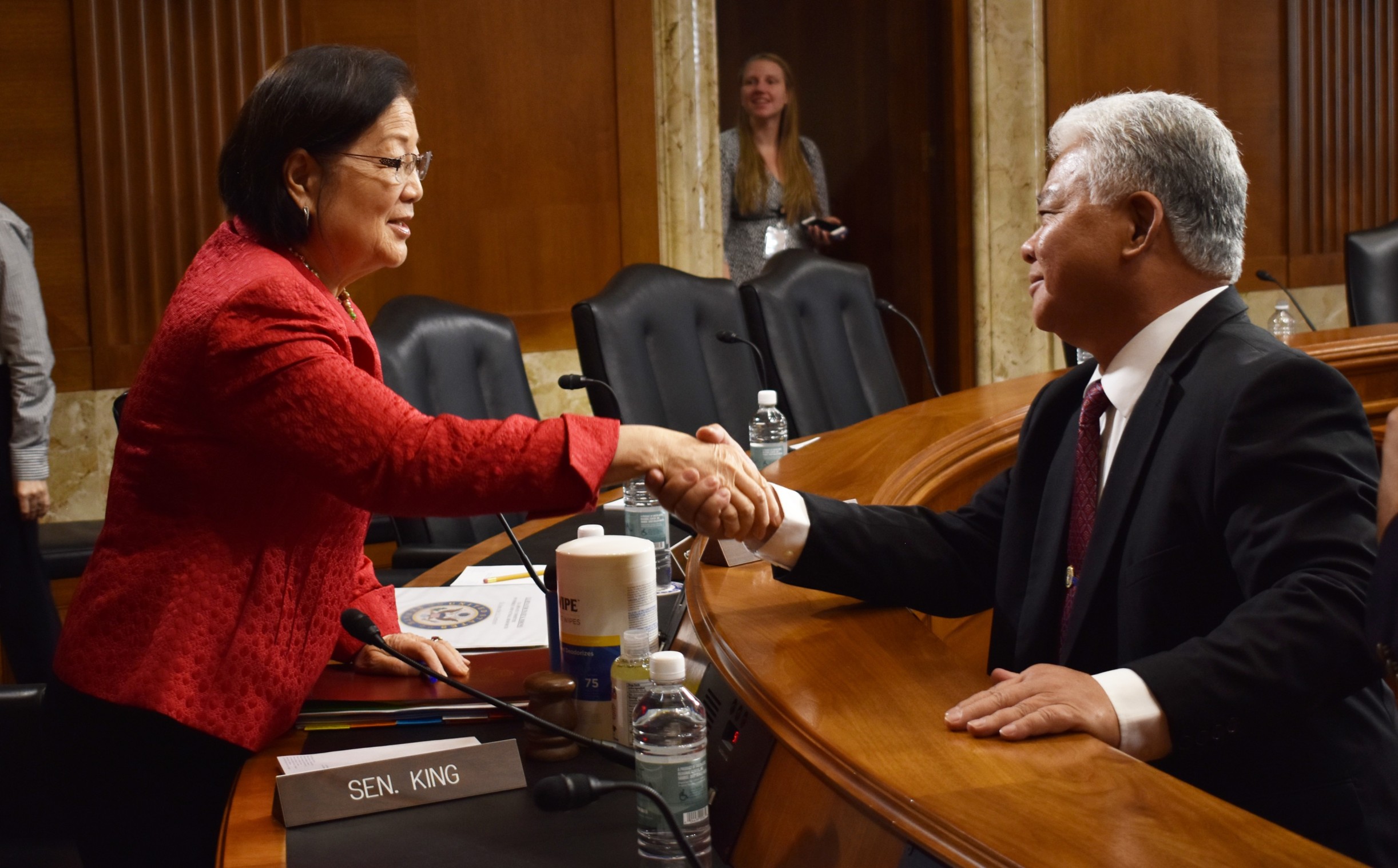
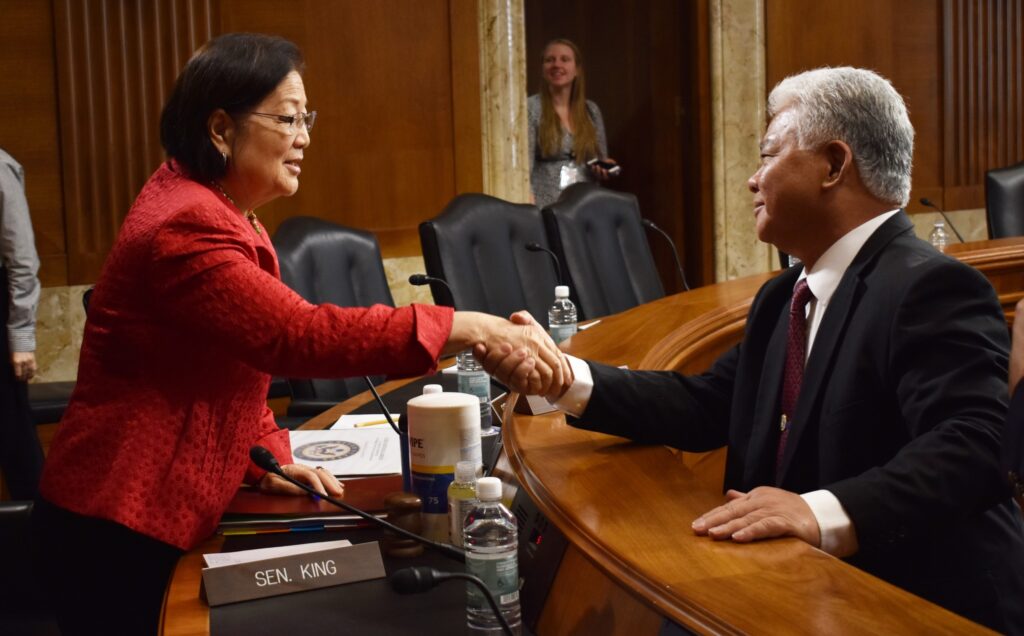
CNMI Gov. Arnold I. Palacios shakes hands with U.S. Senate Committee on Energy and Natural Resources member Sen. Mazie K. Hirono, D-HI, after testifying before the committee on Feb. 9, 2023. Governor Palacios provided a snapshot of the CNMI’s state of affairs, including some of the financial challenges that the Commonwealth is facing. He sought federal assistance to achieve economic stability which, he stated, was inextricably linked to the national interests of the U.S. and the region. The governor also asked committee members to help the CNMI address workforce issues by seeking flexibility with the U.S Workforce Act, to ease bottlenecks that are impeding infrastructure projects, and to support U.S. Congressman Gregorio Kilili Camacho Sablan’s Population Stabilization legislation.
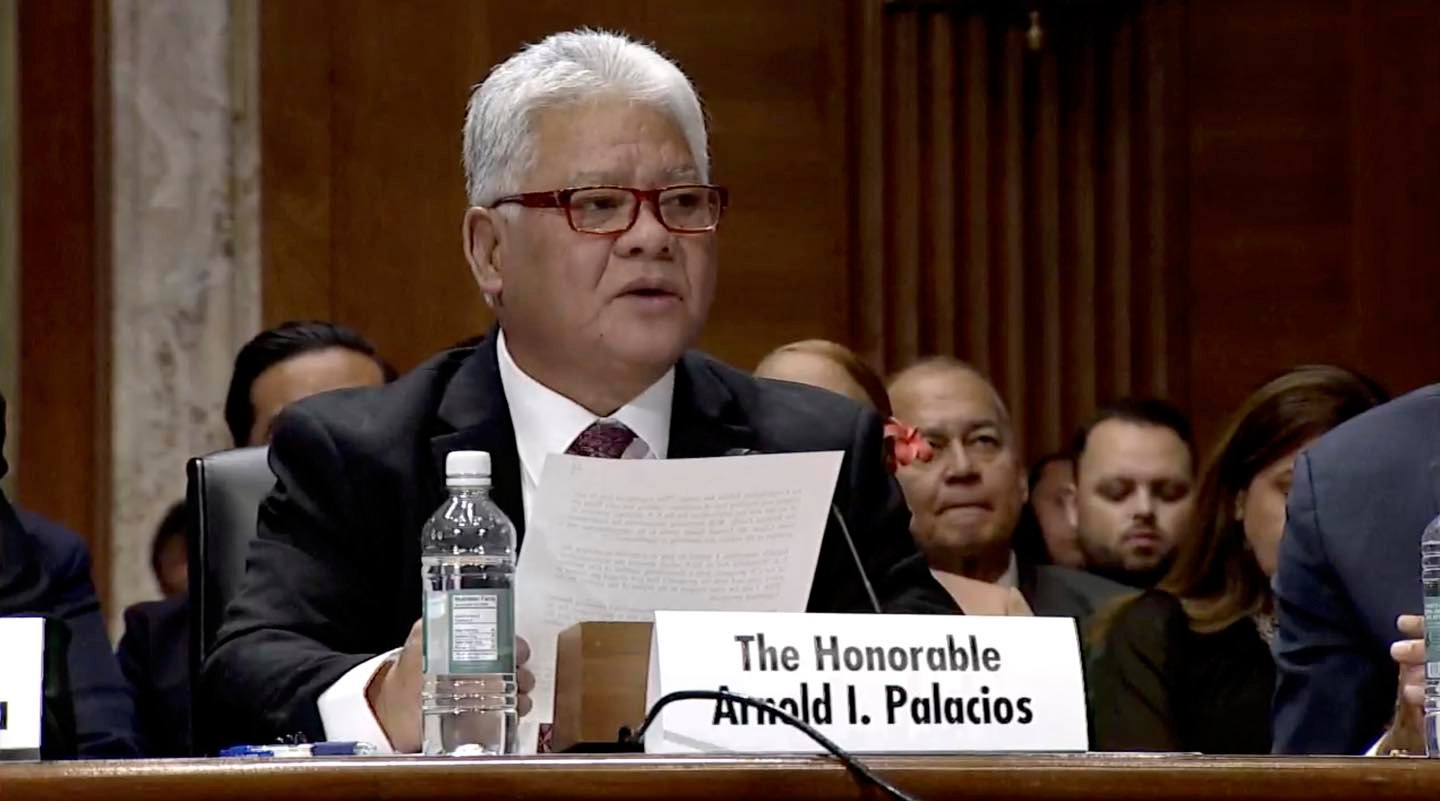
Gov. Arnold I. Palacios testifies before the Senate Committee on Energy & Natural Resources during a hearing on the State of the U.S. Territories on Feb. 9.
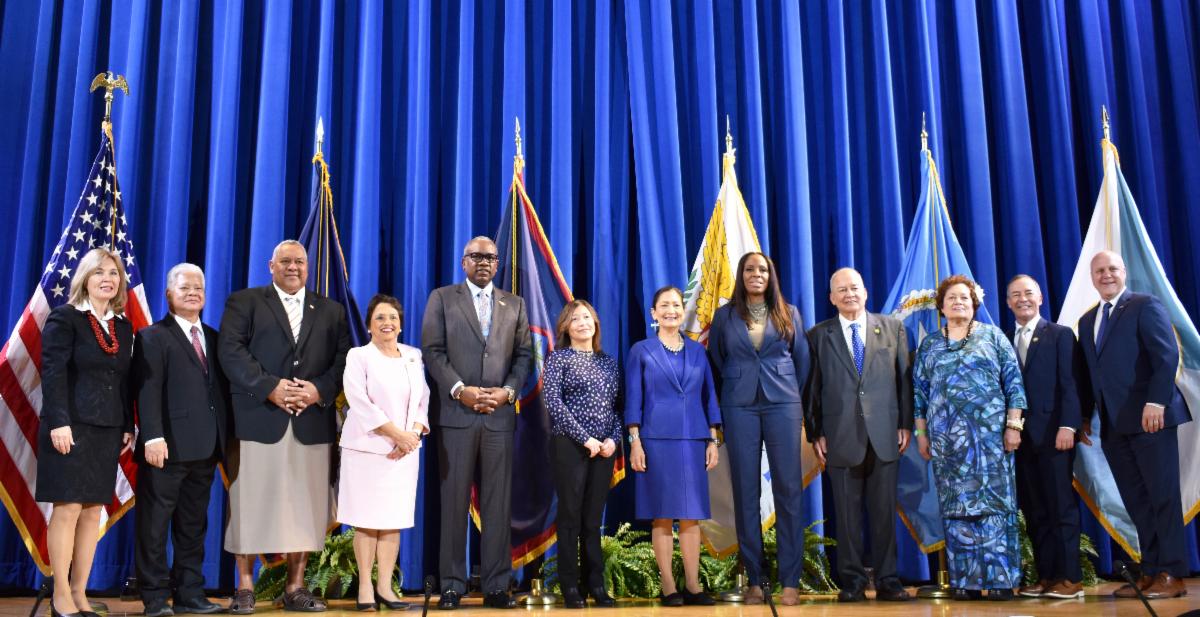
Principals attending the Interagency Group on Insular Affairs meeting last week. From left, Assistant Interior Secretary for Insular and International Affairs Carmen Cantor, CNMI Gov. Arnold Palacios, American Samoa Gov. Lemanu Mauga, Guam Gov. Lou Leon Guerrero, U.S. Virgin Islands Gov. Albert Bryan, Director of Intergovernmental Affairs Julie Rodriguez, Interior Secretary Deb Haaland, U.S. Virgin Islands Delegate Stacey Plaskett, CNMI Delegate Gregorio Kilili Camacho Sablan, American Samoa Delegate Amata Radewagen, Guam Delegate Jim Moylan, and President Biden’s Senior Advisor and Infrastructure Coordinator Mitch Landrieu.
