




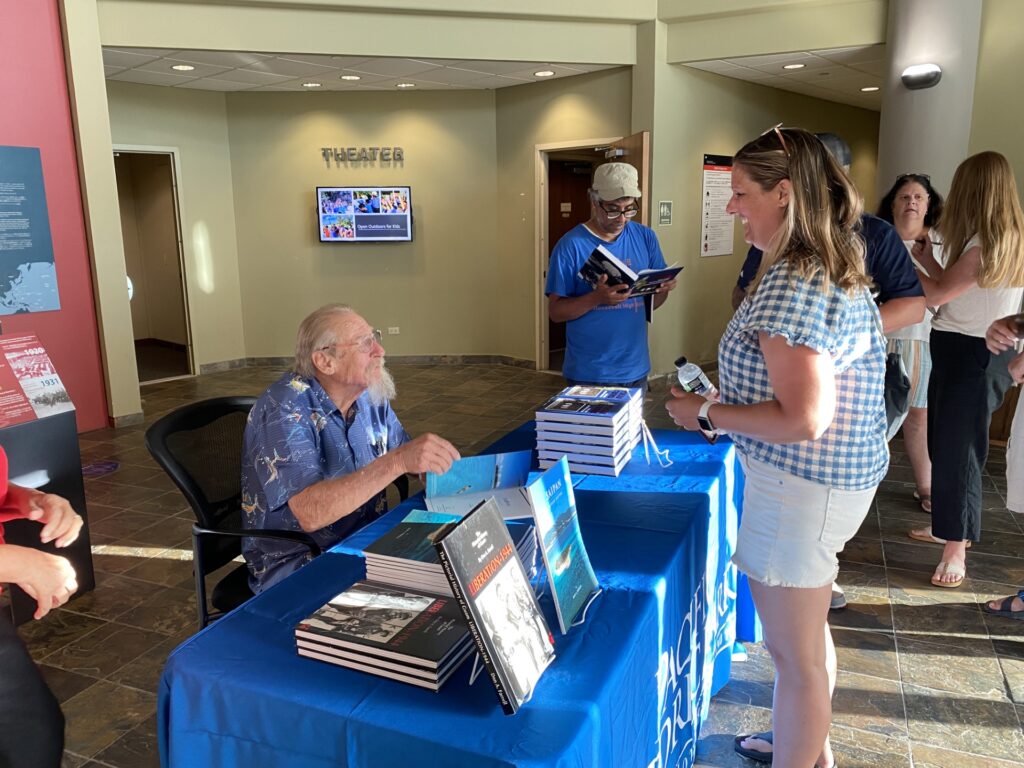
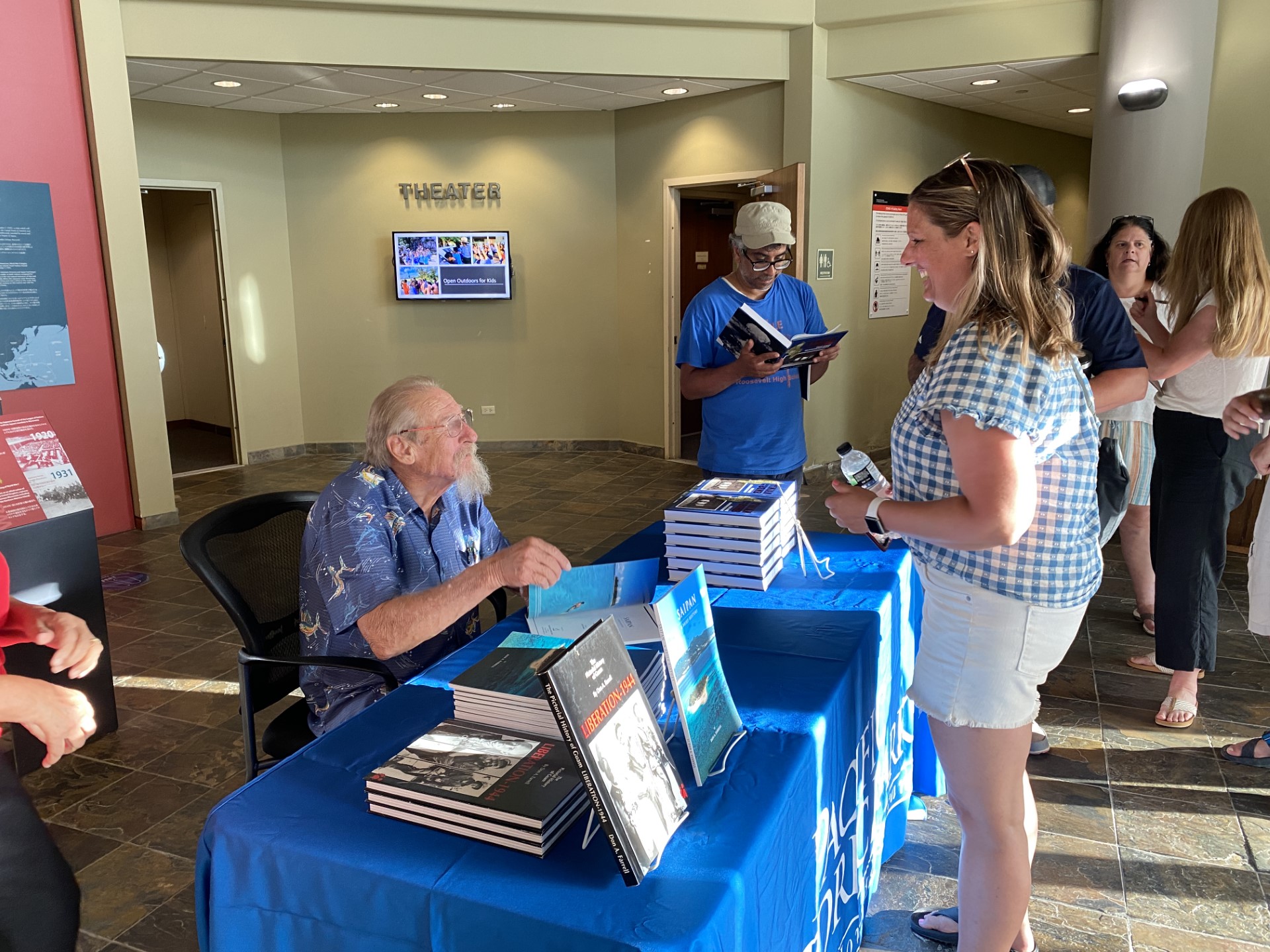
Seated at a table that displays his books, historian and author Don Farrell talks to an educator at the Visitor Center of American Memorial Park on Monday, July 10. Farrell is one of the lecturers in the “Saipan’s Land and Sea: Battle Scars & Sites of Resilience” program.
THIRTY-SEVEN educators from the Marianas and the mainland U.S. on Tuesday completed Week 1 of “Saipan’s Land and Sea: Battle Scars & Sites of Resilience,” a residential educational program focused on World War II education and presented by Eastern Carolina University.
According to the program’s website, it provides “K-12 educators an incomparable opportunity to interact with a continuous, intact, and largely undisturbed record of conflict history outside of museum walls on the island of Saipan.”
The program began on Wednesday, July 5.
ECU Professor Dr. Anne Swenson Ticknor, project director, said that there are eight participants from Saipan, one from Rota, two from Guam, and 26 from the mainland U.S.
Their schedule over the week involved snorkel tours of the World War II Maritime Heritage Trail, jungle hikes, latte site visits, the historical sites in Marpi and much more, Ticknor said.
She said aside from going on site visits, the cohort also took part in classroom training sessions to bring the knowledge they learned from the program into their elementary, middle, and high school classrooms.
Ticknor said there are museum educators and curriculum specialists in the cohort as well.
The program lecturers include Tinian-based educator, local historian and author Don Farrell, historian Genevieve Cabrera, Northern Marianas College President Galvin Deleon Guerrero, ECU history professor Jennifer McKinnon, and Pacific Development Inc. Managing Director Gordon Marciano.
Ticknor calls it “an intense week,” and said that a second cohort of 38 participants will join the program today, Wednesday, July 12. Like the first cohort, most participants are traveling from off-island to learn about Saipan’s history.
Farrell, who talked about World War II in the Marianas on the evening of July 10, said he was glad to help bring the story of the islands abroad.
He said when he was a former staff member in the Office of the Governor of Guam, he was hard-pressed to find non-military members in Washington, D.C. who knew where Guam was.
With 5,000 military families moving to Guam in the future, Farrell said the training program demonstrates one way the CNMI can benefit through military tourism. Military families want to learn about World War II in the Pacific, he added.
“That’s the purpose of all of this,” Farrell said. “I’m a retired school teacher — this is education, and I’m providing teachers with a tool.”
Week 2 participants will also participate in several activities when they arrive on island.
Ticknor said the public is welcome to attend the second round of lectures to be delivered by Farrell, Cabrera, Deleon Guerrero, and McKinnon.
All presentations will be held at the American Memorial Park Visitor Center at 6 p.m.
On July 12, McKinnon will discuss “Civilian and Military Experiences in the Battle for Saipan”; on July 13, Cabrera will deliver a lecture on “Indigenous NMI History”; on July 14 Deleon Guerrero will screen his film, “We Drank Our Tears,” and lead a discussion on the film afterward; and Farrell will make a second presentation on the military perspective of the Battle for Saipan on July 17.
