






HAGÅTÑA (The Guam Daily Post) — Bill 291-36, better known as the Guam Heartbeat Act, has managed to pass the 36th Guam Legislature with just enough votes to be sent to the governor for her consideration.
Sens. Tony Ada, Frank Blas Jr., Joanne Brown, Chris Duenas, James Moylan, Telena Nelson, Amanda Shelton and Telo Taitague voted in favor of the legislation.
Speaker Therese Terlaje, Vice Speaker Tina Muña Barnes and Sens. Sabina Perez, Clynton Ridgell, Joe San Agustin and Mary Torres voted against the measure. Sen. Jose Terlaje passed three times during voting, which resulted in his vote being considered “no.”
The Guam Heartbeat Act would ban abortions once a fetal heartbeat is detected, or within about six weeks — sooner than when women might know they are pregnant. The controversial measure makes no exceptions for rape or incest, only for medical emergencies.
Bill 291 received backing from anti-abortion supporters and certain religious organizations, including the Archdiocese of Agana. But the bill also drew significant opposition from abortion-rights supporters and certain businesses and medical providers. The vast majority of written testimony opposed the Guam Heartbeat Act.
Gov. Lou Leon Guerrero, who has spoken about maintaining access to abortion services on Guam, is anticipated to veto the measure. But when asked for comment on the bill’s passage, the administration stated that the governor and her office “will thoroughly review the bill and consider the changes made on the session floor and the public input received.”
The governor has ten days, not including Sunday, to act on or let lapse Bill 291, in addition to the myriad other bills that passed Friday. The Legislature, which is on its final session this term, currently stands at recess until Dec. 29, when senators may entertain any more agenda items or act on any action that the governor takes on the bills. Lawmakers will need 10 votes to override a veto.
Bill 291 was authored by local attorney Peter Sgro and introduced by Nelson. The senator will not be returning for the 37th Guam Legislature, having run for the island’s delegate seat in Congress rather than reelection as senator. Nelson lost that race in the primary election. The bill was co-sponsored by Ada, Blas, Duenas and Shelton. Ada also won’t be returning as senator, having run for lieutenant governor and losing. The remaining co-sponsors won their bids for reelection, however.
Speaking Friday about the Guam Heartbeat Act, Nelson said, on the issue of life, for her, “there is no gray area, there is (only) black and white.”
“And when we teach these things to the youth about life, about the right to choice, this ideology is a huge challenge. Because essentially what we’re teaching them is in uncertain circumstances, in a crisis, that there is another option and that option is death,” Nelson said. “And when we remove the option of hope, which is fundamental for life to begin and end, what are we doing for our society as we move forward?”
‘I am disgusted’
Vice Speaker Barnes spoke briefly on the bill before Nelson spoke.
“While I’ve always been an advocate for choosing life, as shared 42 years ago, it’s exactly that. The right to choose. I made that choice, and I will, in my heart, ensure that every woman has that right to choose. Yes, I am disgusted that we can sit here and tell victims of rape and incest that they don’t have the right to choose how they want to deal with their trauma. It astounds me that such an amendment failed,” Barnes said.
Just a few days ago, San Agustin attempted to change language in the bill so that pregnancies resulting from rape and incest would be exempt from the abortion ban. The amendment received only three votes and failed. While San Agustin has described himself as anti-abortion, he has been opposed to measures that make no exceptions for rape and incest. That, coupled with the civil suit enforcement scheme of the bill, led San Agustin to vote against Bill 291.
“(Bill 291) causes life-threatening, life-disturbing trauma for victims and allows for a profit-making venture, all that will cause more issues socially for the family and most especially, the victim,” San Agustin stated in a release published a couple days before Friday’s vote, in which he confirmed he would vote “no” on Bill 291.
The Guam Heartbeat Act is modeled after Texas law, which authorizes private citizens to sue anyone who may be in violation of its provisions. This enforcement scheme was developed to help the legislation dodge court review and evade getting struck down at a time when abortion was a constitutionally protected right. The Supreme Court has now done away with those older rulings, and states can now regulate abortion as they see fit.
Bill 291 exempts women who seek or obtain an abortion from lawsuit, but the civil suit enforcement scheme it utilizes has been criticized as “bounty hunter” legislation due to the cash payout it provides to successful claimants — at least $10,000. The potential for frivolous lawsuits under Bill 291 had drawn concerns from the Guam Women’s Chamber of Commerce, as did the risks posed by the ban to women’s health providers.
Sen. Torres had said the Guam Heartbeat Act appeared to be “merely a pro-lawsuit bill” because of its enforcement scheme. Torres has consistently called for a voter referendum as the best way to decide the abortion issue on Guam.
The Texas heartbeat law has so far survived legal challenges, but a recent Texas court decision would appear to cause issues for its enforcement scheme, and by extension, the scheme within the Guam Heartbeat Act.
The court threw out a lawsuit against a doctor, ruling that a person does not have legal standing to sue if they have not been directly impacted by the abortion services provided. While the ban remains in place, the ruling did set “an important precedent for other courts when considering whether bounty-hunting laws violate states’ constitutions,” according to a release from the Center for Reproductive Rights, which represented the doctor in the lawsuit.

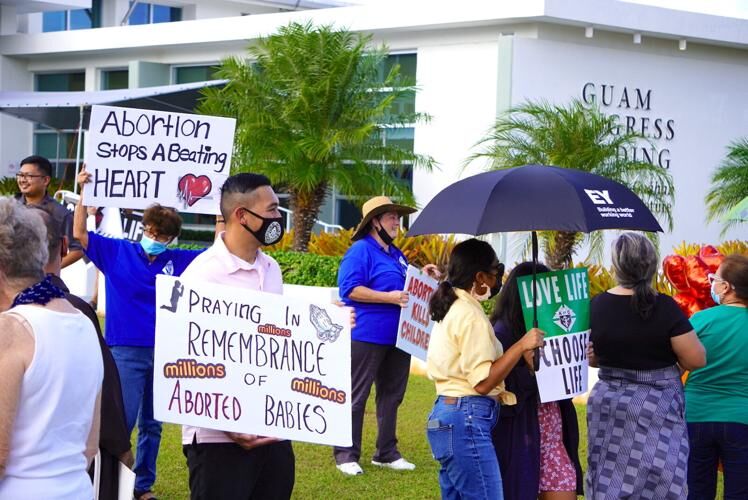
Anti-abortion protesters gather on May 3, 2022 outside the Guam Congress Building in Hagåtña.
