





By Walter Ulloa
For Variety
HAGÅTÑA (The Guam Daily Post) — ASTRO America brought a packed room to attention at the nation’s premier additive manufacturing conference last month in Boston with a panel focused on a claim few in the room had heard made so plainly: building what the organization’s leader calls the best metal additive manufacturing facility in the United States, not in California, not in Texas, but on Guam.
The panel, held April 15 at the RAPID+TCT 2026 conference, centered on ASTRO’s Guam Additive Materials and Manufacturing Accelerator, known as GAMMA, a facility taking shape at the Pacific Industrial Park in Dededo.
“We are committed to bringing just-in-time manufacturing to Guam that will meet critical warfighter needs at the best value to the taxpayer,” said Neal Orringer, ASTRO America’s president and CEO, in a release announcing the event.
In an interview with The Guam Daily Post, Orringer drew a sharp line between GAMMA and the military’s usual approach to manufacturing in the field.
“A lot of folks have been experimenting with the military about what they call expeditionary 3D printing,” he told the Post. “Putting factories in a box, temporary solutions. That is not what we’re doing in Guam.”
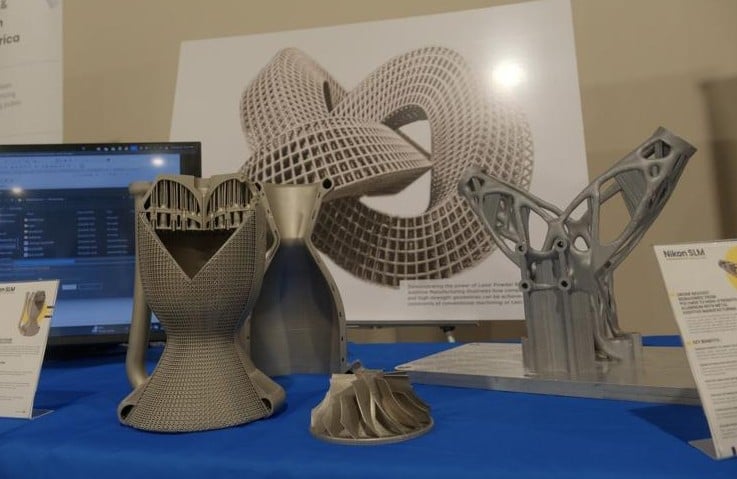
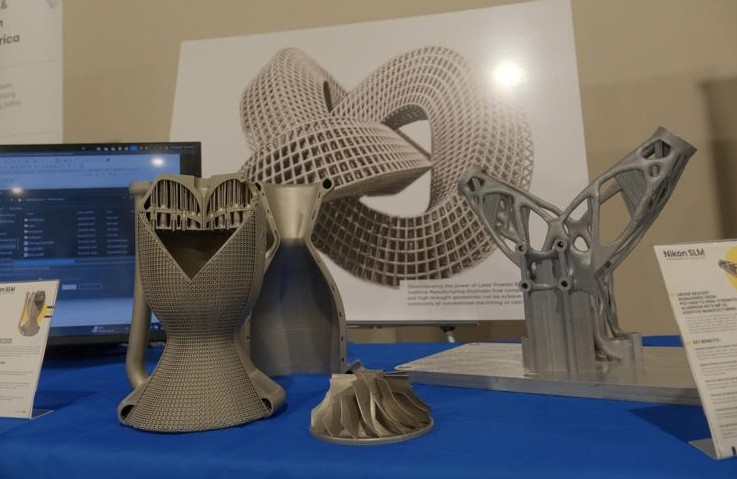
What ASTRO is building includes laser powder bed fusion machines, directed energy deposition systems, heat treatment capability, and metrology equipment for part inspection, with the fusion machines among the largest of their kind currently available. The goal is to produce Navy-grade replacement parts for submarines operating across the Pacific, on demand, without waiting weeks or months for shipments from Hawaii or the mainland.
Virginia-class submarines carry tens of thousands of parts. When components fail far from port, readiness suffers. Orringer put the stakes simply.
“Pearl Harbor is 4,000 miles away,” he said. “Being able to get to Guam and get some maintenance (and) get some part replacements. It’s critical.”
The submarine fleet, often called the silent service, operates largely out of public view by design. Virginia-class and Los Angeles-class submarines serve as the U.S. military’s most stealthy intelligence-gathering and reconnaissance platforms, capable of inserting special operations forces in places that attract no public attention. For those vessels, Guam functions as an essential waypoint. It is one of the few ports in the region with adequate depth and infrastructure to service submarines, and it sits thousands of miles closer to Pacific operations than Pearl Harbor. Ships the Navy does not publicly confirm as visiting Guam still come in for temporary maintenance and part replacements before heading back to Hawaii, Orringer noted.
The panel included Justin Rettaliata, additive manufacturing program manager for the U.S. Navy’s Submarine Industrial Base Office, which funds GAMMA. As the Navy’s former technical warrant officer for additive manufacturing, Rettaliata determined which 3D-printed parts could be accepted for ship construction across the entire Naval Sea Systems Command. He has since moved to the Navy’s Submarine Industrial Base Office, where he oversees the applied research programs now funding GAMMA.
“Having him there, speaking about not only the importance of our initiative but also speaking to his experience as to why the Navy is bullish on additive manufacturing, was really important given his perspective,” Orringer said.
Matthew Herrmann, a principal at The Roosevelt Group and former chief of staff to former Guam Congressional Delegate Madeleine Bordallo, also served on the panel, moderated by Debbie Holton of Converge Consulting.
The conference itself drew the significance of the moment into relief. RAPID+TCT, run by the Society of Manufacturing Engineers, has tracked the explosion of additive manufacturing across aerospace, energy, and shipbuilding for years. Those industries now routinely rely on metal 3D-printed components. Every commercial jet engine flying today contains metal parts made through additive manufacturing processes, Orringer noted. For a Guam initiative to hold a panel at that forum, alongside U.S. Navy program managers and former congressional staff, signaled something beyond a local story. It placed GAMMA in a national conversation about how the country builds and sustains its defense industrial base in remote and contested environments.
On timing, Orringer said GAMMA’s initial operating capability is targeted for late summer, with machines installed, a quality management system in place, and potentially the first parts rolling out by end of August.
Reaching this point has taken years. Gov. Lou Leon Guerrero first directed the Guam Economic Development Authority to commission a feasibility study more than two years before ASTRO delivered its full implementation plan to the Guam Bureau of Statistics and Plans in July 2024. That plan, built on three pillars of workforce development, component testing, and manufacturing business incubation, set the course for everything now coming to fruition. A benedición and groundbreaking followed at the Pacific Industrial Park in Dededo in November 2025. After that long runway, GAMMA’s first operating machines are now weeks, not years, away.
“I’m trying to be patient, but I’m the least patient within our organization right now,” he said.
Vendors are navigating shipping routes to Guam they’ve never used before, and fuel price uncertainty adds to the challenge. Still, Orringer said the project is on track. He is hoping to host a commissioning event with senior Navy officials and the government of Guam as well as university leaders, where guests can see the machines running and handle actual finished parts.
“People won’t just be walking into an empty room full of posters,” he said. “You’ll see the real-life thing.”
Beyond its Navy mission, Orringer envisions GAMMA eventually serving the Guam Power Authority, Guam Waterworks Authority, emergency response agencies, and commercial clients. Gov. Lou Leon Guerrero, who once admitted she had to look up what additive manufacturing even meant, has since become one of its most vocal champions on the island. At November’s benedición, she tied the technology directly to everyday island needs.
“How many times do our ambulances go down and we can’t get the parts quick enough for those ambulances to get back on the streets,” she said. “This is the value of what this industry is going to bring to our island.”
She has not softened that conviction since.
“This is a very phenomenal industry that is worth the investment that we made,” Leon Guerrero said.
“If we get to the point where we can have an industrial-grade metal inspection house here in Guam, we’ll be the only industrial inspection house for thousands of miles,” Orringer said. “You can imagine people making parts all over Asia coming here for inspection, not just 3D printing.”
Workforce development is central to sustaining GAMMA well beyond its launch. ASTRO is partnering with the University of Guam and the Colorado School of Mines to build a pipeline of locally trained mechanical engineers who, Orringer believes, will eventually supply GAMMA and other industries drawn to the island.
“The skills that they’re starting to put together will be translatable to other industries,” he said. “If we don’t have to rely on imports and can just build things on demand, then it’s going to be a wonderful thing.”
The governor carried Guam’s manufacturing pitch to a wider audience last week at the 2026 SelectUSA Investment Summit in Maryland, where investor interest ranged from drone manufacturing and data centers to battery storage and higher education partnerships.
Orringer did not shy away from acknowledging who made it possible.
“She took a risk,” he said, “and we’re going to prove her right in the next couple of years.”
