



AS in most things political, your brand of politics will usually determine what you see when looking at the politics of any nation (or territory for that matter).
The Philippines — a U.S. possession for almost half a century — is holdings its general election on May 9th, but qualified Filipinos working, studying or living abroad have begun casting their absentee ballots on April 10th at Philippine embassies, consulates, and other diplomatic offices around the world.
Here’s some of the things you may want to know about Philippine politics.
There is no Left-Right divide. Most, if not almost all, of the political parties believe that Government (with a capital “g”) is all, and it must be big. Poverty? Government should fix it. Economy? Government should guide it. Typhoons? Government should ban them. Law of Supply and Demand? Government should repeal it. Potholes? Juvenile delinquents? Philandering spouses? Karaoke fanatics who won’t stop singing Frank Sinatra’s “My Way”?
To quote another American musical artist, Vanilla Ice, Government’s motto is: “If there is a problem, yo, I’ll solve it!”
One of his admirers attribute outgoing President Rodrigo Duterte’s enduring popularity to his “leadership style”: he governs like a mayor. And what do mayors do? Genie-like, they grant your wishes — if possible. If not, they’ll give you something else. A mayor can be more informal than a president. A mayor is more approachable.
Philippine political parties, in any case, are either center-left, leftish, left or very left. (This reminds me of that old joke about the traffic lights in Manila: green means go, yellow means go faster, and red means go if you can.)
Back in the day, President Marcos was considered “rightist” by the left. But he said he was a centrist who was trying to save the Republic from the Maoists and the Oligarchs.
In 1974, the pro-USSR Communist Party of the Philippines, founded in 1930, entered into a “political settlement” with Marcos. As for the Maoist Communist Party of the Philippines, founded in 1968, Marcos said it was in bed with his main political opponent, the fast-talking Sen. Benigno “Ninoy” Aquino. (The father of Duterte’s predecessor, Noynoy Aquino.)
Marcos’s primary speechwriter was left-leaning. Under the Marcos presidency, the Philippines established diplomatic ties with Mao’s China, Brezhnev’s USSR and its satellite nations in Eastern Europe. Marcos’s resident ideologues included a former Maoist whose “Filipino Ideology” became the regime’s official creed: a nationalist big government that spouted the usual leftist slogans: “workers representation,” “cooperative action,” “cultural reawakening,” “social and economic liberation,” “equality.”
All the Philippine presidents since Marcos have been supported by leftists of various shades. Duterte calls himself a socialist and had friendly ties with the Maoist guerillas operating in his hometown. Just before he was elected president in May 2016, Duterte chatted online with his former college instructor, Joma Sison, the founder of the Maoist Communist Party of the Philippines. They talked about, among other things, the “elite” that continued to inflict “suffering on the masses.”
As for the “elite” or “oligarchs” — in the P.I. they usually refer to the very rich who do not support a politician who, consequently, hates them. Marcos railed against the oligarchs. “Too long had government been either the partner of the oligarchy or its servitor,” he said in a speech. “In liberating itself from the oligarchy, government once again became the focus of popular power.”
His running mate in the 1965 and 1969 elections became an “oligarch” after their falling out, and was overpowered and driven to exile by the martial law regime, just like the other rich families who dared opposed Marcos. And what happened during his 13-year “New Society” dictatorship? His cronies became the new “oligarchs.”
As for the outgoing, oligarch-hating President Duterte — well, as Nikkei Asia reported in Dec. 2019, he “Promised to destroy the Philippines’ elite. Instead, he chose his own…. Duterte has simply opened the door to a new wave of businesspeople and loyalists, who have been given access to political power and lucrative government contracts.”
This year, as in previous elections, the candidates for president are denouncing corruption and have vowed to “combat illegal drugs.” And they’re all “for the people.”
As an American governor general of the P.I. noted in 1907 (not a typo), “the first and only genuine political parties that have ever lived and had their being in the Philippines…are the Ins and the Outs. The Ins are generally conservative, the Outs are always radical — until they get in. The Ins are conservative from conviction, the Outs are radical for convenience.”
Send feedback to [email protected]

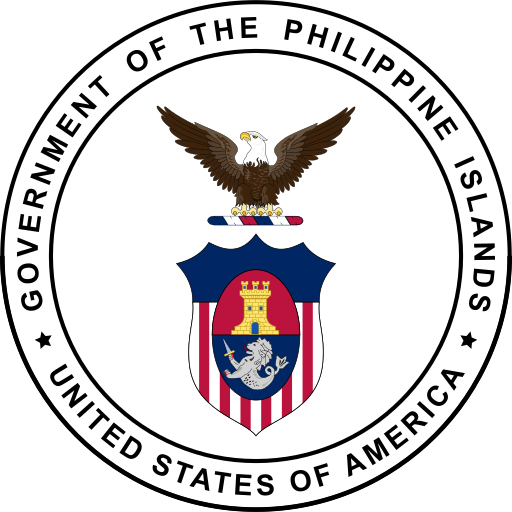
Great seal of the Philippine Islands, a U.S. possession from 1898 to 1946.
