


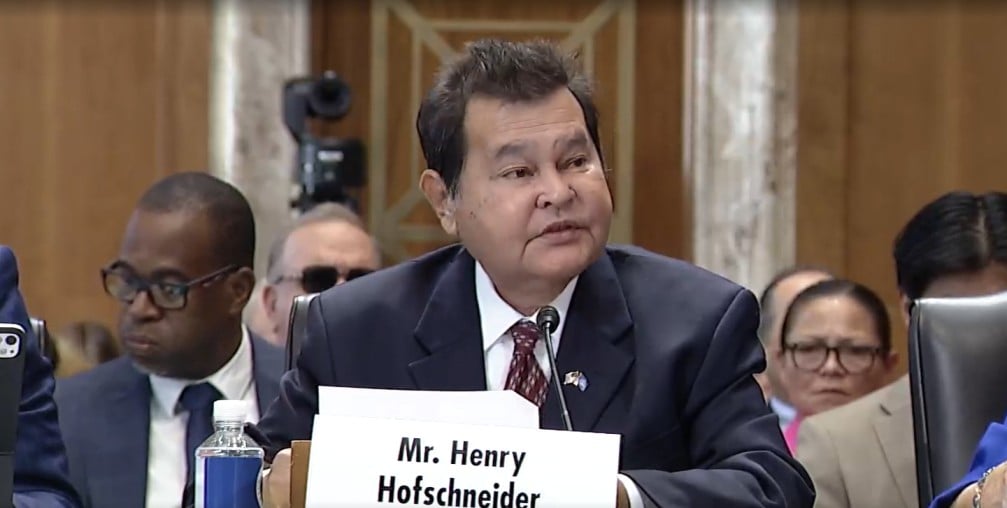
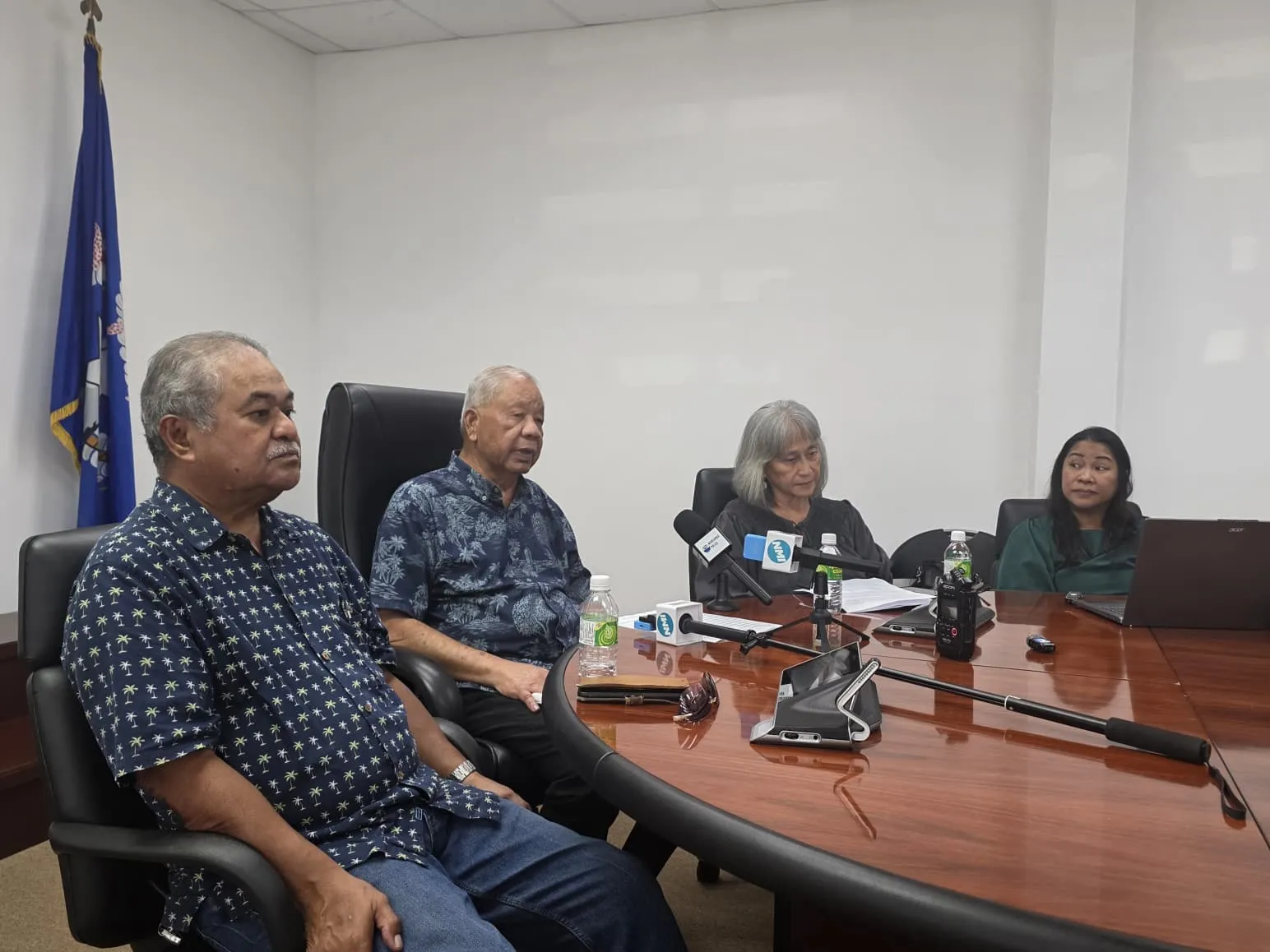




DAY three of the four-day Senate Special Committee oversight hearings on the Office of Grants Management and State Clearinghouse was conducted Tuesday in the Senate chamber.
OGM-SC administrator Epiphanio E. Cabrera, Jr. appeared before the special committee, this time to speak on his office’s budget and scope of operations.
Cabrera also talked about the total indirect cost revenue or reimbursement and expenditures, as well as the total subgrant expenditures, for fiscal years 2017 to 2021 as of May 2021.
He likewise spoke about last month’s indirect cost revenue balance.
Joining him were OGM-SC grants specialists Dana Calvo, Ezra Lizama, and Frankie Angel.
The grants office has one staff member each on Rota and on Tinian, and eight personnel on Saipan.
The total indirect cost revenue or reimbursement provided to the office amounts to roughly $1.658 million for 25 business units under the subgrant section over which the OGM-SC has expenditure authority.
Indirect costs are negotiated by OGM-SC and the federal grantor, which Cabrera noted has yet to be done for FY 2022.
This percentage can change per fiscal year, he added, noting that it is formula-based.
“We are trying to do it ahead so that the agencies can prepare for planning purposes for next fiscal year,” he said.
Cabrera clarified that the CNMI government does not collect indirect costs off of certain items, such as heavy equipment and furniture.
The current balance, given all of the positive and negative subgrant sections, comes out to -$1,394.49.
“This is only because certain charges came in just recently that drew a negative on our account that we were not expecting, but we will address that negative [balance] in the near future,” Cabrera said, noting that this is specifically due to salaries. “Hopefully those charges will be reversed by next week.”
As recommended by the special committee, Cabrera said his office will meet with the secretary of Finance to figure out how to cover this shortfall.
The special committee, for its part, said that it would take note of these payroll overruns, as it intends to amend the law to prevent such cases from occurring again in the future.
The total amount of money received by the office over the past five years in terms of indirect costs is $3,695,755.99.
On average, it costs $755,000 to $800,000 a year to operate the office.
About $450,000 is for salaries, and about $305,000 to $350,000 a year is for operations and subgrants, Cabrera said.
The OGM-SC has a list of agencies it has assisted for subgrants.
Government agencies and non-profit organizations are able to apply for subgrants.
Based on their needs and the merit of those needs, OGM-SC reviews the applications and decides if there is enough money to help that agency or non-profit, Cabrera said.
But he noted that some autonomous agencies decline or refuse to be assisted by OGM-SC.
“I believe that every government agency should try their best to try and avail themselves of any grants they can…. Every agency should make the effort to try and get more money into their agency,” Cabrera said.
“I believe that certain agencies should be included so that more grants can be obtained to better help the community with those grants.”
The special committee recommended that in identifying grants, as mandated by Public Law 19-49, OGM-SC notify each applicable agency of federal funds it can apply for and recommend that it avail itself of those funds.
With regard to deadlines for the fiscal year, Cabrera said grant proposals for the U.S. Department of the Interior-Office of Insular Affairs’ Technical Assistance and Maintenance Assistance programs are due on April 1, but this deadline sometimes changes depending on decisions coming from Washington, D.C.
The Energizing Insular Communities program grants are due June 30, while Coral Reef and Natural Resources Initiative grants are due around the same time as the TAP and MAP grants.
The special committee recommended that the office include in the next OGM-SC citizen-centric report and report to the Legislature the other items that it leverages.
Cabrera said what usually occurs is that OGM-SC receives a formal letter from the DOI-OIA notifying the office of awarded grants.
His office then communicates this to the administration, which then announces it to the public.
He said his office also notifies applicable agencies of these awards.
As far as grant applications go, Cabrera said OGM-SC puts together a grant proposal and tries its best to figure out a way to obtain the grant.
With competitive grants, it is the federal government that decides who gets them, he added.
“We just try our best to submit grant proposals — we advocate for what is best for the CNMI,” he said.
Senate President Jude U. Hofschneider, Floor Leader Vinnie F. Sablan, Sen. Victor B. Hocog, and Sen. Francisco Q. Cruz comprise the Senate special committee.

