







By Bryan Manabat
[email protected]
Variety News Staff
THE Commonwealth government on Thursday outlined eligibility requirements for the Disaster Nutrition Assistance Program, emphasizing that the $40 million federal package is intended primarily for households not currently receiving regular Nutrition Assistance Program benefits.
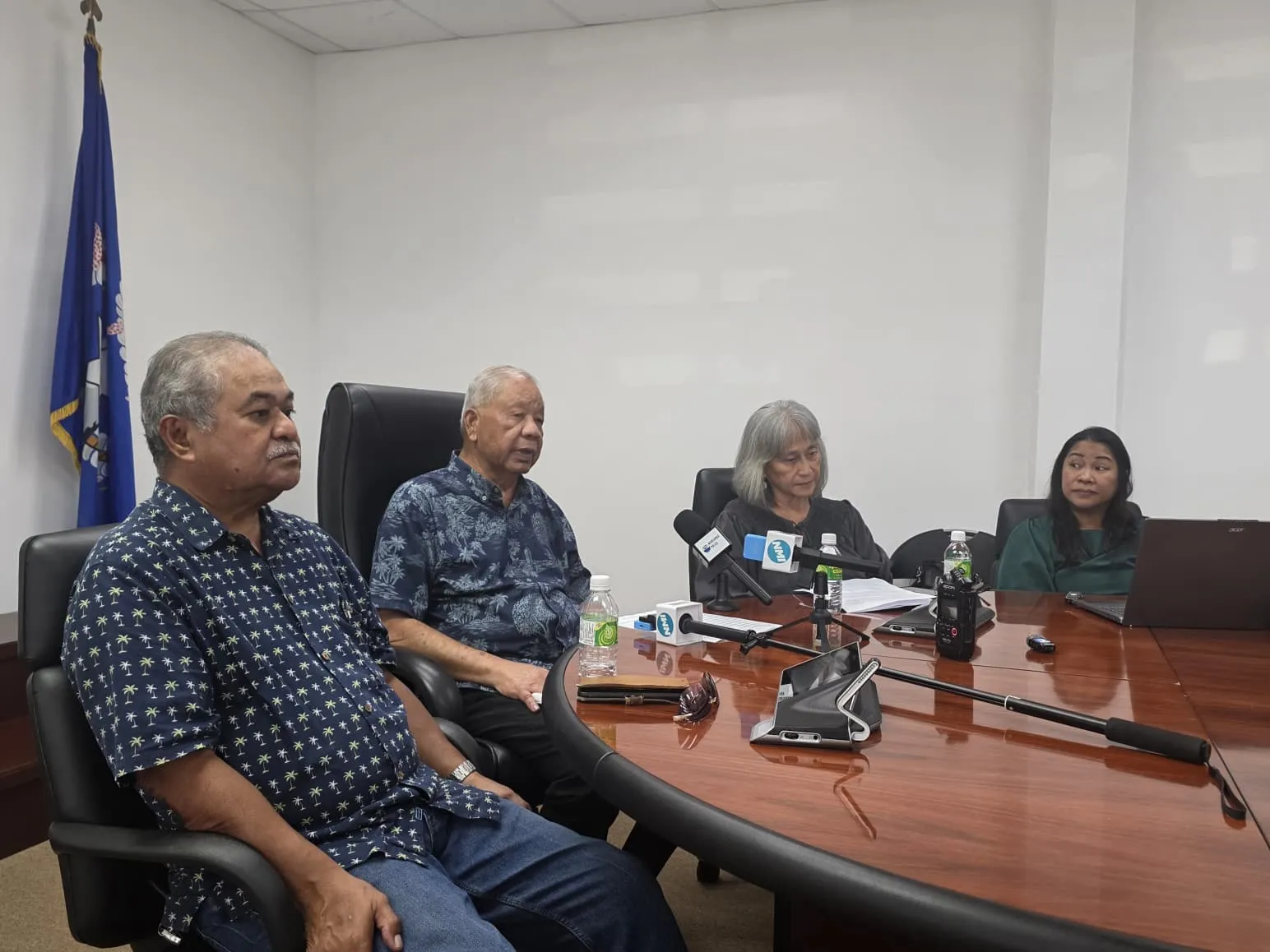
During the announcement, Gov. David Apatang, Community and Cultural Affairs Secretary Frank Rabauliman, NAP Administrator Margaret Aldan, and NAP Administrative Services Supervisor Annie Reyes detailed the eligibility criteria and scope of the program, which is expected to assist thousands of families affected by Typhoon Sinlaku’s prolonged power outages.
Officials said the CNMI has an estimated 9,000 households, including roughly 8,000 on Saipan and between 350 and 400 each on Tinian and Rota. Of those, about 5,000 to 5,300 are current NAP households already receiving disaster-related enhancements through the regular program. DNAP is intended to serve a significant portion of the remaining non-NAP households that experienced disaster-related losses, although exact projections are still being developed.
To qualify, applicants must have lived or worked in the disaster area — Saipan, Tinian, Rota, or the Northern Islands — during the disaster period from April 11 to May 10. They must also demonstrate disaster-related losses or expenses incurred during that period and meet federal income and resource limits established by the U.S. Department of Agriculture’s Food and Nutrition Service.
Eligibility is determined by adding a household’s total income and accessible resources, then subtracting allowable disaster-related expenses incurred between April 11 and May 10. The resulting amount must fall below the federal gross income limit for the household’s size. Officials stressed that these thresholds are federally established, not locally determined, and that even being one dollar above the limit can disqualify an applicant.
Income counted in the formula includes wages, salaries, public assistance payments, other unearned income, and net self-employment income. Accessible resources include cash on hand and funds in checking and savings accounts. Excluded from the resource calculation are retirement accounts, disaster insurance payments, disaster unemployment assistance, and other federal, state, local, or charitable disaster aid.
Allowable disaster-related expenses must have been incurred between April 11 and May 10 and may include home repairs, temporary shelter costs, cleanup expenses, generator fuel, and food losses resulting from power outages. Expenses incurred after May 10 will not be considered for DNAP eligibility.
Officials also clarified that non-U.S. nationals are eligible for DNAP on the same basis as U.S. citizens and nationals, provided they are CNMI residents who meet the income and resource requirements. Immigration status is not a screening factor.
“You just have to be a resident in order to qualify,” one official said, noting that the federal grantor imposed no immigration-related restrictions on DNAP eligibility.
The $40 million allocation covers two months of DNAP benefits—approximately $12 million per month—with funding for the second month contingent on the successful implementation of the first. The package also includes approximately $80,000 in administrative costs and a six-month, 20% increase for current NAP households, which will receive their maximum NAP allotment plus the temporary enhancement. New or returning NAP applicants after the disaster period will not receive the maximum-plus-20% increase.
Administrators underscored that households may not receive both DNAP and regular NAP benefits simultaneously. With approximately 5,000 current NAP households already covered under NAP’s disaster provisions, DNAP is expected to serve a substantial portion of the remaining non-NAP households, subject to individual eligibility determinations.
DNAP application intake will begin next week. Tinian and Rota will accept applications June 24-26 from 8 a.m. to 6 p.m. and June 27 from 8 a.m. to noon. On Saipan, intake will be conducted June 30 through July 2 and July 8-11, from 8 a.m. to 6 p.m. each day. Applications, pre-screening, interviews, and eligibility determinations will be completed during these intake periods.
EBT card distribution for Saipan DNAP recipients will take place July 1-2, July 6-10, and July 13-17 from 8 a.m. to 6 p.m. at the multi-purpose center, although officials said distribution could be moved back to the NAP office if operational needs require.
Officials also confirmed island-specific locations: Tinian applications will be accepted at the U.S. Delegate’s Office, with EBT distribution at the multi-purpose center; Rota applications will be accepted at the NAP office, with EBT distribution at the multi-purpose center; and Saipan applications will be accepted at the NAP office, with EBT distribution at the multi-purpose center.
Officials further warned that misuse of benefits — such as using food assistance benefits to pay off store credit — can result in serious penalties, including long-term disqualification. They encouraged all potentially eligible households, including non-U.S. nationals, to gather the necessary documentation before intake begins so the program can reach as many qualifying families as possible.
Administrators added that online applications will be available by Monday, along with fillable forms, income guidelines, and complete program schedules.
Bryan Manabat was a liberal arts student of Northern Marianas College where he also studied criminal justice. He is the recipient of the NMI Humanities Award as an Outstanding Teacher (Non-Classroom) in 2013, and has worked for the CNMI Motheread/Fatheread Literacy Program as lead facilitator.
