




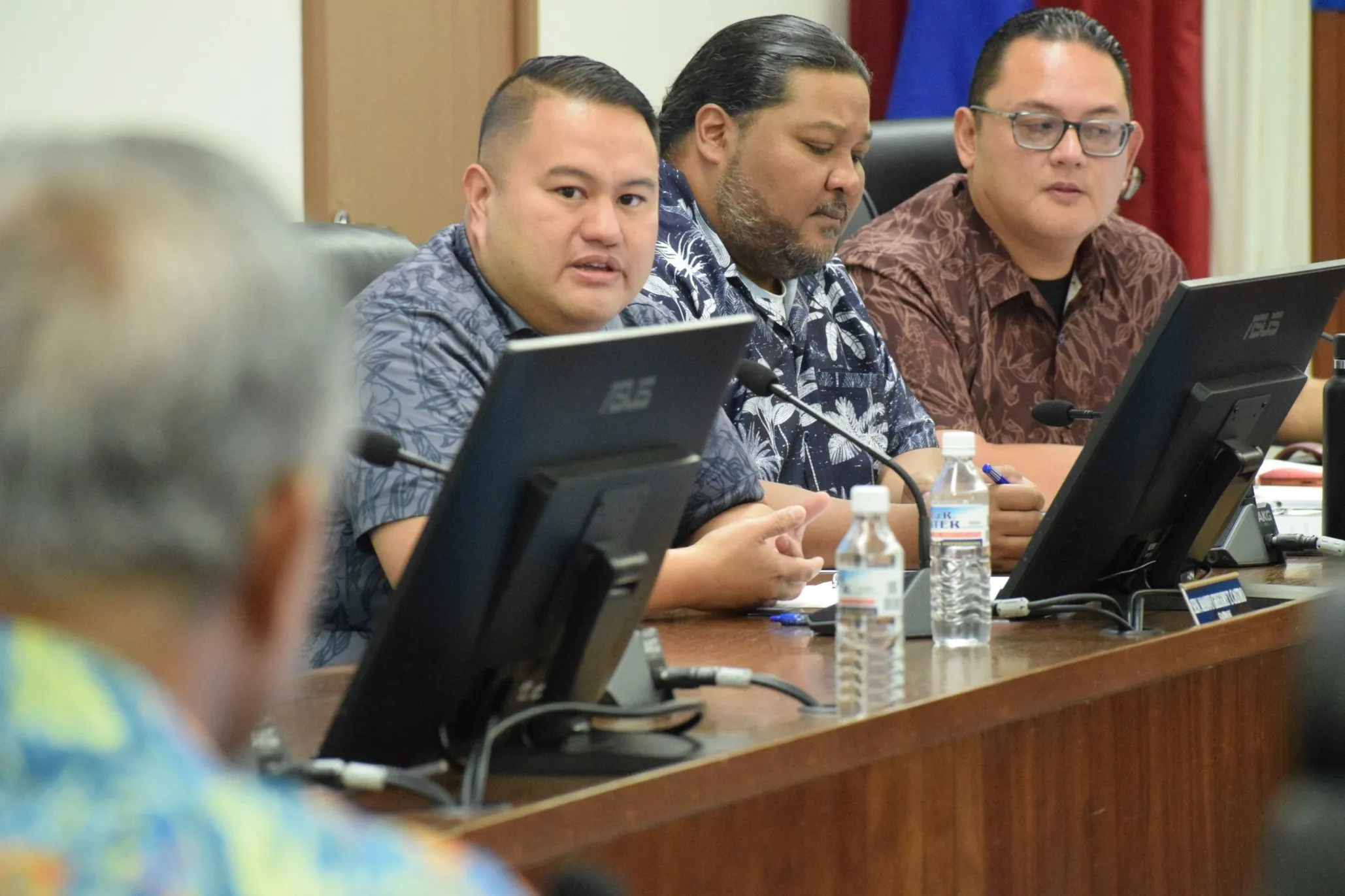


THE Senate unanimously passed on Friday a substitute bill proposing not to pay government workers for three legal holidays this fiscal year 2010, except those working for the Public School System and Northern Marianas College, rather than reducing their work hours by one hour every day.
The substitute version of House Bill 17-45 or the Pay Reduction Act of 2010 proposes not to pay public sector employees on Memorial Day, May 31; Liberation Day, July 4; and Labor Day, Sept. 6.
“In light of the commonwealth’s present financial situation where dwindling resources can no longer adequately address present needs, the Legislature finds that the CNMI government must implement cost reductions and impose revenue generating measures,” the findings of the substitute bill reads. “…personnel cost reductions can be achieved by suspending legal holidays for the remainder of FY 2010…. It is much more reasonable than a 10-hour pay period reduction or austerity Friday or Monday closure of government offices.”
Contractual employees of different government agencies under the executive branch, however, already received notices their work hours would be cut to 70 every payroll within 30 days after they were informed of the move.
A legislative mandate, however, is needed to include civil service employees in any pay cut reduction measure.
The salaries of the governor, the lt. governor, lawmakers, justices and judges, are constitutionally protected from being cut.
The government spends $280,000 for the payroll of its estimated over 4,000 workforce. The amount does not cover autonomous government agencies.
Rep. Ramon Basa, Covenant –Saipan, chairman of the House Ways and Means Committee, told the Variety in an interview on Thursday, he won’t reintroduce his bill if the Senate changes the essence of his legislation which sought to reduce the biweekly payroll of government employees from 80 hours to 70 to cut personnel expenses by 12.5 percent.
He said tax collection figures do not add up to the projected expenses of the government, thus, austerity measures should be put in place.
New taxes
The substitute bill also seeks to increase the license fee for poker machines from $6,000 to $7,500 every year per machine.
Additionally, excise taxes will be imposed on the commercial operation of an automated teller machine in the CNMI.
Excise taxes for cigarettes, which currently stand at $1.75 per pack, will be raised to $3; tobacco and related products will be taxed 70 percent of the invoice tax while beer and malt beverages will be taxed 2.5 cents per fluid ounce.
Distilled alcoholic beverages will be taxed 20 cents per fluid ounce and wine and sake will have 8 cents per fluid ounce in terms of excise tax.
Cellular and mobile phones will also be charged a 10 percent ad valorem tax if the substitute bill becomes law.
The nine-member senators said revenue enhancing measures should be put in place to address the CNMI cash-strapped government’s growing financial problem amid its economic crunch.
“The Legislature proposes several revenue generating measures to increase revenue collections for the CNMI government such as increasing the poker annual license fees, imposing an ATM annual license fee, increasing SIN taxes and license fees associated with alcohol and tobacco, reducing the rebate offset amount which will be used for public health purposes,” the bill further states.
Sen. Jovita M. Taimanao, Ind.-Rota and chairwoman of the Senate Fiscal Affairs Committee, which conducted public hearings on H.B. 17-45 on Saipan, Tinian and Rota before it was put on the floor for a vote, there are several reasons why she’s not supporting the administration’s one-hour daily work reduction proposal.
She said people complained about their economic sufferings during the public hearings and are worried that the 12.5 percent cut on their take home pay will further inflict harm on their families.
This scenario is particularly felt on Tinian and Rota where the prices of basic commodities are higher compared to Saipan.
“On Tinian and Rota, the prices of commodities are extremely high. It is best to focus on unpaid holidays than cut individuals’ work hours every day,” Taimanao told the Variety.
She said many of those who attended the public hearings earn less than $20,000 a year and have children who are already in school.
H.B. 17-45 now heads to the House which has yet to call for a special session.
