

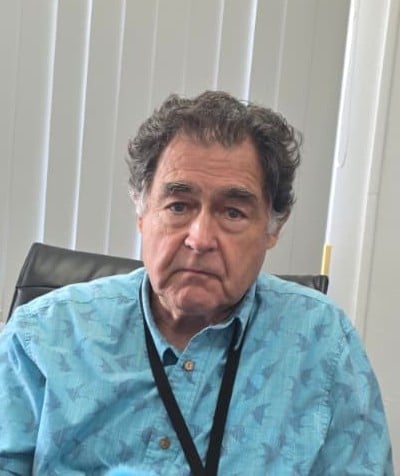


Approximately 90 human resource practitioners and employers convened yesterday at the American Memorial Park Visitor Center auditorium where USCIS Honolulu District Director David G. Gulick guided them in the filling out of applications and addressed possible issues that petitioners have encountered in this regard.
Gulick told attendees of the first of three USCIS workshops this week that they were concerned with only 366 applications have been received so far by the agency with two weeks left before Nov. 27.
This prompted them to come to Saipan and conduct workshops as they were concerned that about 4,000 people may not have petitions on Nov. 28.
In an interview with Variety, some petitioners and their representatives alluded to some confusion with requirements that they need to submit.
An HR practitioner who declined to be identified said, “How come they didn’t tell us point blank in the beginning what documents we need to provide them. It’s only now that we found out that we have spent time working on unnecessary documents.”
She, however, expressed gratitude USCIS for doing the workshops and for clearing things while they still have time to do so.
“We were confused as to what kind of documents we need to submit,” she said.
A gentleman who also spoke on condition of anonymity welcomed the decision of USCIS to provide workshops at this juncture.
He said, “We’re glad that they did the workshop. We were relieved to know today how much we could save in filing petitions especially now that all those workers with similar jobs, work duration, and workplace although with different pay can be bundled in one petition.”
He said prior to yesterday’s workshop, they were planning to file different petitions for workers with different salary rates.
He also said they have already processed six petitions but they are now ready to send majority of the petitions over to USCIS this week.
Glo, who did not give her complete name, but who works for Tang Enterprises, said aside from confusion with the requirements, she said they had a difficult time working on the petitions as it coincided with the BGR tax filing as well.
Asked on how many petitions they need to work on, she said they need to work on four petitions only.
SDA’s Ernie Lacorte, Joyce Corpuz, and Remie — who shyly responded to the interview and declined to give her complete name — attested to the confusion that some had had to deal with. However, they expressed gratitude to USCIS for coming up with a series of workshops this week.
Corpuz said, “Absolutely there was confusion especially with how we interpret what’s we read online and how we’re supposed to do the filing of petitions.”
She, however, expressed relief that they found out yesterday that some forms were not really needed and that would save them time in completing the applications.
“It’s a huge relief for us to have this workshop.”
Remy commented that it’s not that they were waiting for the others to have their parole extended. “Some are just really on a wait-and-see attitude,” she said.
Multiline Supply vice president Lourd Martin Sy said they had to wait until all their job vacancy announcements had been posted. “We’re ready to file petitions for our workers this week.”
He also said they are looking at compiling their petitions in binders so it would not be a burden for those evaluating their petitions. “It would help if our petitions are well organized.”
According to USCIS, as of Nov. 4, a total of 366 CW-1 workers had been petitioned on 198 I-129CW petitions.
For Gulick this concerned them at USCIS.
He also said they have processed between 2,500 to 3,000 parole extensions.
During the workshop yesterday, Gulick told attendees that USCIS neither required petitioners to submit photographs for their employees nor did it ask for them to get the services of attorneys in preparing petitions.
As he was guiding the petitioners on the filling out of forms, Gulick said they would not reject petitions because these were not filled out completely.
He said this may only delay the process but it does not mean rejection.
He said they will issue a request for evidence should they find that the application for I-129CW lacks some documents.
He reminded employers too that they need not wait for extension of parole for beneficiaries whose paroles are expiring on Nov. 27.
He said they can go ahead and file petitions for those employees.
Responding to an inquiry about petitioning of those who entered the CNMI on a B1/B2 visa, Gulick said they are not eligible for CW-1 visa until they leave the CNMI.
As for filling out the job location in the form, Gulick told petitioners to indicate “where they’re actually working—where you assign them.”
For those working in more than one job location, Gulick advised them to state the two locations—physical location.
He said, “If you move them routinely on a schedule, put down the physical locations of both locations.”
He asked petitioners “to a maximum extent possible” to put the physical address like complete name of the street or name of the building where the beneficiaries are technically working.
For house workers, Gulick pointed out there has to be an employer-employee relationship with the employer as someone who has the authority to hire and fire the employee.
He also reminded the petitioners and employer representatives that they currently have a parole policy for caregivers and USCIS grants on a case by case basis whether a caregiver can travel with a patient off island for medical treatment.
For wages, Gulick said the petitioners can put a range of wages for multiple beneficiaries in one petition.
As for the length of time that the petitioner is looking to hire the beneficiary, Gulick said it is up to the petitioners if they wish to indicate in the form that they intend to keep the beneficiary for a longer period of time.
He also reminded petitioners to have one attestation per beneficiary and to have checks cut separately for $325 filing fee, $150 education fee, and $85 biometrics fee.
As for some pertinent documents to accompany their petitions, petitioners must present copies of the biographical page of the passport, umbrella permit, CNMI permit [if it is still valid], valid parole or I-94, license/s, job vacancy announcements, among other documents.
Gulick said USCIS did not ask for photographs, Form G-325, birth certificates, or employment certificates.
But if the petitioners would like to submit previous employment certificates, they can do so, if they want.
“It’s not required that you have a contract,” he added.
He, however, reminded the petitioners to respond to USCIS’ request for evidence.
“Respond to it,” Gulick said.
Failure to respond to the request will result in petition to start all over again. He said there is no appeal.
He also said they prefer that the petitions be not stapled; instead, should be held together by a clip.
As for the fees, he said that employers must pay the fees and not the employees.
And in making the attestation, Gulick said the petitions must do the best job in doing so and encouraged petitioners to write explanations if they have to.
As for petitioning one or more workers who are lawfully present in the CNMI with a federal nonimmigrant status [F1 or H-1B], USCIS said petitioner must submit a Form I-129CW with the $325 application fee, pay the mandatory CNMI education fee of $150 per beneficiary but should not submit a biometrics fee.
For those petitioning one or more workers who are lawfully present in the CNMI with a CNMI permit or have been granted parole by USCIS, petitioner must pay $325 application fee and submit Form I -129CW, pay the mandatory $150 education fee per beneficiary. However, USCIS said either the employer or the employee will pay for the $85 biometrics fee.
For those requesting for consular processing abroad, petitioner must submit Form I-129CW and payment of $325 filing fee and $150 education fee. However, USCIS stated that petitioner should not pay the biometrics fee as it may be required by the Department of State where the worker applies for his or her visa abroad.
If an employer is requesting for an extension of status for CW nonimmigrant worker, he or she must submit Form I -129CW and pay $325 in application fee and the mandatory $150 education fee per beneficiary.
USCIS, Gulick said yesterday, is holding webinars on Thursday, Friday, and Saturday. He, however, told the petitioners that questions may be limited during those webinars.
For more information, go to www.uscis.gov.
