






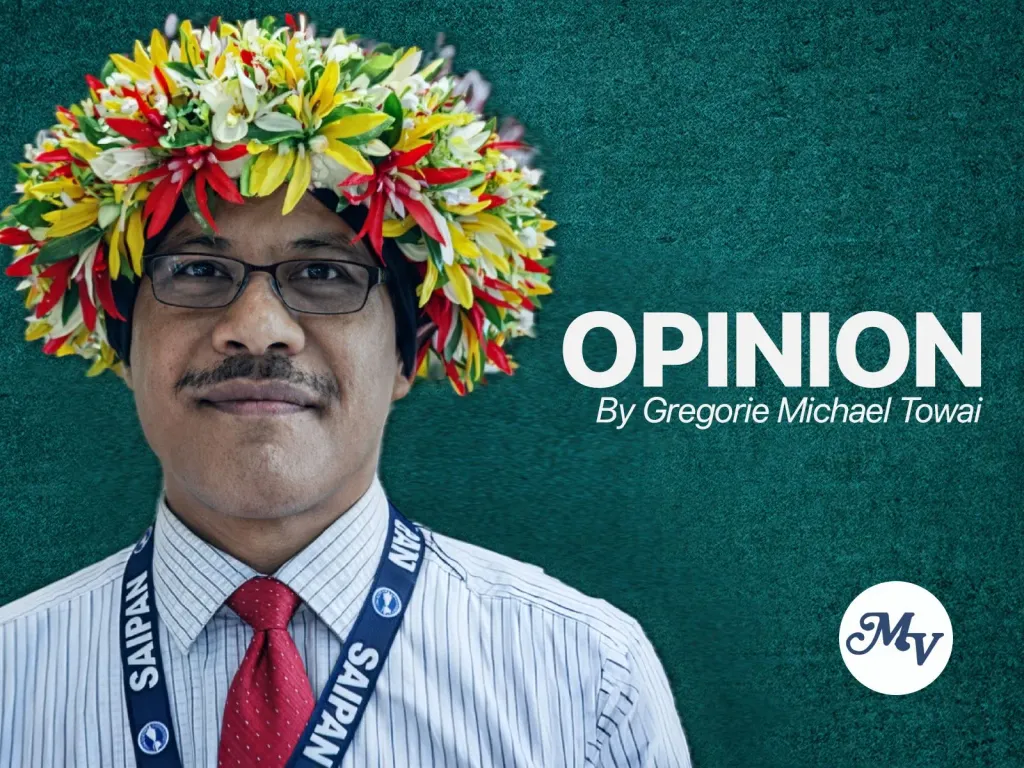
By Gregorie Michael Towai (Eipéráng)
For Variety
LIEUTENANT Governor Dennis Mendiola’s op-ed, “One of the CNMI’s Greatest Challenges: Preparing the Next Generation,” posted on NMI News Service, raises an important issue that deserves serious discussion. Few would disagree that the CNMI faces a growing challenge in retaining young talent, transferring institutional knowledge, and preparing future leaders.
The problem is not that the Lieutenant Governor is wrong.
The problem is that his analysis stops short of confronting why so many young people have lost confidence in the very institutions they are being asked to inherit.
The op-ed frames the issue largely as a generational transition. Older leaders are remaining in positions longer. Generation X is caught in the middle. Millennials and Generation Z are looking elsewhere for opportunities. While there is truth in that observation, it risks treating a symptom as the disease.
The CNMI’s greatest leadership challenge is not age.
It is trust.
For decades, many of our brightest young people have watched governments change, administrations come and go, campaign promises rise and fall, yet many of the same structural problems remain. They have witnessed political patronage, inconsistent accountability, limited economic diversification, aging infrastructure, rising utility costs, and a public sector that too often appears more concerned with maintaining existing systems than transforming them.
The Lieutenant Governor himself acknowledges that “maintaining existing systems often takes priority over long term transformation.”
The obvious question is: Who has been maintaining those systems?
This is where the op-ed becomes noticeably quiet.
The article speaks as though these barriers exist somewhere outside government, as though they emerged naturally and independently. Yet government is one of the primary institutions responsible for creating the conditions that either encourage or discourage young people from staying.
Young people are not leaving the CNMI simply because they desire adventure or because social media has exposed them to opportunities elsewhere.
Many are leaving because they do the math.
They see rising utility costs.
They see limited housing options.
They see constrained career opportunities.
They see public institutions struggling to deliver basic services efficiently.
They see government agencies fighting recurring crises instead of building long term resilience.
And perhaps most importantly, they question whether merit alone is enough to succeed.
This is the conversation that remains largely absent from the Lieutenant Governor’s op-ed.
A true discussion about preparing the next generation must include an honest examination of how opportunities are distributed. It must ask whether advancement is genuinely based on competence, innovation, and performance or whether personal relationships, political affiliations, and family networks still play an outsized role in determining who rises and who remains on the sidelines.
Replacing older leaders with younger leaders accomplishes very little if the system itself remains unchanged.
A younger gatekeeper is still a gatekeeper.
A younger patronage network is still a patronage network.
A younger political machine is still a political machine.
What young people are demanding is not merely representation. They are demanding credibility.
The Lieutenant Governor correctly states that culture survives because people carry it forward.
I agree.
But culture also survives when people believe their future can exist within the place they call home.
A young teacher cannot sustain culture if they cannot afford to stay.
A young entrepreneur cannot strengthen the economy if barriers to entry remain too high.
A young public servant cannot become tomorrow’s leader if innovation is viewed as a threat rather than an asset.
Preparing the next generation therefore requires more than leadership seminars, mentorship programs, or succession plans. Those are important, but they are only part of the equation.
It requires creating institutions worthy of inheriting.
It requires transparency that earns public trust.
It requires accountability that applies equally regardless of position or status.
It requires policies that make staying in the CNMI economically viable.
It requires rewarding competence over connections.
It requires empowering young leaders not only to participate, but to challenge assumptions, improve systems, and occasionally make current leaders uncomfortable.
The irony is that many of the younger people the Lieutenant Governor hopes to inspire are already leading. They are starting businesses. They are creating nonprofits. They are developing digital platforms. They are advocating for government reform. They are engaging in civic discussions. They are finding innovative solutions to old problems.
What they often lack is not talent.
What they often lack is access.
The future of the CNMI will not be secured simply by encouraging young people to prepare for leadership.
It will be secured when today’s leaders demonstrate through action that they are willing to share authority, open doors, reform institutions, and create genuine pathways for advancement.
That is the real test of leadership.
Not whether we can talk about succession planning.
But whether we are willing to build a system that the next generation believes is worth inheriting.
Until then, the Commonwealth’s challenge is not merely preparing the next generation.
It is convincing the next generation to stay.
Gregorie Michael Towai (Eipéráng) is a CNMI born independent researcher, cultural advocate, and founder of the Refaluwasch Journal of Knowledge and Culture. His work focuses on Pacific governance, resilience, Indigenous stewardship, and sustainable futures for island communities.
