



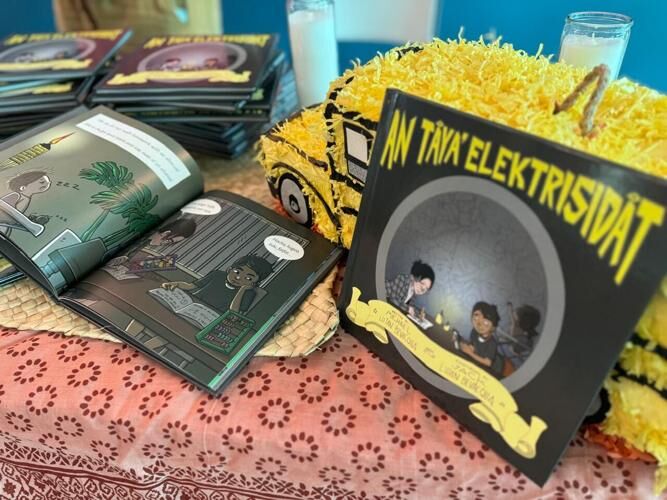

“An Tåya’ Elektrisidat” is a new children’s book written by Michael Bevacqua and illustrated by Jack Bevacqua.
HAGÅTÑA (The Guam Daily Post) — On Saturday at the Guam Museum in Hagåtña, children’s book author Michael Bevacqua released a new book, “An Tåya’ Elektrisidat,” inspired by his children and their first time experiencing life without electricity after Typhoon Mawar last year.
“I currently have four kids, and none of them for most of their lives had ever experienced a really devastating supertyphoon…. There have been storms, you know, times where there was maybe no power for a day or two. But none of them had experienced like when I was growing up, where you have no electricity for months or no water for months,” Michael Bevacqua told The Guam Daily Post.
This is the fourth children’s book that Michael Bevacqua has authored and published with The Guam Bus. It is available for purchase at The Guam Bus website, Faith Bookstore, and Rexall Drugs.
Realities that kids face
Michael Bevacqua and his brother Jack Bevacqua worked on the book together. Jack Bevacqua did the illustrations.
“And so, talking to my brother Jack, who’s the artist for this book, he was really like, we should make a book in which we can talk about the realities that kids face today. Where if a typhoon hits, you’re going to be without these things for a while. But it doesn’t mean that your life stops just because the thing that you think is the center of your life right now, whether it’s your cellphone or whether it’s your video games or whether it’s your YouTube or whatever it is, that life keeps going on,” Michael Bevacqua said.
Launched on Saturday, the book’s CHamoru title, “An Tåya’ Elektrisidat” translates as, “When there’s no electricity.” It’s a bilingual book in CHamoru and English that offers youth an opportunity to discover and make meaningful connections.
His three older children appear early in the book “crying,” according to Michael Bevacqua, who said they didn’t know what to do without electricity to power their devices. Then their grandmother comes in and reminds them that there is more to life.
“Their nånan biha, or their grandma, comes in and reminds them, saying, ‘Hey I grew up there wasn’t much electricity, no internet, no iPads, no iPhones. We still had fun. Open your eyes.’ She says, ‘Did you go blind from those screens? Open your eyes.’ And so, with her advice, they look around, and they think, ‘OK, there’s got to be ways we can have fun,'” Michael Bevacqua said.
The brothers wanted to remind people that after typhoons the community often comes together.
“So, they (the children) go out, and they help people clean their yards. They go out, and they enjoy nature, look at the sunsets. They go out and hunt for duendes. But then we also wanted to be silly, so we say, ‘Oh, you know, let’s make them play in the Chonka Olympics.’ They do their taxes by the candlelight. My favorite is they do a rosary for their devices now that they’re matai, now that they’re dead,” Michael Bevacqua said.
Writing the book was an experience for Michael Bevacqua’s children, who gained an understanding of life without power.
“For my two older kids, it was definitely eye-opening for them to be teenagers after Typhoon Mawar and kind of confront the realities. For my younger kids, it was interesting. For my youngest, who’s going to turn 3, for her to see herself in the book was very, very exciting. So she loves to open up the book and look at herself,” Michael Bevacqua said.
Michael Bevacqua made it a point to write the book with both CHamoru and English translations, noting that when he grew up, there weren’t many CHamoru books.
“When me and my brother Jack were growing up in Guam in the 1980s and 1990s, there was not a lot of CHamoru books out there.… So, as we got older and especially as I had kids, I really wanted there to be media, comic books, things so that for those people that want to learn or for those people that just want to share and say, ‘This is where I come from,’ that it exists, it’s out there,” Michael Bevacqua said.
