

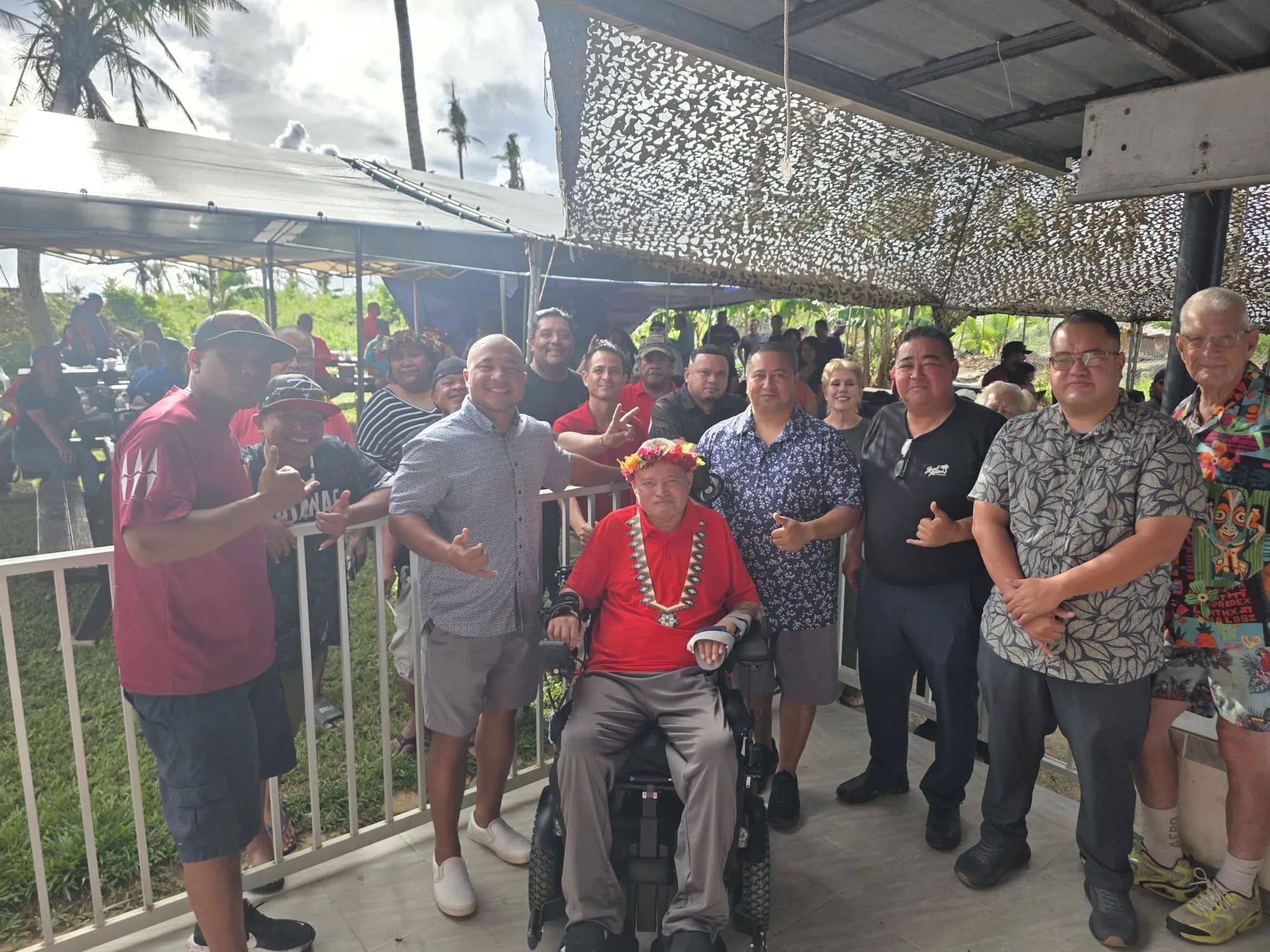


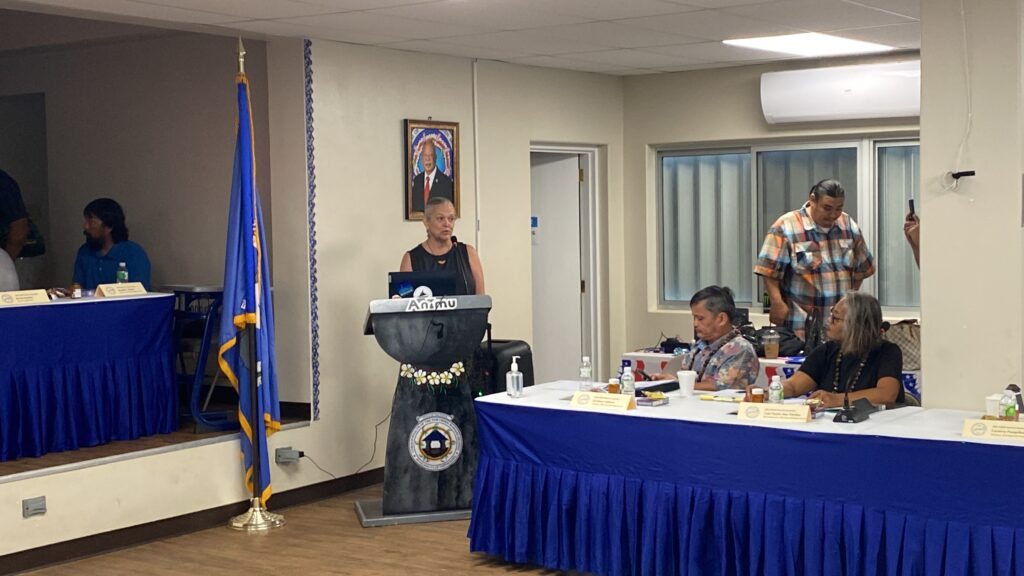
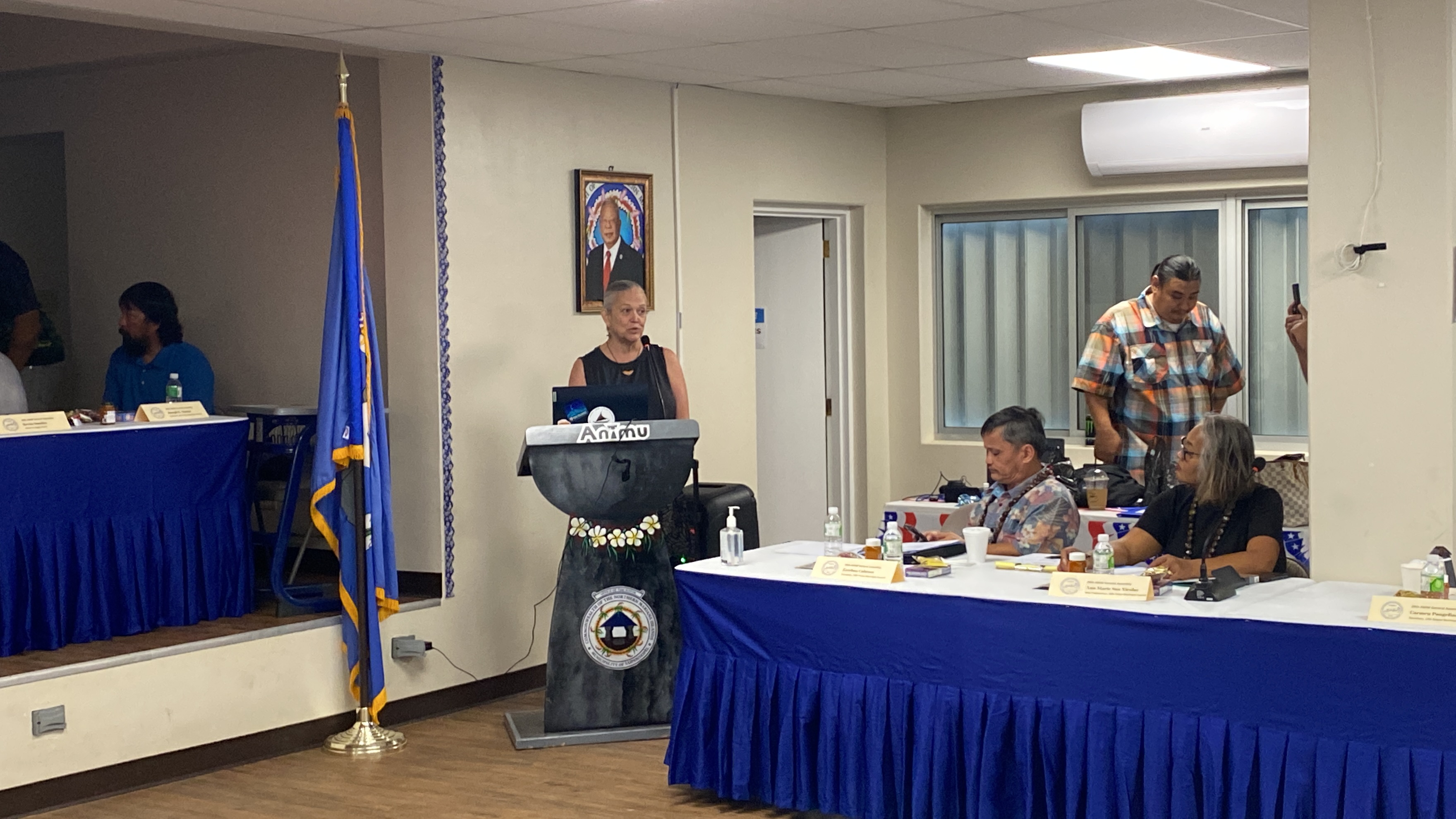
Emma Perez shares 500 Sails’ vision for a sustainable maritime economy with the Association of Mariana Islands Mayors, Vice Mayors and Elected Municipal Council Members during a meeting at the Koblerville Youth Center on Friday, April 19.
500 Sails cofounder Emma Perez was at the Koblerville Youth Center on Friday, April 19, to discuss the role that Chamorro canoes could play in an ecologically sustainable economy.
Perez was one of the guest speakers of the Association of Mariana Islands Mayors, Vice Mayors and Elected Municipal Council Members or AMIM that met on Saipan.
Perez was invited to the AMIM meeting by Dededo, Guam Mayor Mellisa Savares after hearing Perez’s keynote speech at the University of Guam-Center for Island Sustainability Conference.
At the AMIM meeting, Perez said 500 Sails’ Cultural Maritime Training Center develops resources that support maritime work in the CNMI.
She said at the CMTC, 500 Sails is able to do small vessel fiberglass fabrication, as well as conduct traditional canoe sailing courses, and American Red Cross-certified water safety instructor and lifeguard classes.
500 Sails has also hosted certifying courses for residents to earn operator of uninspected passenger vessel licenses, which allow sea captains to operate commercial boat rides for up to six passengers.
Perez said the non-profit organization is currently piloting a beach canoe program with Crowne Plaza Resort in which 500 Sails provides canoe rides to tourists.
Perez said 500 Sails hopes to expand the program beyond Garapan.
“We want to do 20 canoes across five hotels and 70 well-paid jobs,” she told the municipal officials. “The CNMI and [Guam] could be a unique place where these cultural canoes are on the water all the time…. [Tourists] would come to the Marianas to sail on these beautiful canoes. They could become the basis for a sustainable and inspiring maritime community,” she said.
Perez said the CMTC aims to eventually export canoes to sailors throughout Micronesia.
She also shared that the organization is considering how to create “inter-island, wind-powered transport for both cargo and passengers.”
Savares said canoes could help the Marianas be sustainable.
“We’re really relying on the containers that come in through shipment so that we can eat,” she said. “We have crops, we have the ocean that surrounds us. There’s more ocean than land. How can we be sustainable? This is just one of those ways, of traveling to each other and trading and bartering like we used to do over 4,000 years ago.”
Aside from the opportunity to build an ecologically sustainable economy, Perez said the re-inclusion of canoes into the daily lives of the Marianas could be “impactful.”
“What if we had never lost our canoes, what would it look like here [in the Marianas]?” she asked. “We would be an economically and environmentally sustainable maritime community. We were that for over 4,000 years. We would appreciate and understand the natural world. We would have more fishers, more marine biologists and more oceanographers. Better health from a more active life and local food availability. Let’s get the Tinian beef all over the Marianas. Let’s get the Rota produce up there. There’s so much that we could do. And we would be sailing between our islands regularly in a horizon full of sails, and the youth would know that their ancestors were scientists and extraordinary voyagers.”
