







HAGÅTÑA (The Guam Daily Post) — Three bills relative to the Guam Department of Education were the focus of a public hearing on Thursday, all seeking to improve the public education system.
Bill 91-37, introduced by Sen. Joe San Augustin and co-sponsored by Sen. Chris Barnett, would allow the hiring of retired personnel to help GDOE maintain its facilities using American Rescue Plan funds.
If enacted, retirees won’t lose their pensions if rehired with GDOE as limited-term employees. GDOE Facilities and Maintenance has 66 full-time positions, but 24 are vacant.
“From 2018 to 2020, Facilities and Maintenance averaged 70 full-time positions with an average of 14 … vacancies. In the last two years, (the) staffing pattern decreased to an average of 67 positions with average vacancies increasing to 28,” said GDOE Superintendent Kenneth Swanson. “The need to fill and retain maintenance positions is apparent in these figures and even more pressing when compounded with the new regulatory requirements and facilities concerns that face our island’s public schools.”
The department continues to make concerted efforts to recruit and fill vacancies through participating in job fairs and announcing job opportunities, he said.
“We are seeking to hire welders, carpenters, plumbers, electricians, equipment operators, refrigeration and automotive mechanics, building maintenance and plumbing supervisors,” Swanson reported.
The superintendent said being able to hire retired personnel provides an advantage.
“If we do hire individuals with an appropriate skill set and institutional familiarity regarding GDOE’s facilities, it allows immediate action to address long-standing facility issues within our public schools,” Swanson said.
According to Swanson, there are 32 eligible Facilities and Maintenance retirees. He also encouraged lawmakers to consider allowing Facilities and Maintenance personnel retired from other GovGuam agencies to be eligible for temporary hire under the bill.
He asked that the temporary hires be allowed six days of sick leave and annual leave, which isn’t normally afforded to limited-term hires.
“I don’t see this as a long-term solution, but in the near term we need the extra manpower. As you all know, some of the work we have ahead of us is going to take several months to accomplish. At the same time, we need to continue our recruiting and training efforts for younger employees as well,” Swanson said.
Service learning
Senators also heard testimony on Bill 105-37, which would allow students to engage in school and village beautification efforts as part of their student service learning hours, which is a requirement for graduation.
Joseph Sanchez, GDOE deputy superintendent of Curriculum and Instruction, said the agency supported the bill, with some minor tweaks, such as allowing 20 of the required 75 hours to be used for beautification efforts.
He also noted the need to change some of the language to allow the service learning hours to be applicable to the graduating class of 2027.
“Lastly, we have the request to change the program to community service because one of the challenges we’ve had over the last several years is service learning has a very particular set of requirements in the education field. It’s directly related to a curriculum, it has to have standards, it has to have a lot of guidelines attached to it,” Sanchez said.
Management audit
Bill 113-37 would restore the GDOE management audit mandate.
“The last and only GDOE management audit was done by Evergreen Solutions in 2009. The focus of the recommendation was the elimination of expensive practices, the closing of F.Q. Sanchez (Elementary) School, which had less than 200 students at the time and other cost-cutting measures. The measures, if implemented, would have saved taxpayers tens of millions of dollars,” Barnett said.
Swanson testified on the the bill as a professional who has been engaged in school system accreditation and evaluation for the last five years, not as superintendent. He agreed with the intent of the proposed legislation, but shared concern over the mechanics of the implementation, such as the term “audit.”
“It means different things to different people. … I look at the language in the bill and it’s not really a problem until we get into section P,” he said.
Section P covers different domains that are to be audited.
“I have real concerns with some of those areas, and this is me as a professional,” he said.
Swanson shared, as an example, several areas in which potential abuse or misinterpretation could arise.
“It leaves a broad area of interpretation in such terms as administrators. It represents a broad class of employees with a variety of responsibilities that may or may not engage in any number of several hundred board policies, depending on the responsibility. … I mean, we have several thousand policies,” Swanson said. “So that becomes a question.”
He also questioned who would perform the audit.
“What’s their background? What’s their professional knowledge and understanding?”
Barnett said he would take the concerns raised by the new superintendent back to the education committee.
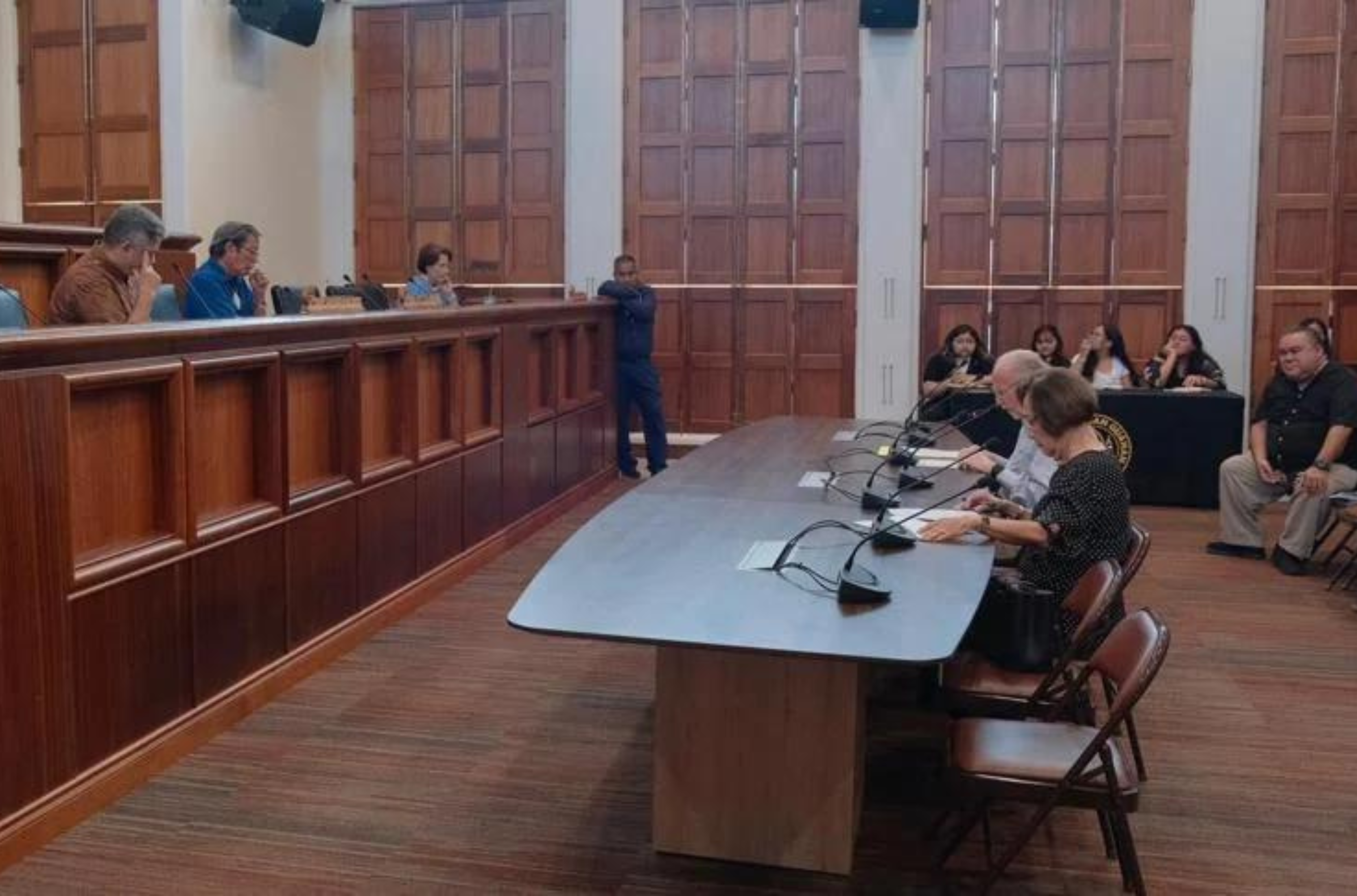
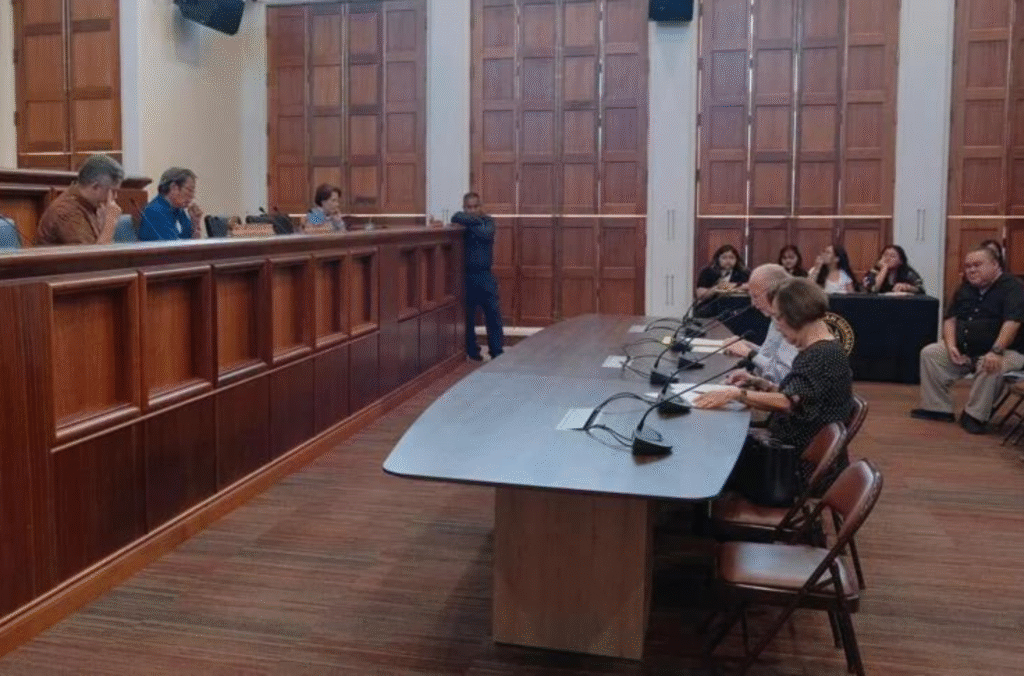
A public hearing is held Thursday, July 20, 2023, at the Guam Congress Building in Hagåtña to discuss Bill 91-37.
