



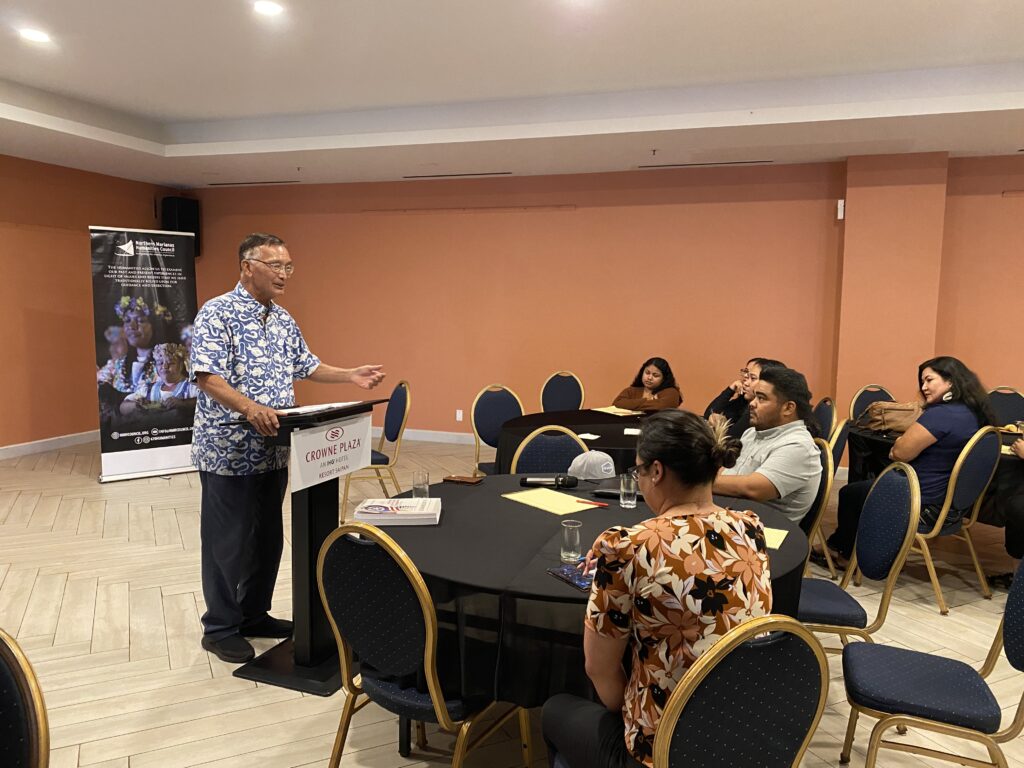
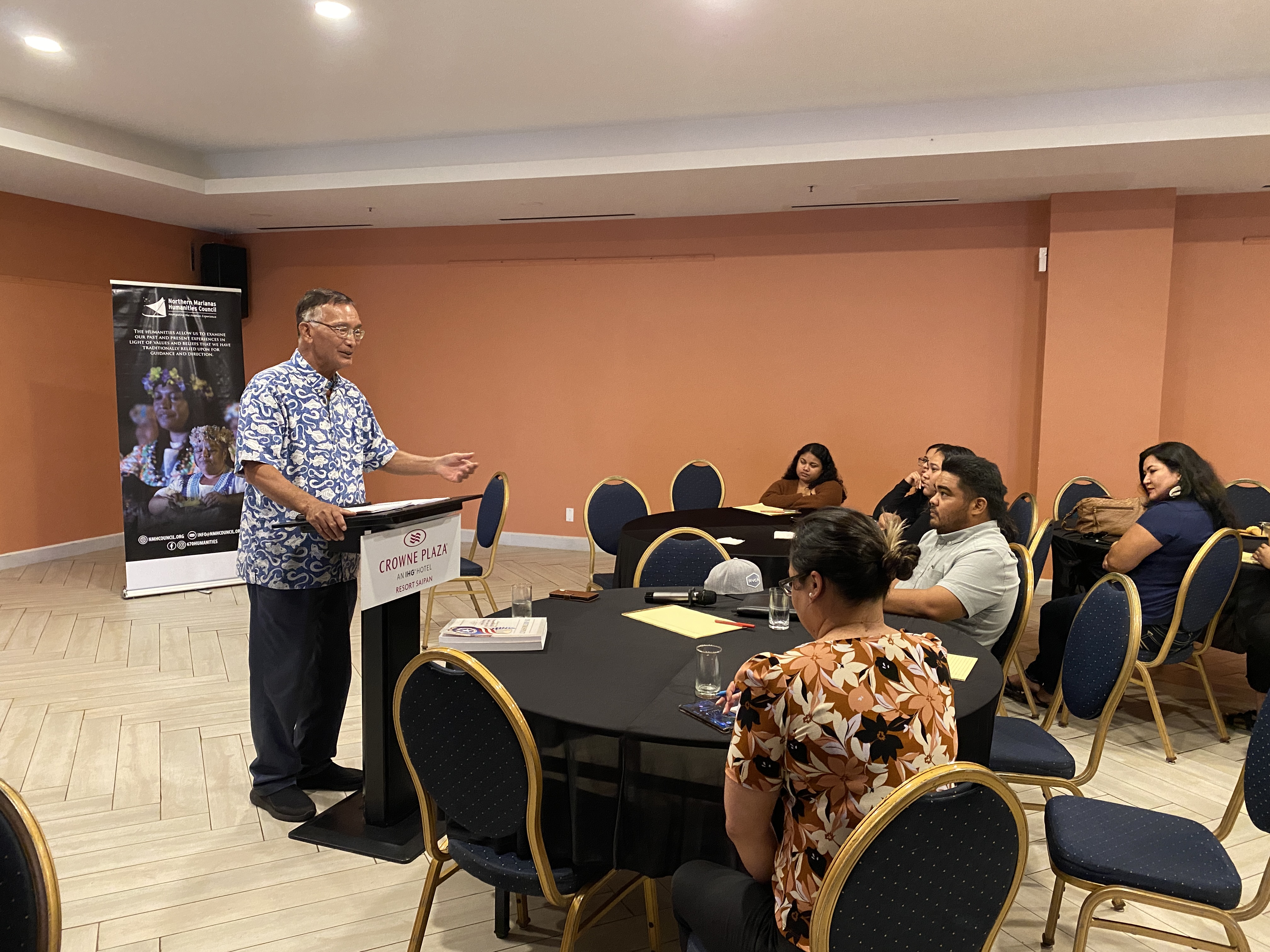
Former Gov. Juan N. Babauta speaks to participants of a civics workshop at the Crowne Plaza Resort on Wednesday.
AT a civics workshop organized by the Northern Marianas Humanities Council on Wednesday, Nov. 15, former Governor Juan N. Babauta answered questions regarding using Section 902 of the Covenant as a mechanism for the CNMI to address issues with the federal government.
Babauta, who is also a former resident representative to Washington D.C., said Section 902 talks would be a “consultation” and not a “negotiation.”
“It is not a 902 negotiation,” he added. “We are no longer negotiating anything, we are consulting.”
Participating in the civic workshop were Northern Marianas College students and other community members.
Earlier in the day, the Humanities Council organized a workshop on navigating local laws and becoming civically involved in the lawmaking process.
Babauta spoke about how the relationship between the CNMI and the United States works under the Covenant.
Babauta then took questions from the workshop participants.
He said the Section 902 talks allow the federal and CNMI government to come together, but it is the Commonwealth that initiates the talks.
Babauta said the CNMI governor appoints a representative for these talks who would then meet with a representative appointed by the U.S. president.
He said the CNMI may also request to meet with federal department representatives as well.
“The nice thing about [Section 902] is that on the federal side we can ask them to bring in people from the U.S. Department of Commerce, or the Treasury,” Babauta said. “We can sit down, and [see] if we can solve an issue at the table by consultation. Many times, we find ourselves needing to have certain laws amended.”
He said among all U.S. territories, the Section 902 talks are unique to the CNMI.
“Nobody else has it except for us,” Babauta said.
He added that while there are “no negotiations” that take place, the Section 902 talks can be “a space to address issues” involving the Covenant.
“Some issues are very pressing,” Babauta said. “[The issues] may not be in direct violation of the Covenant but it might be violating the spirit of the Covenant and the spirit of this [political] relationship.”
The Covenant established the CNMI “in political union with the United States of America.”
The Covenant was approved by NMI voters in a 1975 plebiscite, and by the U.S. Congress. It was then signed into law by President Gerald Ford in 1976.
