







CHARLOTTE, N.C (TNS) — Lawmakers return to Washington this week with billions of dollars in funding for Israel, Ukraine and border security up in the air — and widespread skepticism on whether Congress will answer President Joe Biden’s pleas to take action on the daunting range of global crises.
The commander–in-chief has asked Congress to approve nearly $106 billion in emergency funding — $61.4 billion for Ukraine’s struggle with Russia, $14.3 billion for Israel’s war with Hamas and $13.6 billion to boost security at the U.S. border with Mexico, among other initiatives.
But with Republicans voicing skepticism on Ukraine and progressive Democrats calling for restrictions on funding for Israel, members of Congress sounded a bleak note through Thanksgiving weekend.
“I think it’d be very difficult to get it done by the end of the year,” Rep. Michael Turner (R-Ohio) said Sunday on NBC’s “Meet the Press.”
He went on to criticize the White House approach to including border security in its massive spending proposal.
“It’s going to need policy changes,” Turner said. “Congress is going to require that there be laws changed to make certain that the border returns to its prior state.”
House Speaker Mike Johnson (R-La.) and Senate Minority Leader Mitch McConnell (R-Ky.) have said they won’t support funding for Ukraine unless the U.S. cracks down on immigration.
But immigration reform has long eluded Congress, and recent months have seen more GOP lawmakers voicing opposition to funding for Ukraine, with a majority of Republican voters saying the military aid should stop.
On Israel, the Republican-controlled House passed an aid package this month. But tying the funding to cuts to the Internal Revenue Service made the legislation a nonstarter in the Democrat-run Senate.
As the House is forced to go back to the drawing board on Israel, some progressives are demanding curbs on future spending, arguing that the U.S. shouldn’t fund potential human rights abuses.
Sen. Chris Murphy (D-Conn.), who’s involved in the budget negotiations, voiced openness to such restrictions on Sunday as Hamas released 17 hostages, including a 4-year-old American girl.
“We regularly condition our aid to allies based upon compliance with U.S. law and international law,” he told CNN’s “State of the Union.”
“And so I think it’s very consistent with the ways in which we have dispensed aid, especially during wartime, to allies, for us to talk about making sure that the aid we give Ukraine or the aid we give Israel … is used in accordance with human rights laws.”
Biden recently called the restrictions a “worthwhile thought.” But national security adviser Jake Sullivan was noncommittal Sunday on conditions for aid to Israel.
The president “acknowledged the idea,” Sullivan told CBS’ “Face the Nation.” “And then he said … he thought the approach that he is taking is the approach that has generated the results that we have seen so far.”
Sen. Bernie Sanders (I-Vt.) recently called for conditions on aid to Israel including “an end to indiscriminate bombing,” “massive humanitarian assistance” and “a commitment to broad peace talks for a two-state solution in the wake of the war.”
“Nobody has been a stronger advocate for a two-state solution than President Joe Biden,” Sullivan said Sunday.
Prior to Hamas’ Oct. 7 attack on Israel, which prompted a fierce military response, the situation between Israel and Palestinians was widely seen as being on the back burner in Washington.
But the outbreak of war in the region and Russia’s invasion of Ukraine represent a major test of U.S. leadership on the global stage.
With a presidential election coming up next year, the stakes are high on the home front, too.
Recent weeks have seen a significant drop in voter support for Biden as he seeks to continue helping Israel and Ukraine. Along with a slumping overall approval rating, he’s facing decreasing support from young voters, according to Politico.
In brief remarks Sunday, Biden shied away from politics as he confirmed Hamas’ release of 4-year-old hostage Abigail Edan, a dual U.S.-Israeli citizen.
“Thank God she’s home,” he told reporters in Nantucket, Mass., as he readied to return to Washington. “I wish I were there to hold her.”
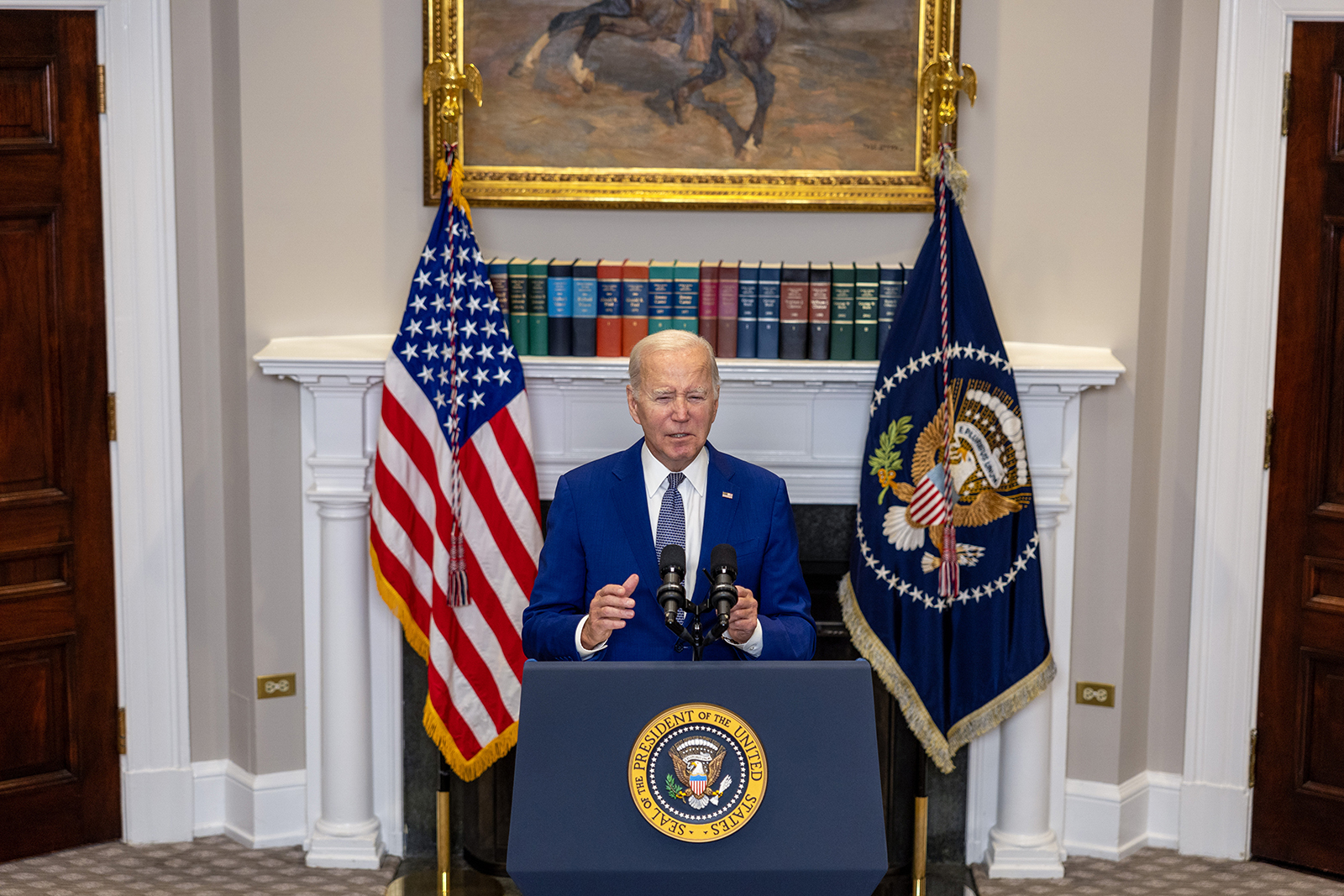
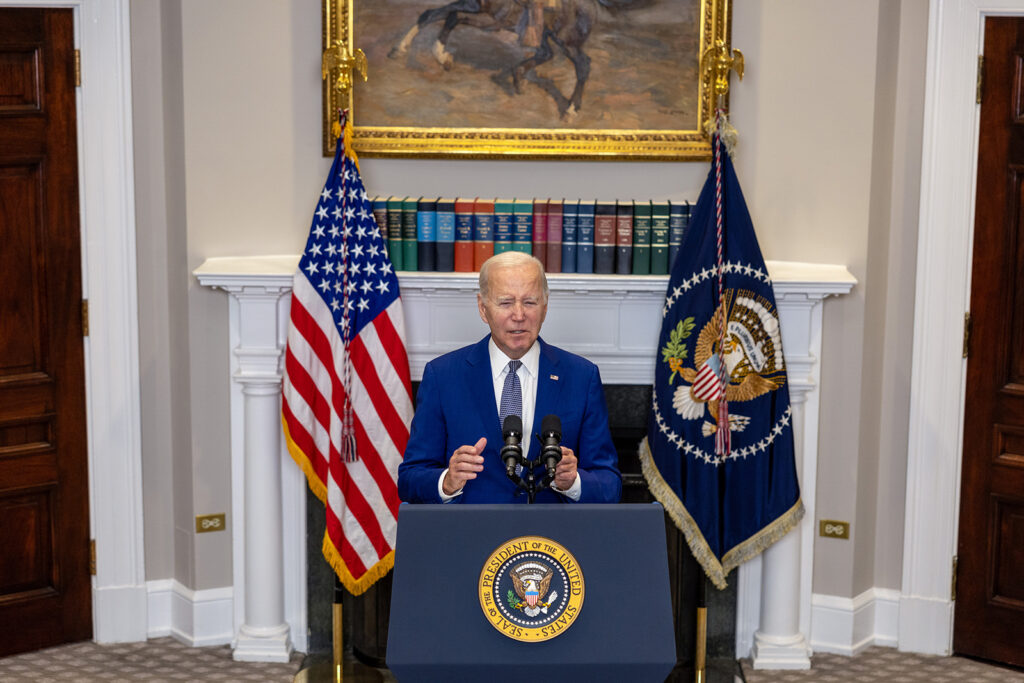
U.S. President Joe Biden delivers remarks in the Roosevelt Room of the White House on Oct. 1, 2023, in Washington, DC. (Tasos Katopodis/Getty Images/TNS)
