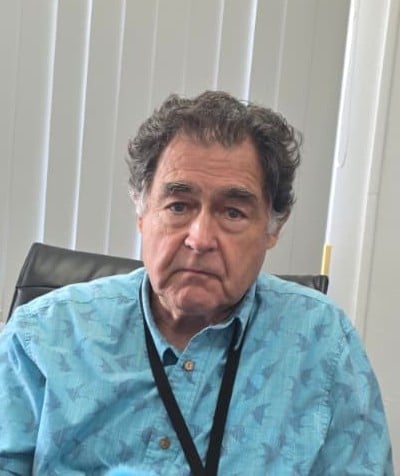





GOVERNOR Ralph DLG Torres, through his attorneys Viola Alepuyo and Matthew Holley, has officially filed a motion for the Office of the Attorney General to withdraw or be disqualified as prosecutor.
Close to 400 pages of exhibits accompanied the motion to disqualify the AG’s office which has filed a criminal case against the governor alleging 12 counts of misconduct in public office and one count of theft relating to the issuance of airline tickets for business class, first class, or other premium class travel for himself and/or first lady Diann T. Torres.
The case also alleges one count of contempt for failure to appear in compliance with a House committee subpoena.
Torres has pled not guilty to the charges of misconduct in public office, theft, and contempt filed by the AG’s office.
According to the governor’s motion, pursuant to the CNMI Constitution, the Office of the AG, through Attorney General Edward Manibusan, is also the legal adviser of the governor.
Government travel policy background
On Sept. 26, 2007, Public Law 15-86 was enacted codifying airfare restrictions, and imposing a civil penalty on a government employee who “caused the issuance” of a premium air class ticket.
When P.L. 15-86 was enacted, the Department of Finance did not have a uniform travel regulation in place as per the audit of the CNMI Office of the Public Auditor.
In 2017, the executive branch created the Travel Regulations Steering Committee to address travel regulations.
According to the governor’s motion, the committee was organized to implement a policy allowing premium travel for the governor and lt. governor, and to allow all others the option to upgrade at the government employee’s own expense.
On June 6, 2017, Epiphanio Cabrera Jr., administrator for the Office of Grants Management and State Clearing House, issued a memorandum to all government agencies through Governor Torres and on behalf of the Travel Committee “seeking input, suggestions, recommendations, or improvement metrics from all agencies to better improve and update our current travel regulations.”
The Office of the AG provided legal advice and approved the policy and regulations drafted by the travel committee, the governor’s motion stated.
The draft travel regulations that were promulgated by the committee and approved by the OAG included specific language that the governor and lt. governor were allowed to travel first class, the governor’s motion added.
The draft travel regulations also expressly stated that “all individuals traveling abroad for recruitment purposes, conferences, seminars, etc. shall resort to the economy rate with the exception of the governor and lt. governor.”
At no point during OAG’s legal advice and consultation with the travel committee did it ever recommend the removal of the provision allowing the governor and lt. governor to travel first class, the governor’s motion stated.
It added that the travel committee’s travel regulations, with the OAG’s approval, were implemented by the Department of Finance.
OPA
The Office of the Public Auditor, for its part, investigated the Commonwealth’s travel policy and found numerous violations of 1 CMC § 7407(f) or the “Restrictions on Government Paid Travel Outside of the Commonwealth.”
By auditing several Commonwealth agencies, OPA found that there was no uniform policy regarding premium class travel, and found that several government officials were using premium class travel in their official capacities.
On or about Dec. 2, 2019, Finance informed OPA that first class or business class airfare had been authorized and purchased by Finance, and that its draft regulations would allow first class travel for the governor and the lt. governor.
According to the governor’s motion, both the speaker of the House of Representatives at the time, and the Department of Finance formally agreed with OPA’s findings of a lack of uniform travel policy, including the government’s policy on premium class travel.
The lack of a uniform premium class air travel policy and guidance on interpretation and meaning of 1 CMC § 7407(f) rests with the Office of the AG, the governor’s motion stated.
It added that the OAG provided legal advice and supervision on the development of premium class air travel.
AG’s first class travel
On or about February 16, 2016, Attorney General Edward Manibusan traveled in premium class, the governor’s motion stated.
“AG Manibusan, the Commonwealth’s Chief Legal Officer, demonstrated that he too must follow Department of Finance’s travel regulations by obtaining approval for his government-sponsored travel.
“Naturally, anyone authorized to sign off on AG Manibusan’s Travel Authorization would not question the legality of his premium class travel, given his position as the Chief Legal Officer.”
The exhibit noted that Governor Torres signed the AG’s TA.
“Based on the legal advice provided by the OAG on the travel regulations, and on AG Manibusan leading by example and flying premium class, the way was paved for numerous government officials and across several government agencies, to obtain premium class in their official capacities, including former Tinian Mayor and former Attorney General JP San Nicolas.
“The OPA eventually became aware of the Government’s non-uniform travel policy and the widespread use of premium class travel among government officials such as board members of the Marianas Public Land Trust.”
According to the governor’s motion, the OAG’s prosecution of Governor Torres based on alleged violations of travel policy is directly contrary to the advice and guidance it gave in assisting the executive branch in developing regulations for travel policy.
This circumstance presents a situation which requires automatic withdrawal or disqualification, the governor’s motion stated.
“The OAG has a non-waivable conflict of interest in prosecuting Governor Torres.”
According to the governor’s motion, “not only has the OAG failed in its constitutional duty to defend the Executive Branch, the Travel Committee policy, and in particular Governor Torres, but at the same time, it is criminally prosecuting Governor Torres for an alleged violation in which the OAG provided legal advice. An alleged violation that AG Manibusan, along with other government officials of other agencies, have also allegedly committed.”
The Finance Department’s justification for approving premium class travel falls squarely on the shoulders of the OAG, the governor’s motion stated.
“The Attorney General should have faithfully represented the Governor in this matter and if that was impossible, he should have stepped aside.”
Citing a previous court ruling, the governor’s motion stated that the issue “then becomes whether the Attorney General may represent clients one day, give them legal advice with regard to pending litigation, withdraw, and then sue the same clients the next day on a purported cause of action arising out of the identical controversy.”
“If the OAG believes the Governor is acting contrary to the law, it may withdraw as counsel, but it may not take a position adverse to him,” the governor’s motion stated.
“In this case, the OAG has decided to represent one of its clients, the Commonwealth, to criminally prosecute another one of its clients, Governor Torres. The OAG’s prosecution of this case may potentially result in the conviction and incarceration of one of its clients, and may also serve as a basis for that same client to be impeached as Governor and precluded from running in the 2022 election.
“Furthermore, even though the OAG is criminally prosecuting Governor Torres, it is also still serving as [his] legal counsel and has the constitutional obligation to provide legal advice to Governor Torres in connection with his duties as Governor.
“The OAG’s prosecution of this case ‘materially limits’ its responsibility to provide legal advice to Governor Torres,” the governor’s motion stated
“This matter is not an exception to this fundamental fracture of the attorney-client relationship.
“A prime example of the fractured attorney-client relationship is seen by exhibits accompanying this memorandum, which consist of documents associated with the current and former Attorneys General traveling to Washington, D.C., as Commonwealth government officials. The documentation shows that the current Attorney General traveled business class round-trip between Guam to Honolulu; Honolulu to Houston; and Houston and Washington, D.C., along with the return to Saipan. The OAG did not inform the Governor that Commonwealth law precluded the issuance of a premium class ticket for government travel. Of course, Governor Torres never thought or considered that his lawyer would have him approve or participate in conduct which is an unlawful act or that his attorney would not inform him of the adverse legal consequences associated with the issuance of a premium class airline ticket for government travel. It is now obvious that such a belief and Governor Torres’ faith in the OAG was misplaced and misguided given the criminal charges the OAG has brought against Governor Torres.
“Moreover, in retrospect, it is somewhat disconcerting that apparently the OAG has never provided its client, Governor Torres, or any other executive branch client, with a written opinion concerning 1 CMC § 7407(f).
“It is quite noticeable that the OAG has not brought criminal charges against the Attorney General or any other Commonwealth Government officials for having ‘caused’ the issuance of a premium class air travel ticket.
“The attorney-client fracture is further evident by the fact that the OAG’s Civil Division is the division prosecuting Governor Torres in this criminal case.
“The OAG is divided into various divisions. The OAG’s Solicitor Division is delegated the task to ‘improve the management of our appellate practice, streamline the review and commenting of pending legislation, and the delivery of legal services to government agencies.’
“The Criminal Division ‘is in charge of prosecuting criminal offenses pursuant to Article III, Section II of the Commonwealth Constitution.
“It is therefore concerning that the criminal prosecution against Governor Torres was instituted by, and is being pursued by, the OAG Solicitor Division, which is the division responsible for providing legal advice to Governor Torres and the Government.
“This conflict is highlighted by the history associated with the Executive Branch’s effort to promulgate regulations in conformity with 1 CMC § 7407(f).
“It should be further noted that the OAG could not and cannot rationally believe it can render diligent and competent legal advice to Governor Torres when it appears that this criminal case was instituted in an effort to ‘shore up’ the constitutionally defective Articles of Impeachment filed against Governor Torres.
“It is public knowledge that the OAG commenced this prosecution eleven days after Governor Torres filed a dismissal motion in the pending Senate trial which indisputably establishes that the Articles of Impeachment are constitutionally defective and subject to dismissal for a myriad of reasons.
“The most basic defect of the Articles of Impeachment is that a judicial felony conviction was necessary to grant the primary sanction of barring Governor Torres as a candidate in the 2022 election.”
According to a CNMI Supreme Court ruling, the governor’s motion stated, the OAG’s power to prosecute is not absolute.
The high court ruling specially noted that “to minimize the pernicious effect that might arise” from the OAG prosecuting the Governor, Article III, § 12 of the CNMI Constitution established a system of checks and balances, which included the creation of the Office of the Public Auditor to serve as a sentinel against government malfeasance.”
This law establishes that the OPA has the legal authorization and power to prosecute or retain special counsel to prosecute the governor, his motion stated.
The OAG, for its part, has a constitutional duty to protect and advance Governor Torres’ qualified immunity defense on the underlying offense, a civil travel statute, and subpoena contempt, the governor’s motion stated.
“Qualified immunity applies to the Governor, and state actors, where they rely on the advice of the Attorney General.
“Here, the OAG reviewed and approved regulations that authorized the Governor and Lt. Governor to fly first class, said the attorneys. (‘The Governor and Lieutenant Governor are allowed First Class travel; all others economy. Upgrades shall be borne at the traveler’s personal expense.’)
“This Chapter 70 Travel Regulation dated January 23, 2018 was reviewed by the OAG.”
The governor’s motion reiterated that “it is important to note that the Attorney General is obligated to represent the Governor’s qualified immunity interest, as his attorney.”
“The representation and conduct of the OAG could very well be the central issue in this case, even on facts relating to a defense on public authority,” the governor’s motion added.
The OAG cannot both protect and advance the Governor’s interest relating to his immunity claim and at the same time prosecute him on the very same facts and issue, the governor’s motion stated.
“AG Manibusan himself is a potential fact witness to determine if Governor Torres acted ‘reasonable’ and is constitutionally bound to protect and advance Governor Torres’ immunity interest; of that, there can be no dispute.”
As for the subpoena issue, the governor’s motion stated that the OAG declined to represent the governor, the executive branch or the Office of the Governor relating to the House JGO proceedings.
In that case, Torres, a Republican, was found by the Democrat-independent-led committee in contempt of a legislative subpoena for refusing to appear before the panel which was investigating his public expenditures. The governor has asked the Superior Court to find the subpoena invalid and unlawful.
“The Constitution provided no alternative for the OAG to decline representation even if it concludes that it may have a potential conflict of interest in the future.
“The OAG has failed to defend the Governor in his official capacity…and instead turned around and prosecuted him criminally while the Civil Action is pending.
“This is worth repeating: the OAG knows very well that the criminal charge on the subpoena disrupts the pending Civil Action.
“The criminal charge against Torres sends a chilling effect and directly undermines the Governor’s legal theories.
“The NMI Constitution does not grant the OAG the luxury to decline representation of the Governor only to turn around and prosecute him on matters it was initially required to protect and advance.”
The OAG, represented by Chief Solicitor J. Robert Glass Jr., recently asked the court to look into a possible conflict of interest in the representation of Governor Torres by attorneys Viola Alepuyo and Anthony Aguon because they previously represented two government witnesses in the House JGO hearings.
For the governor’s motion to disqualify the AG’s office, the court has scheduled a hearing for May 31 at 9 a.m.