






HAGÅTÑA (The Guam Daily Post) —The federal funding of millions of dollars Guam has received over the past 20 years as reimbursement for hosting migrants from nations with Compacts of Free Association with the U.S. is set to expire in September.
Del. Jim Moylan is working to get the money extended through at least next year. After that, a longer-term solution will have to be drawn up, he said.
Much of the money, which has fluctuated between $14 million and $17 million annually, has been used for lease payments on several public schools.
Compacts with the Federated States of Micronesia, Palau and the Marshall Islands were set to expire this year, along with the law authorizing compact impact payments to host jurisdictions such as Guam, the Commonwealth of the Northern Mariana Islands, American Samoa and Hawaii.
The FSM and Palau have renewed the agreements and the Marshall Islands is expected to follow, but the Biden administration didn’t include money for Guam or other host communities in its fiscal 2024 budget.
The White House is looking to push more money and influence toward freely associated states, but isn’t looking to support affected areas such as Guam, Moylan said.
“Instead of it coming to us, it goes for the purpose of providing other services to these (compact) nations that are also going to get $6.5 billion over the next 20 years,” he said. “But the Biden administration refused to give … money to the host areas.”
Safety net instead
According to Bobby Shringi, Moylan’s chief of staff, the Biden administration wants to move away from direct aid to impacted areas and toward a “safety net” approach for migrants in U.S. territories, giving them access to more federal benefits and assistance.
The recent inclusion of Compact of Free Association citizens on Medicaid rosters is an example. GovGuam and Guam Memorial Hospital historically have had to grapple with how to cover medical service costs for Compact of Free Association citizens who don’t have insurance but didn’t qualify for federal coverage.
But gaps in assistance will remain and local governments will have to pick up the tab in areas where the feds won’t help.
Typhoon Mawar provided a good example.
Citizens from islands with compacts whose homes were destroyed won’t get assistance from FEMA, Shringi said.
Moylan said he’s spoken to Biden officials about the issue, including Secretary of the Interior Deb Haaland and Assistant Secretary for Insular Affairs Carmen Cantor.
“You need to continue that (funding), because the migrants will continue to come to Guam and continue to use the services. … The federal government needs to provide that for us. Don’t make this another border city that is just going to collapse,”he said.
Lobbying on the congressional front is ongoing and budget discussions will pick up in mid-July, Moylan told The Guam Daily Post.
Representatives from impacted areas are seeking an amendment to the budget act to keep payments going through next fiscal year, which has support from four of the five subcommittees that need to sign on, according to Shringi. Moylan’s office is seeking $14 million of the $35 million for affected areas.
Upcoming congressional delegations to Guam and the region will provide an opportunity to garner more support for an extension, according to Moylan. The delegate said he is working with representatives from Hawaii to show the effect accommodating migrants from the freely associated states has on communities that take them in.
The details of the new budget bill should be ironed out by September, Moylan said. Though Congress hasn’t passed a budget on time since 1996, “the expectation is something will be renewed” by the end of the fiscal year, Shringi said.
Local estimates put the total impact on GovGuam for absorbing Compact of Free Association migrants at $90 million, according to Shringi. Getting that much could be a long shot, but moving the needle in that direction and getting more support for the islands, such as more direct help from U.S. Immigration and Customs Enforcement, could be a possibility.

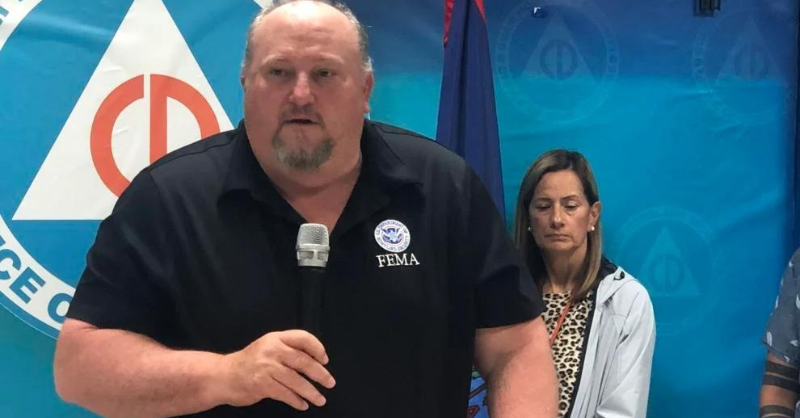
Robert Fenton Jr., administrator for Region 9 of the Federal Emergency Management Agency, speaks at a press conference Monday, May 29, 2023, at Guam Homeland Security/Office of Civil Defense headquarters in Agana Heights.
