







HAGÅTÑA (The Guam Daily Post) — The impact of Typhoon Mawar and additional auditing procedures, the result of transitioning to a new firm, will delay the fiscal year 2022 audited basic financial statements for the government of Guam by two months, according to a letter from the Department of Administration.
The statements were due June 27, but are now expected to be ready by Aug. 31.
DOA Director Edward Birn stated that the Deloitte & Touche LLP firm decided to discontinue operations on Guam, and Ernst & Young LLP was awarded the contract to conduct the fiscal 2022 audit.
“Most of the additional audit work relates to the government-wide statements and allocated liabilities component units,” Birn stated.
However, the director added that governmental statements are nearly complete and a preliminary release of unaudited results for governmental funds will be issued by Wednesday.
Annual GovGuam audits report on government revenues and expenses, as well as information on long-term debt.
While it may be a couple more months before the complete local audit is published, recent trends on public debt, risk factors and other issues for Guam and other U.S. territories have been reported by the U.S. Government Accountability Office, through the 2023 public debt outlook for the territories.
Using Guam’s fiscal 2021 audited financial statements – the most recent available during the development of the report – the GAO found that Guam’s total public debt outstanding was $2.6 billion, or about 43% of the island’s gross domestic product.
The total debt figure is the same as reported in GAO’s 2021 report, which noted that Guam’s total public debt remained constant at about $2.6 billion between fiscal years 2017 and 2019.
It was in the decade prior when the island’s total public debt ballooned, going from nearly $1 billion to $2.5 billion between 2005 and 2015. Most of the island’s public debt is in the form of bonds, with the GAO having been told that bonded debt outstanding has primarily been used by the local government to comply with federal requirements and court orders.
The 2023 GAO report states that GovGuam and its components issued new debt to finance infrastructure and capital improvement projects.
“For example, in 2020, the Guam Waterworks Authority issued a $134 million bond to fund water system upgrades,” the 2023 report stated.
In fact, 59% of Guam’s public debt belonged to government components, with the Guam Power Authority and GWA comprising the majority of the $1.5 billion in debt attributed to government components.
The GAO stated that the “primary government” held about $1.1 billion in debt.
Concerns ‘allayed’
Public Auditor Benjamin Cruz stated that he appreciated the GAO report, because it provides a comparison of the debt within the territories, and that Guam has been good about making sure bond obligations are timely paid.
Cruz, a former senator, said he was considered “fiscally conservative” while in the Guam Legislature because he did not support too much borrowing.
“My concerns are allayed by the fact that the first thing the Legislature does is that it appropriates for the bond obligations before it does anything else,” Cruz told The Guam Daily Post. “I believe the autonomous agencies do the same. We have been good about making sure all our bond obligations are timely paid. I endeavor to make sure it remains that way.”
He added that he wished the government would use any surplus that it experiences to pay down its debts, but he acknowledged that mandating that is not within the power of his office.
“I hope that we remain within our Organic Act debt limit, and that we all borrow only what we can realistically repay,” Cruz said.
According to the fiscal 2021 GovGuam audit, public indebtedness for GovGuam must not exceed 10% of the aggregate tax value of property on island, which amounted to $1.35 billion as of October 2020.
The total amount of debt issued as of Sept. 20, 2021, that was subject to the debt ceiling, was about $989 million. There was a reduction of long-term debt by nearly $54 million between fiscal years 2020 and 2021.
The 2023 GAO report also noted that Guam’s GDP had declined by almost 2% annually from 2016 to 2021, after experiencing 1% annual growth from 2006 to 2016. That decline reflects the decline in tourism as a result of the COVID-19 pandemic, although the GAO noted that the island’s economy is in recovery. The opening of the Marine Corps base on Guam is also expected to stimulate economic growth, the GAO stated.
In her comments on the 2023 GAO report, dated June 13, Gov. Lou Leon Guerrero stated that her administration prioritized refinancing existing debt to secure lower interest rates without extending the debt maturity.
The governor noted that the GovGuam general fund audit reported in fiscal 2021 that $83 million in accumulated deficit had been eliminated in the governmental fund balance sheet without the use of borrowing, and that general fund surpluses were produced each year of her first term. This was achieved through conservative revenue and expenditure projections, by maximizing federal fund revenues and by reducing general fund expenditures, the governor added.
She also noted that the Moody’s rating agency recently upgraded Guam’s financial health rating, from stable to positive.
The GAO stated that Guam’s financial statements were reliable, but weaknesses in internal controls still exist, which involved having an inadequate financial management information system.
Leon Guerrero said a $30.7 million contract is in place to replace the government’s aged financial management information system, a five-year project scheduled to be operational by January 2024.
The governor also stated that Typhoon Mawar had disrupted Guam’s tourism recovery from the pandemic, but despite significant damage from the typhoon, GovGuam and its autonomous agencies will not have to borrow to further recovery efforts.

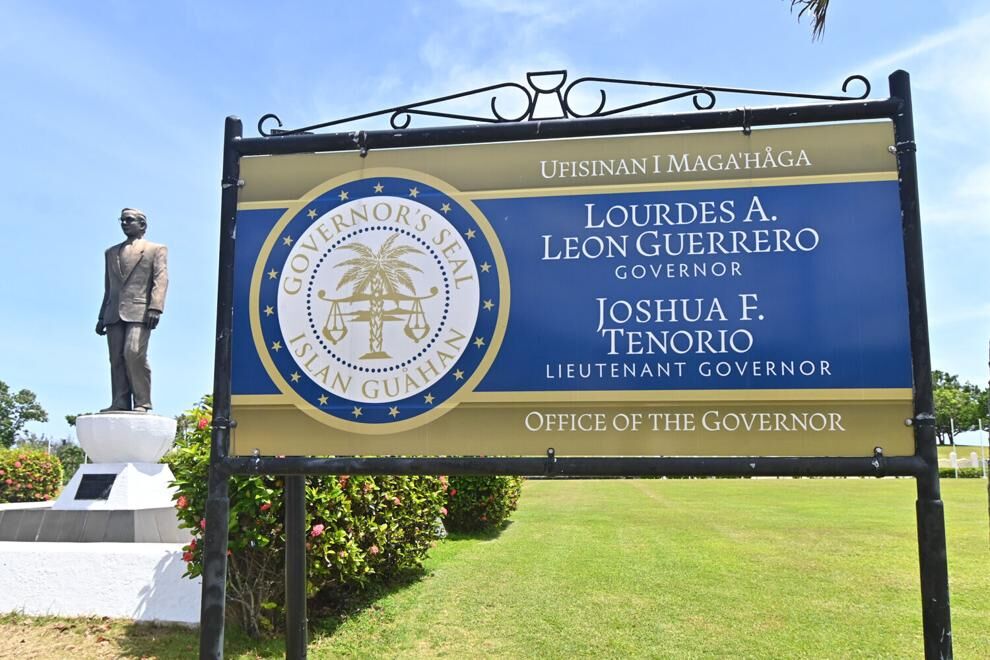
The Ricardo J. Bordallo Governor’s Complex in Adelup is shown May 4, 2023. The government of Guam’s audited financial statements will be delayed by about two months.
