






HAGÅTÑA (The Guam Daily Post) — Los Angeles County in California is the most populous in the United States, so it should come as no surprise that the county also contains one of the largest homeless populations in the nation. This is no more evident than in Skid Row, the infamous neighborhood in the City of Los Angeles where makeshift shanties line entire city blocks.
Guam has nowhere near the population of the city, let alone L.A. County, but could something like Skid Row happen here?
Acting Gov. Josh Tenorio said he doesn’t believe the homelessness issue on the island is as concerning as in L.A. But as familiar, albeit scaled down, elements of the homelessness problem in L.A. sprout up here and there on Guam, the acting governor cautioned that the island may end up on a similar path without intervention.
“We could be on a trajectory to have to deal with that kind of complicated thing. We see elements of that throughout the community with unsheltered folks. There’s an infamous camp … it was right across Micronesia Mall. So, we have little signs of that. There was one in Yona recently, a camp causing problems, manåmko’ not feeling safe,” Tenorio said Friday at the 2nd Annual Housing and Homelessness Summit held at the University of Guam in Mangilao.
“For me, as complicated as the homeless population is on Guam, surely it’s not an overwhelming tidal wave. Or, we have to make sure it’s not that tidal wave we see in some of the bigger places. And that requires us to work together,” he added.
Tenorio also is the chair of the Guam Interagency Council on Homelessness. He told summit attendees that two major issues were brought to his attention some years ago, when he was first elected into office. The first related to unsheltered children, and the second is the need for transitional housing on Guam. Tenorio said shelters on the island are experiencing backlogs, as those sheltered stay longer than shelters are meant to accommodate them.
The government of Guam is working to stand up two new facilities to help service homeless individuals. One is the apartment building in Anigua, an 18-unit facility that is being converted into a shelter and resource site, which Tenorio hopes will help fill that need for transitional housing.
“For me, that’s meant for those of you in the nongovernment sector and in the public sector to house folks that are making good transition through your emergency shelters. And you have confidence that going into this transitional housing is going to further advance housing security and stability for a longer period of time, and take them to a place where they can hopefully find pathways to go back into neighborhoods. That’s ideally what I would like,” Tenorio said.
The other facility is a warehouse in Tamuning meant to become a drop-in center and “bed for the night,” according to Tenorio. This is a place where law enforcement and mayors can direct homeless individuals to go for the night, and a place where they can store personal documents and where agencies can offer intervention services. Tenorio said GovGuam is acquiring this facility, but for both the Anigua and Tamuning facilities, he anticipated they would be up next year.
3D printing houses
Of course, homelessness issues are intrinsically linked to affordable housing concerns.
While the Housing and Homelessness Summit took place at the CLASS Lecture Hall of the University of Guam, across the campus, at the Jesus and Eugenia Leon Guerrero School of Business and Public Administration, several government officials and other stakeholders engaged in their own discussion about additive construction.
The main topic at play: affordable housing possibilities through 3D concrete printing.
This was a roundtable discussion organized by the UOG Office of Research and Sponsored Programs. It included several speakers involved in 3D concrete printing, additive manufacturing and community design.
Ernesto Guades, an assistant professor of civil engineering at UOG, discussed the potential development of sustainable concrete for Guam by using recycled building materials. He also discussed how some states are looking at 3D printing homes to help resolve housing issues, due to anticipated lower costs.
“Now, one of the biggest hurdles for new technology is acceptance. And usually, for this technology, it’s not still written in the codes. If you submit for building permit, the Department of Public Works, … if they’re not really confident, they won’t issue that one,” Guades said Friday.
“I tried to read some of the references. We have the International Building Code. … There is a provision there that we can use alternative materials. … That is, this can be supplemented by research reports. Even if there’s no codes there, but as long as it can be supplemented by research. … The key here is, before this can be accepted, I think there should be a technical committee,” Guades added.
Tenorio attended the roundtable, as well. He said one of the keys to trying to provide housing security is finding new technologies.
“And sometimes, disruptive technologies, as Ernesto said, takes a little time for people to try and understand and figure out whether they have the comfort level to use their signature and authorities to enable such things to occur,” Tenorio said.
He thanked Guades for the suggestion to have a technical committee.
“I think we will act and have a technical committee and merge that into some other efforts that are happening,” Tenorio said.
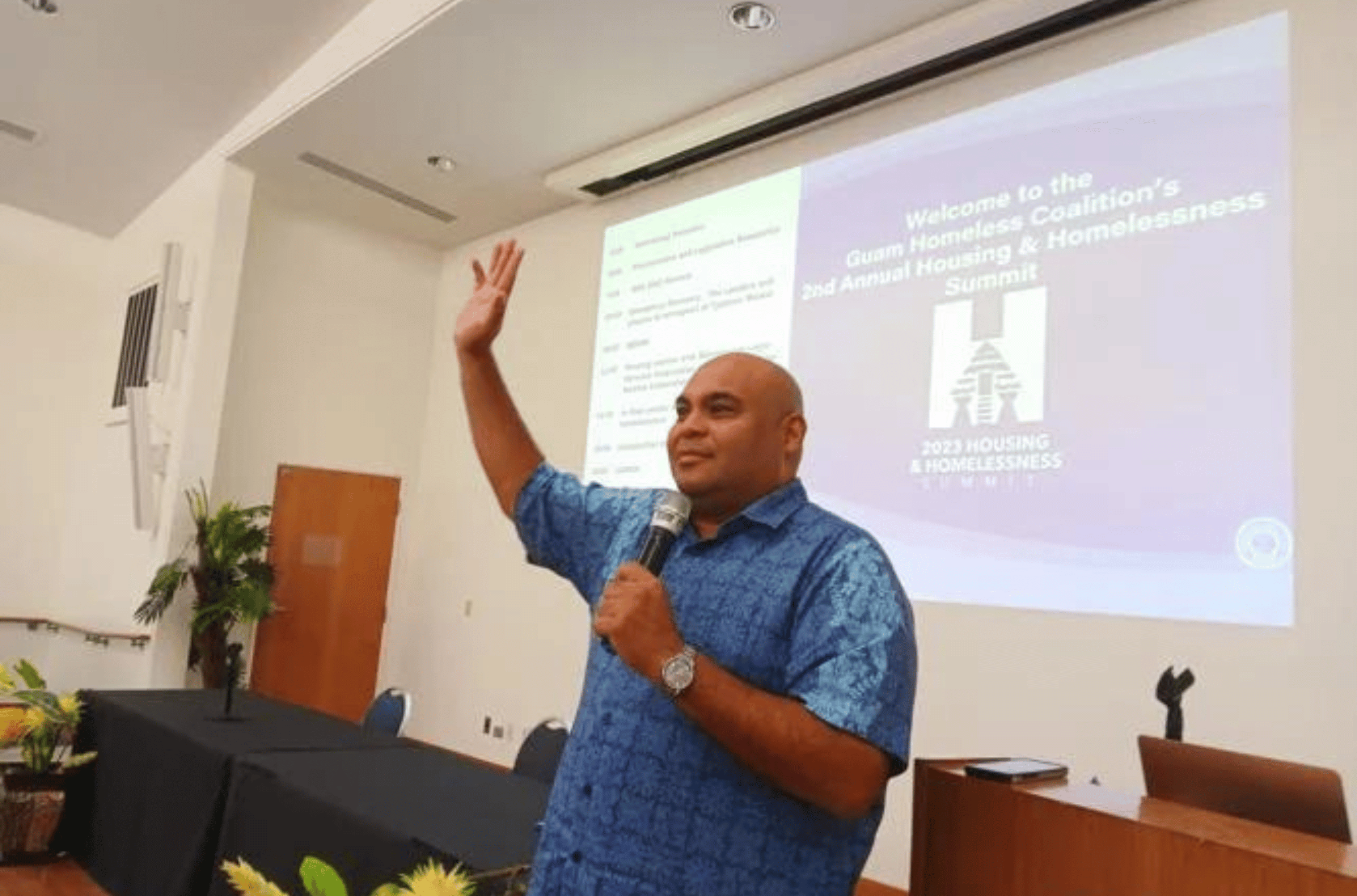
Acting Gov. Josh Tenorio speaks to attendees at the 2nd Annual Housing and Homelessness Summit held Friday, Nov. 17, 2023, at the University of Guam in Mangilao.
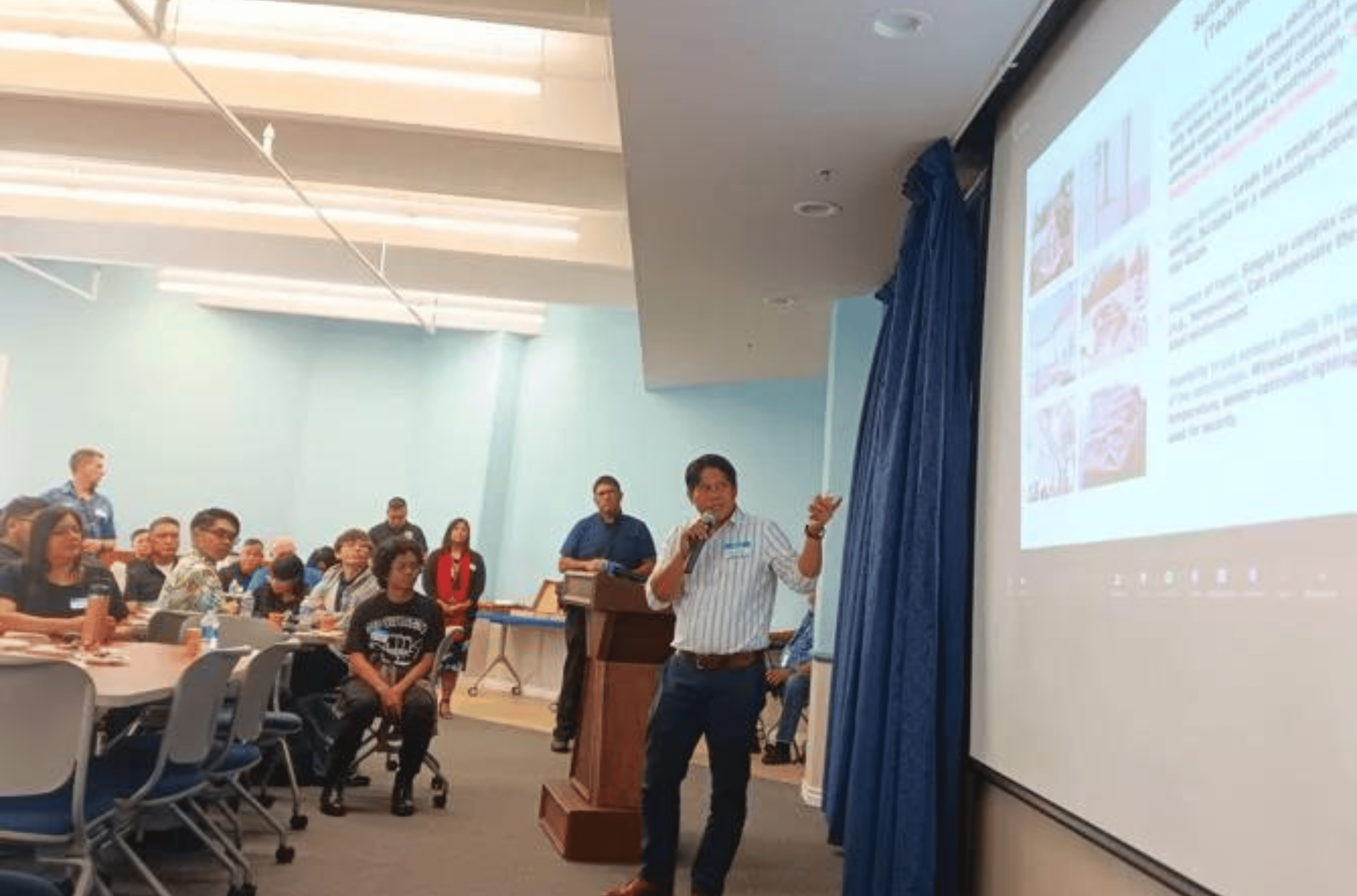
Ernesto Guades, an assistant professor of civil engineering at the University of Guam, makes a presentation during the roundtable on additive construction held Friday, Nov. 17, 2023, at the University of Guam in Mangilao.
