





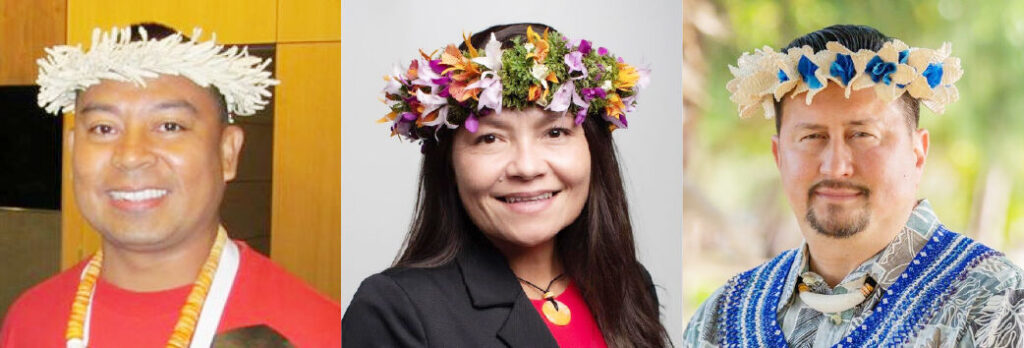
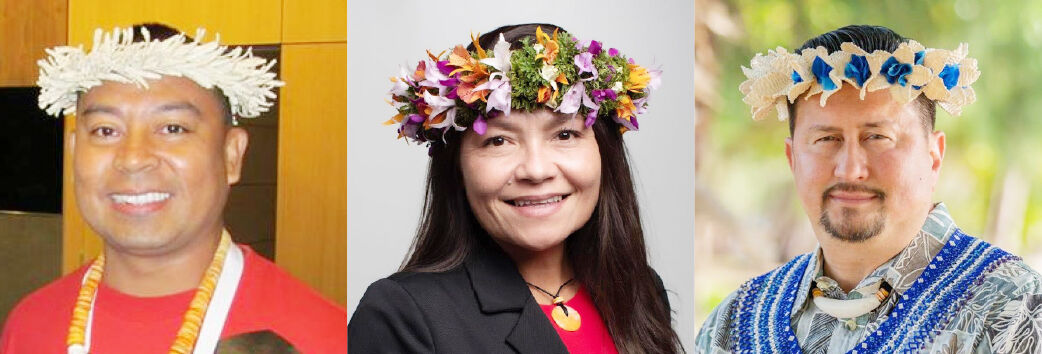
From left, John Gonzales, Kimberlyn King-Hinds and Edwin Propst.
VARIETY asked the three candidates for delegate — House Floor Leader Edwin Propst, attorney Kimberlyn King-Hinds, former TV personality, business consultant and grants writer John Oliver Bolis Gonzales — about the significance of the Covenant, whose 48th anniversary today, Monday, is celebrated as a holiday in the CNMI.
Here are some excerpts from the interviews:
“Covenant Day reminds us that our people democratically decided to become part of the United States,” Propst said.
“Nearly 50 years later, I am so thankful to the members of the Marianas Political Status Commission for their brilliance and foresight that led to our unique agreement with the United States,” he added.
“The Covenant is the difference between the CNMI and other territories,” King-Hinds said. “Our forefathers negotiated a unique agreement that is the foundation of our political partnership with the United States, which allows the CNMI to maintain and protect the identity of our indigenous population within the American political framework.”
“It’s not a perfect document but to me, it is a reflection of America at its best,” she added.
For Gonzales, “Covenant Day is a lasting tribute to our founding negotiators as dedicated visionaries and luminaries of their time — a reminder of the promise of a better quality of life for our people, and the enduring power, commitment and legacy of a mutually beneficial and productive political relationship between the Northern Marianas and the United States.”
Asked whether the promise of the Covenant to establish a self-governing Commonwealth has been fulfilled, Propst said, “As a Commonwealth, we should have more flexibility and autonomy in our day-to-day operations, and I am running for NMI delegate to help ensure that the United States honors the spirit of the Covenant and the promises to the people of the CNMI that are enshrined in that Covenant.”
“It is a work in progress, but generally speaking, yes,” he added.
King-Hinds said, “The promise of self-governance under the Covenant is up to the people of the CNMI to fulfill.”
“You can’t self-govern if you are dependent on federal handouts,” she added. “We are headed toward heavy federal aid reliance and increased militarization of the CNMI because of policy decisions that have been made locally. … The CNMI needs a hand up, not a handout and it’s up to the people to decide that through an election,” she said.
Gonzales said, “The political relationship between the CNMI and the U.S. must be anchored on profound mutual respect, enduring trust, and unequivocal commitment to … the fundamental core principles of each entity in order to fulfill the respective objectives that resulted in their marriage: on the one hand, the NMI’s quintessential and paramount geopolitical importance and strategic location to augment the U.S.’ military and defense interests in the Indo-Pacific region against China, Russia and North Korea; and on the other, the U.S. promise of a lasting political alliance through securing a partnership with the NMI in exchange for financial support and technical assistance and competitive economic tools to improve the NMI’s fragile economy, infrastructure, respect for the NMI’s guaranteed rights to self-governance, and equalizing benefits and programs to sustain the people’s overall quality of life as U.S. citizens.”
Gonzales added, “While I agree that we have witnessed dramatic changes and improvements in some areas, there remains more work to be done to stay mission-focused on other areas, including a stagnant economy reeling from a global pandemic and frankly the U.S.’ unilateral policy actions and decisions to retract strategically competitive economic tools to jumpstart our vulnerable economy like no export tariffs through Headnote 3(a), federalizing our immigration that has now overstepped its limits on the NMI’s right to control its labor by imposing who and what kinds of foreign nationals may enter the NMI to work, choking our fragile tourism industry through its on again, off again policies against some foreign nationals who can visit the NMI as our tourism source market(s); choking our livelihoods, ability to expand village homesteads to build homes and our economic growth to expand hotels and golf courses and other industries through the U.S. Endangered Species Act, and depriving our U.S. citizens in the NMI — especially our hardworking large middle income class and senior citizens — with longstanding disparities on many benefits and programs afforded to U.S. citizens in the mainland U.S., including Social Security, respite care for caregivers, affordable health insurance, subsidies for utilities, housing, home insurance, health insurance deductibles, food expenses, unemployment insurance, Medicaid insurance coverage, expanded Medicaid insurance for dentures and assistive technology devices for mobility.”
The three candidates agreed that the Covenant is a unique agreement.
King-Hinds said, “Unlike other jurisdictions, we exercised our right to self-determination by deciding through a plebiscite that we wanted to enter into a partnership with the United States.”
“This is not true of other territories as they were acquisitions of war,” said the former Commonwealth Ports Authority chairwoman.
Gonzales said, “Our Covenant is unique as it embodies the terms and conditions of the enduring political relationship between the NMI and the U.S. much like two caring individuals in a marriage. It is a living document that guides each entity to fulfill and/or keep them in check to be accountable with their pledge and promise accordingly.”
According to Propst, “We negotiated the Covenant. Ninety-five percent of the people voted on it and almost 80% approved of it. So, we should be extremely proud that we accomplished Commonwealth status and all its potential. I look forward to being able to continue to work on matters that affect our Commonwealth such as the economy and healthcare with the federal government, in the manner contemplated by the Covenant.”
Asked if there is any part or provision of the Covenant that he disagrees with, Propst said, “Generally, as written, the Covenant lists areas of mutual consent. I agree with the concept, but we need to strengthen these provisions with clearer, more CNMI-friendly laws, to hold the U.S. to the promises of the Covenant and ensure that the words have meaning and that those who are in positions of authority understand the true nature and significance of the Covenant as being truly unique in the American family.”
King-Hinds said, “The Covenant is not a perfect document, but it is certainly an ‘honorable accord’ as Howard Willens describes it. It is up to us and the future generations to work towards refining and defining what certain provisions mean like, for example, what are the obligations under the Covenant to have a progressively higher standard of living? This document is living and what I want to see is to breathe new life into it with the voices of our young people whose lives stand to be impacted the most by policy decisions that are being made today.”
Gonzales said, “I am concerned about the provisions that gave much latitude to the U.S. to exercise its plenary powers on major issues that it portends to justify under military defense, but may result in residual collateral damage and irreparable harm to the health and welfare of the NMI’s economy, labor, environment, etc. due to intrusion into and in violation of the NMI’s guaranteed rights to optimal self-governance pursuant to our Covenant. These include but are not limited to federalization of immigration that have since been indirectly adversely impacting our efforts to revitalize and develop a more sustainable economy by limiting which foreign nationals and what occupations can enter the NMI to work to fill those highly specialized, labor intensive jobs, holding our available NMD public and private lands hostage from residential homesteads and homes and more economic industries and businesses due to the U.S. Endangered Species Act, holding our 200 Miles EEZ submerged lands hostage by unilaterally claiming that the U.S. owns it when it was never explicitly and accountably discussed and decided in the Covenant negotiations, inequities with U.S. federal benefits and programs afforded to mainland U.S. citizens and not to NMI U.S. citizens especially juxtaposed against our remote location and exorbitant high cost of living in the NMI, reneging [on] its pledge to fund or dramatically reducing funding for our capital infrastructure improvements projects annually, and lack of due diligence and good faith to equalize social and economic opportunities for NMI U.S. citizens.”
Variety asked the three candidates whether reunification with Guam is still worth pursuing.
“There are definitely pros and cons,” Propst said. “Hawaii, with six major islands, manages statehood over a larger geographic area and with a much larger population, so it is possible, but is it reasonable? Economically, if we could share Guam’s booming military and tourist economy, that would be great. I am totally willing to put this question to another democratic vote and ask the people of Guam and the CNMI what they have to say. Having said that, whether we pursue political reunification or not, I am 100% in favor of working with our brothers and sisters in Guam today, united in spirit, as one Marianas. We are already working closely with Guam on regional issues and have found common ground. We are working on joint government resolutions and partnerships and have a unified voice when it comes to protecting the shared interests of the entire Marianas.”
King-Hinds said, “To pursue that policy decision, a full cost-benefit analysis must be done to determine what that means politically, socially and economically through a transparent public engagement.”
Gonzales said, “Let us not repeat history and I respect Guam’s intrinsic and paramount right to negotiate its self-determination with free and prior consent sooner than later.”
In a special election in November 1969, reunification with the NMI was rejected by Guam voters: 3,720 voted “No” while 2,688 voted “Yes.” Voter turnout, however, was very low: Only 32% of Guam’s electorate cast their ballots. (Source: “History of the Northern Mariana Islands” by Don A. Farrell.)
Because Gonzales and King-Hinds are seeking the CNMI Republican Party nomination, a primary will be held on April 13 from 2 p.m. to 6 p.m. at the Garapan Central Park roundhouse.
Propst, so far, is the only candidate of the CNMI Democratic Party.
