

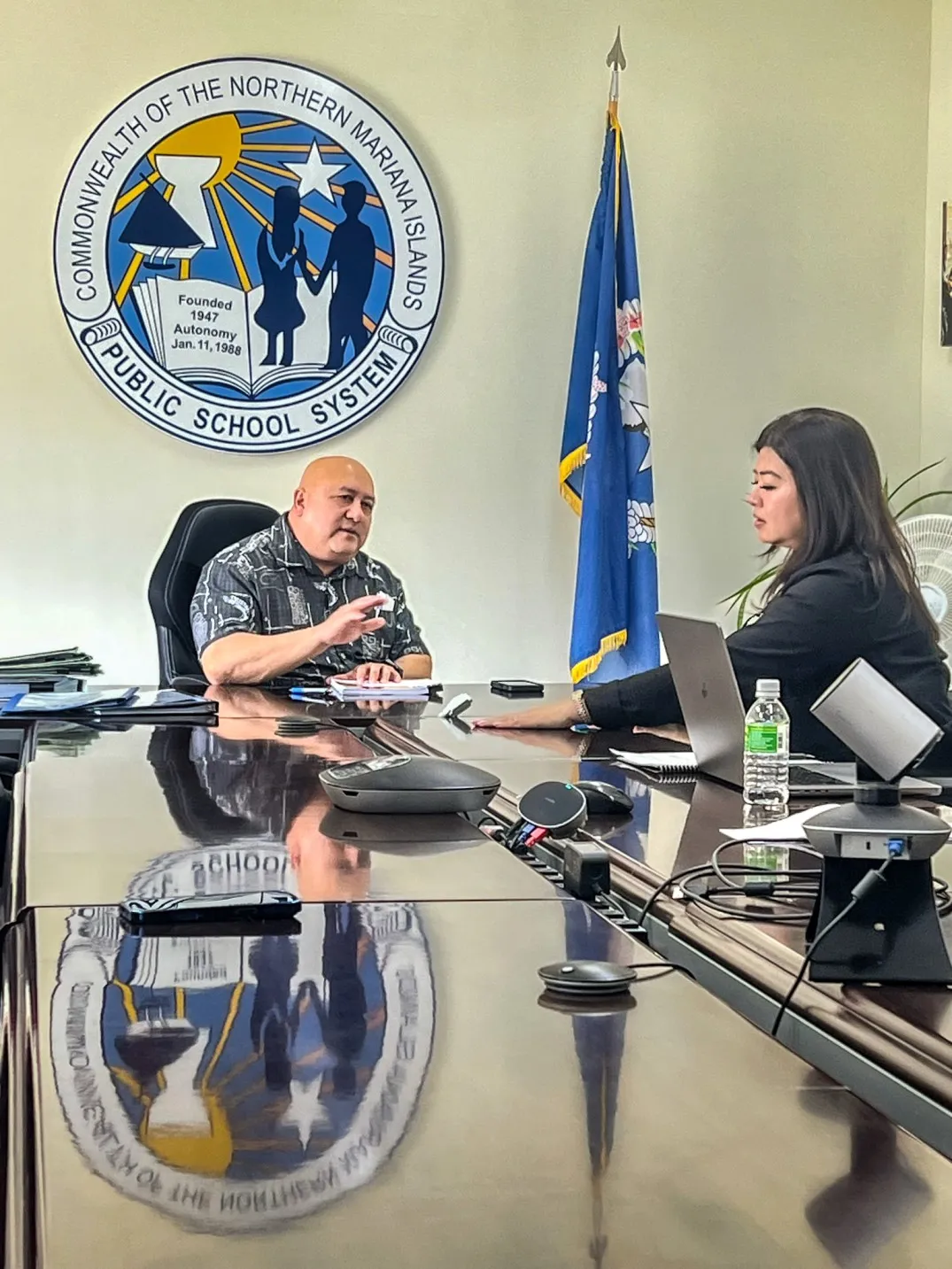


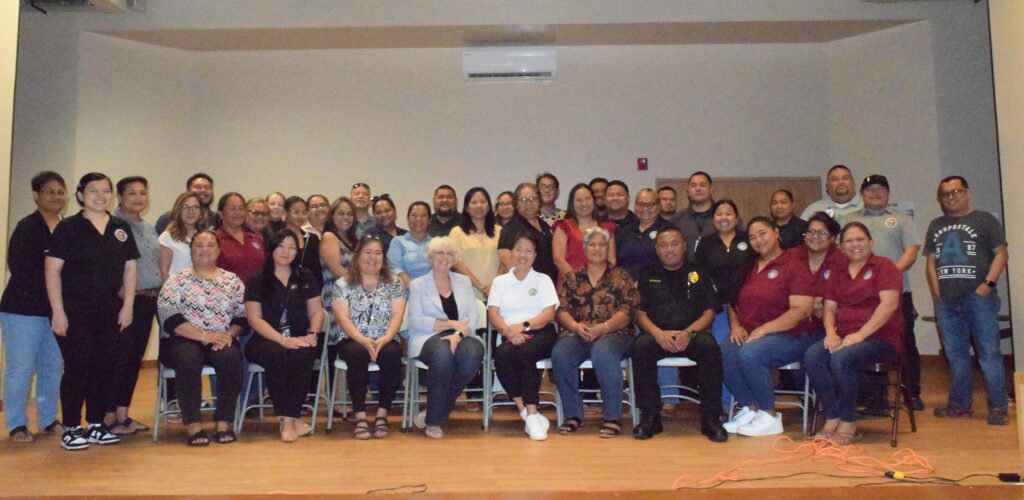

Division of Youth Services Administrator Vivian Sablan, third left seated, and Child Protective Services intervention specialist Mariah Barcinas, second right seated, pose for a photo with community stakeholders at the Kagman Community Center on Monday.
DIVISION of Youth Services officials and staff as well as representatives from other government agencies, schools and community organizations gathered at the Kagman Community Center on Monday to “brainstorm” on a measure that would create a child abuse and neglect registry in the CNMI.
In January, DYS Administrator Vivian Sablan and Child Protective Services intervention specialist Mariah Barcinas announced the completion of the final draft of a proposed policy to establish the CNMI’s first central registry for child abuse and neglect.
The project was funded by a technical assistance grant provided by the Capacity Building Center for States of the Administration for Children and Families, which is under the U.S. Department of Health & Human Services.
Barcinas described the stakeholders’ session on Monday as “a significant step forward in our ongoing efforts to protect the children of the CNMI.”
The participants included representatives from the Office of the Attorney General, the Legislature, private schools, the Public School System, the CNMI Department of Labor, the Office of Personnel Management, the Family Court, the Department of Fire and Emergency Medical Services, Karidat, the Child Care Licensing Program, the Commonwealth Office of Transit Authority and the Commonwealth Healthcare Corp.
Barcinas said they wanted to ensure that all parties involved are informed, engaged, and committed to making the registry a success.
The goal was the bring together “diverse perspectives to ensure the registry addresses the needs of all parties involved,” she said. “By fostering collaboration and inclusive decision-making, we can build a system that is effective and user-friendly. The session also allowed us to address potential challenges, improve communication, and establish clear roles and responsibilities among stakeholders.”
Barcinas added, “Our mission with the CNMI child abuse registry is clear: To protect the children of the CNMI by maintaining a secure and comprehensive database of substantiated child abuse and neglect cases. We aim to share accurate information promptly with authorized entities to support effective child protection interventions and ensure the safety of our most vulnerable members. Our vision is to create a safer and more secure environment for all children in the CNMI, where every child is free from abuse and neglect. We believe that through transparency, accountability and continuous improvement, the child abuse registry will become a cornerstone of our child protection efforts.”
Barcinas said the CNMI child abuse registry is more than just a database.
“It is a proactive measure to prevent further abuse and protect our children. It will help us identify and monitor individuals who pose a risk, allowing for timely and effective interventions. This registry is a testament to our commitment to creating a safe, nurturing environment for every child in the CNMI,” Barcinas said.
For her part, Sablan said: “As you know we don’t have a child abuse registry system in the CNMI. We never had one. It’s been a plan for the past 10 years.”
She said it was the technical assistance grant from the federal government that allowed DYS to move ahead with its mission.
The stakeholders session will guide DYS in the development of a child abuse registry in the CNMI, she added.
DYS will continue to receive guidance as it works on the proposed legislation, Sablan said.
“We won’t know until we test it but we also want to make sure that even though we are developing a very simple system, the system should be responsive to the needs of agencies. So it is necessary that they hear the comments and concerns and get feedback so they can develop it in a way that is short and simple but responsive to the community’s needs,” she added.
