




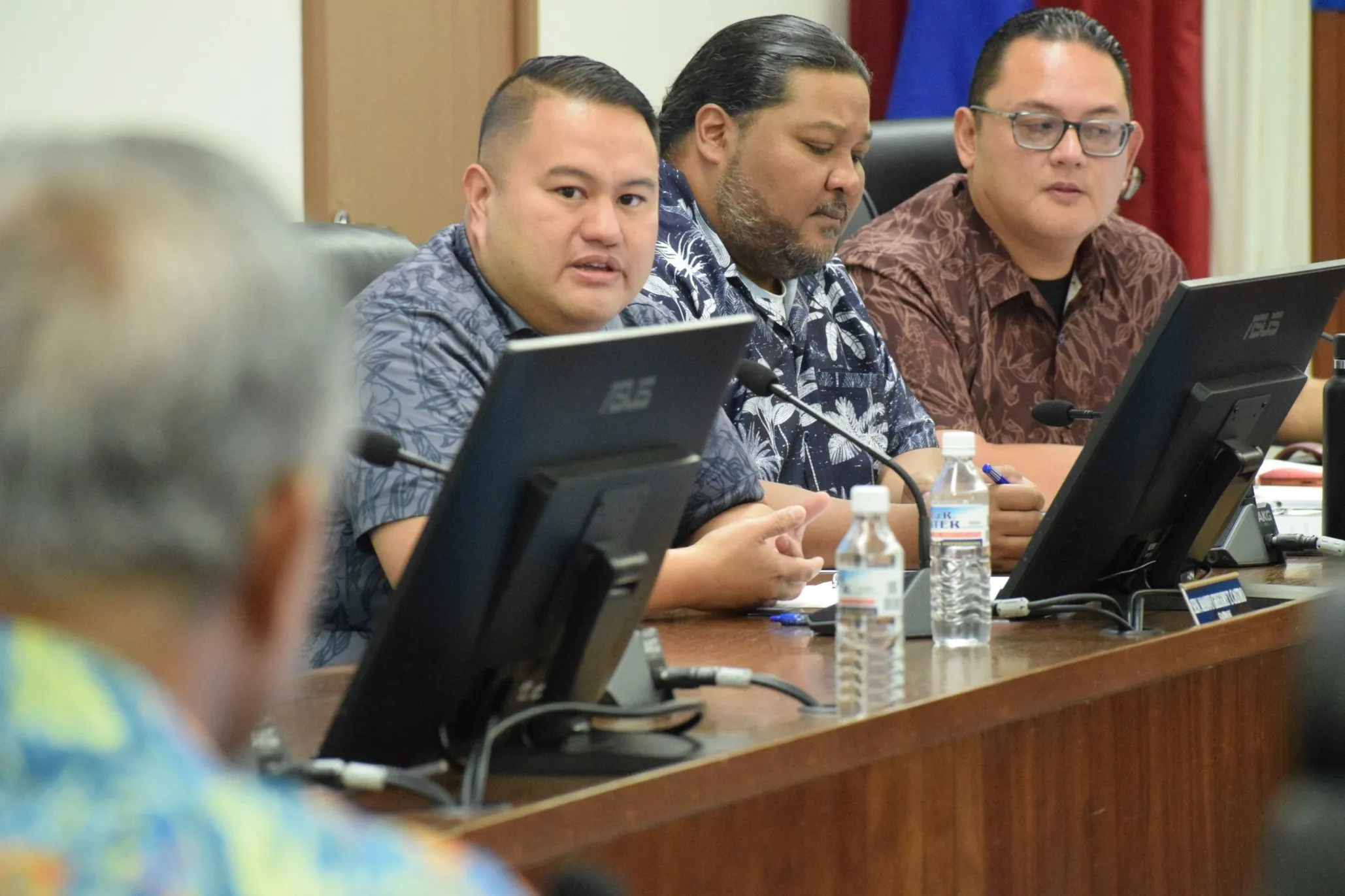


“I will take this matter under advisement and transmit a recommendation to the committee chairman,” he said.
The House Committee on Natural Resources, chaired by Rep. Ramon A. Tebuteb, R-Saipan, wanted Senate Bill 16-42 “filed” — that is, ignored.
Besides Tebuteb, those who voted in favor of filing the bill were Vice Speaker Joseph P. Deleon Guerrero, R-Saipan, House Minority Leader Oscar M. Babauta, Covenant-Saipan, Reps. Edwin P. Aldan, Covenant-Tinian, David M. Apatang, R-Saipan, Francisco S. Dela Cruz, Covenant-Saipan, and Stanley T. Torres, R-Saipan.
Those against were Speaker Palacios, R-Saipan, House Floor Leader Joseph N. Camacho, R-Saipan, Reps. Diego T. Benavente, R-Saipan, Victor B. Hocog, Ind.-Rota, Heinz S. Hofschneider, R-Saipan, Joseph C. Reyes, R-Saipan, Tina Sablan, Ind.-Saipan, and Ralph DLG. Torres, R-Saipan.
Saipan Republican Reps. Rosemond B. Santos and Ray N. Yumul left the session hall before the vote.
Rep. Raymond D. Palacios, Covenant-Saipan, was absent. He signed the committee report.
Rep. Justo S. Quitugua, D-Saipan, was off-island while Rep. Edward T. Salas, R-Saipan, was on medical leave.
‘Noble and respectable’
Introduced by Senate Floor Leader Jude U. Hofschneider, R-Tinian, the bill will reinstate a board of public lands, which the committee described as a “noble and respectable” goal.
But the committee said it’s not recommended to reestablish a board for the Department of Public Lands while DPL remains under the executive branch, as proposed by the bill.
The committee also opposes the proposed creation of DPL deputy administrators for Tinian and Rota.
The report cited a letter from Northern Islands Mayor Valentin I. Taisakan who said that nothing in the bill will prevent an abuse of the board members’ travel costs and per diem as was seen in the now defunct Marianas Public Lands Authority.
Further, Taisakan said, the bill allows the mayors of Tinian and Rota to implement land management policies that may contradict the policies of the public lands board.
The report likewise noted the Office of the Public Auditor’s findings that MPLA’s abuses “negatively affected and are still affecting” DPL’s financial status.
The debate begins
After Floor Leader Camacho moved for the adoption of the committee report, Sablan reminded her colleagues that “there continues to be abuses in the administration of public lands” under DPL.
There are no checks and balances and DPL remains highly “politicized,” she said.
Tebuteb replied that his committee discussed Sablan’s concerns, adding that “there’s supposed to be an advisory board” for DPL.
Sablan said as far she knows, there have been no appointments to the advisory board since Public Law 15-2 abolished MPLA and created DPL in Feb. 2006.
According to the law, each of the four CNMI mayors will appoint one member with the governor naming the fifth.
“It seems that this is a good time to do a more comprehensive review of public lands management,” Sablan said, citing controversies regarding public land leases, homesteads, the Marpi development project “and other concerns.”
The House, she added, “will miss an opportunity” to review these issues if it decided to file the bill.
Outside the box
Representative Hofschneider recalled that under then-Gov. Froilan C. Tenorio, the autonomous Marianas Public Lands Corp. was abolished and authority over public lands was given to the executive branch.
“We [the Legislature later] had to stop his authority because of questionable leases,” Hofschneider said.
Some nine years after the creation of an autonomous board, it was abolished by P.L. 15-2 which returned authority over public lands to the governor.
Hofschneider finds it “alarming” that while the availability of public lands is diminishing the cost of managing them is rising.
“We need to start thinking outside the box and fine-tune the rules governing public lands. There is lack of public participation when considering public land leases. Let’s focus on governance. Let’s allow more public participation.”
Benavente said he did not sign the committee report because he “respectfully disagrees with its findings.”
He was speaker of the House when the 10th Legislature overrode Tenorio’s veto of the bill creating an autonomous public lands board in April 1997.
He recalled that under Tenorio’s contol, the management of public lands “got so bad that we said ‘enough is enough.’ The control over public lands must be removed from political interference. So we created a board. I still believe that we’ll be a lot better off if public lands are managed by an independent body.”
He acknowledged that “there have been failures under that system [an autonomous board].”
“We need to sit with the Senate and come up with a system that removes the governor’s authority in dealing with public lands.”
Improprieties
Speaker Palacios said during public hearings on the bill that later became P.L. 15-2, allegations of widespread abuses on the part of MPLA board members were discussed.
He said there are now similar allegations of improprieties regarding DPL.
“There should be criminal penalties for abuses, but the bill before us did not make specific prescriptions regarding the protection of public lands,” the speaker said.
Perhaps Rep. Ralph DLG. Torres would want to introduce a substitute bill, Palacios added.
All angles
Tebuteb assured his colleagues that his committee “looked at all the angles” and held a “number of meetings” before recommending the bill’s filing.
But according to Rep. Ralph DLG. Torres, “Giving [the authority over public lands] to one person is totally wrong in light of the dwindling public lands. With board members, there will be checks and balances. I disagree with the report.”
Apatang said “we know what is happening. It doesn’t make any difference if there’s one person or 10 persons [managing public lands]. If they disregard the law they should be prosecuted.”
Camacho, however, said board members have to comply with the Open Government Act and have a fiduciary duty.
Moreover, he added, the DPL secretary cannot be impeached by the Legislature.
“We still haven’t decided what to do with the bigger issue — the management of public lands,” he said. “Until we resolve that we’re going to go back and forth” on the concerns regarding public lands.
Hocog said he wants to see a board “that will ensure fairness… and not [dole out] special favors to some people…and create bureaucratic obstacles.”
Reyes said “maybe the problem is that the job is too much for a single person.”
Same problems
Deleon Guerrero said “we’ve seen this agency morphed from [being] autonomous to [becoming] a line agency, but we still have the same problems. We have to look into [this issue] comprehensively.”
Dela Cruz said he agrees with Apatang.
“DPL right now is still in its infancy compared to MPLC/MPLA. The question of whether we should have a board is a policy call. We need the right people. Who are they? We don’t know. Look at the [Commonwealth Utilities Corp.] which used to have a board. [CUC] ran into the ground. It collapsed. Its board members had the fiduciary duty to ensure that the power plants were maintained. But look at what happened. Why was MPLA abolished? We know why. Maybe we should give DPL more time.”
Dela Cruz noted that the author of S.B. 16-42 was concerned about the Tinian homestead program.
Tinian homestead applicants received letters from DPL recently, he said. “Does [Senator Hofschneider] still have the same concerns now? I believe that the author’s concerns have been satisfied.”
But Benavente said the management of public lands cannot be compared to the duties of CUC or other government boards.
“Public lands are our most important natural resource. That’s why our founding fathers saw the need to create [an autonomous] MPLC.”
Sablan said the House should call for a public hearing on the bill.
“This is an important question.”
