




By Bryan Manabat
[email protected]
& Emmanuel T. Erediano
[email protected]
Variety News Staff
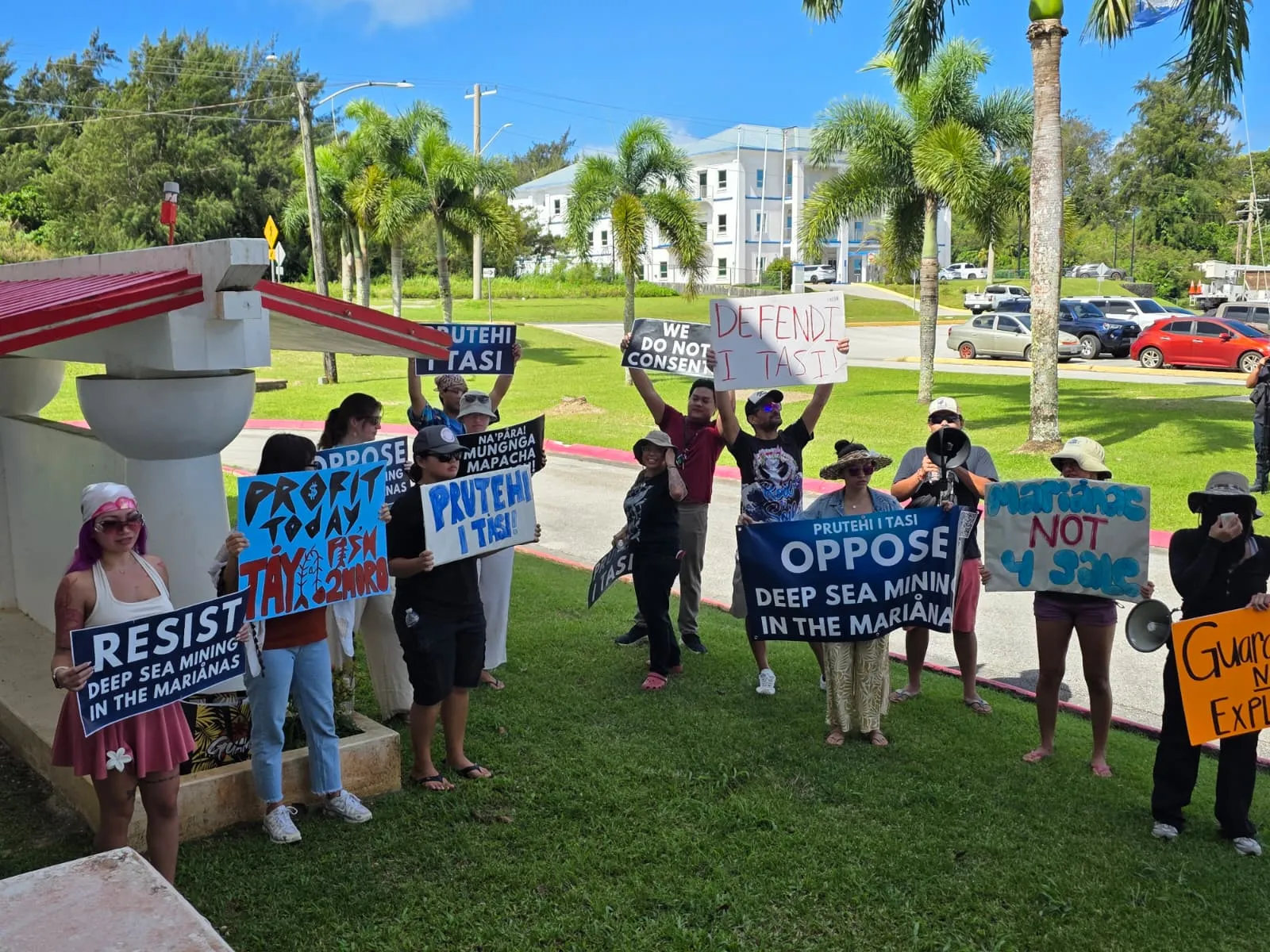
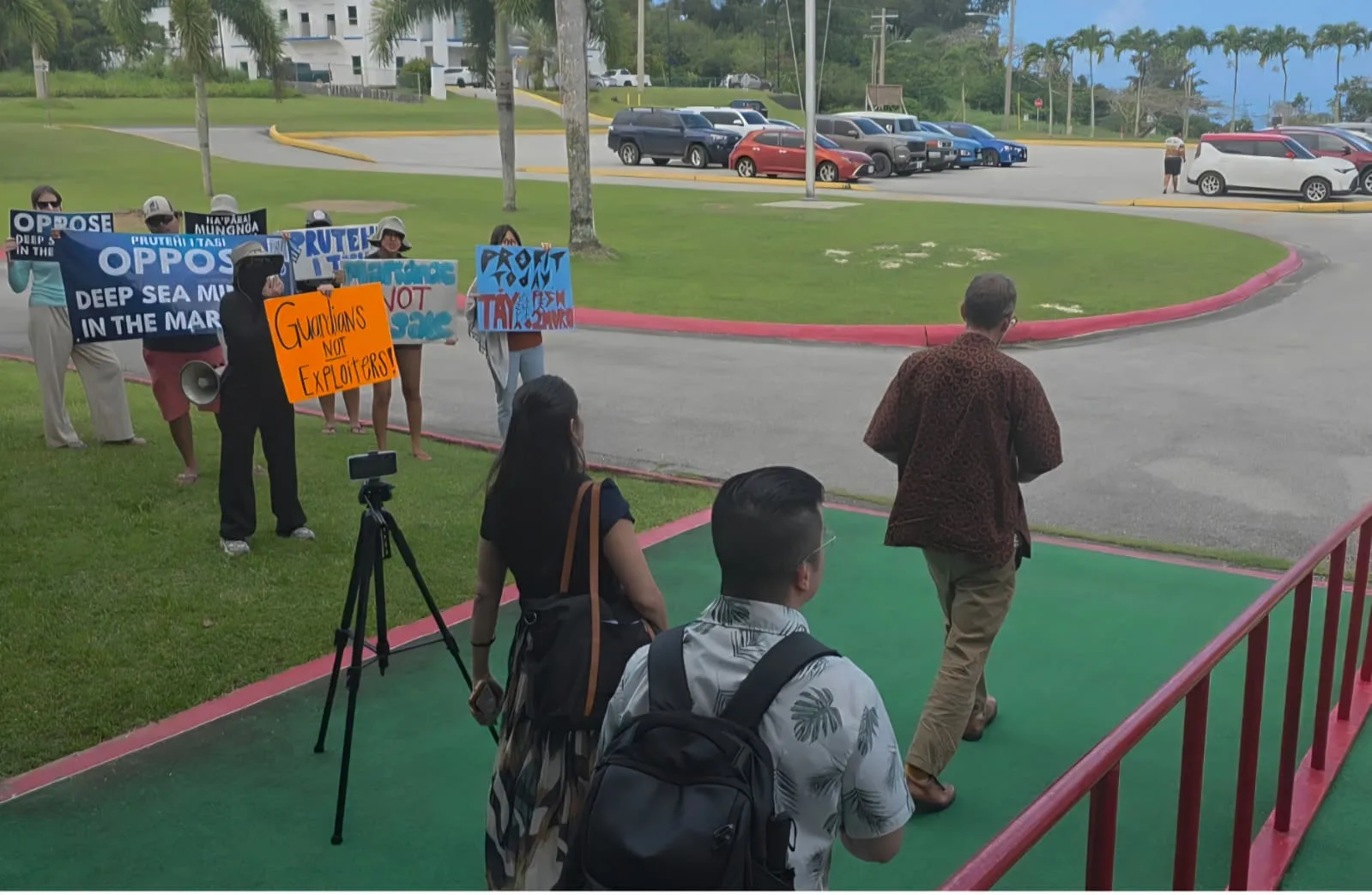
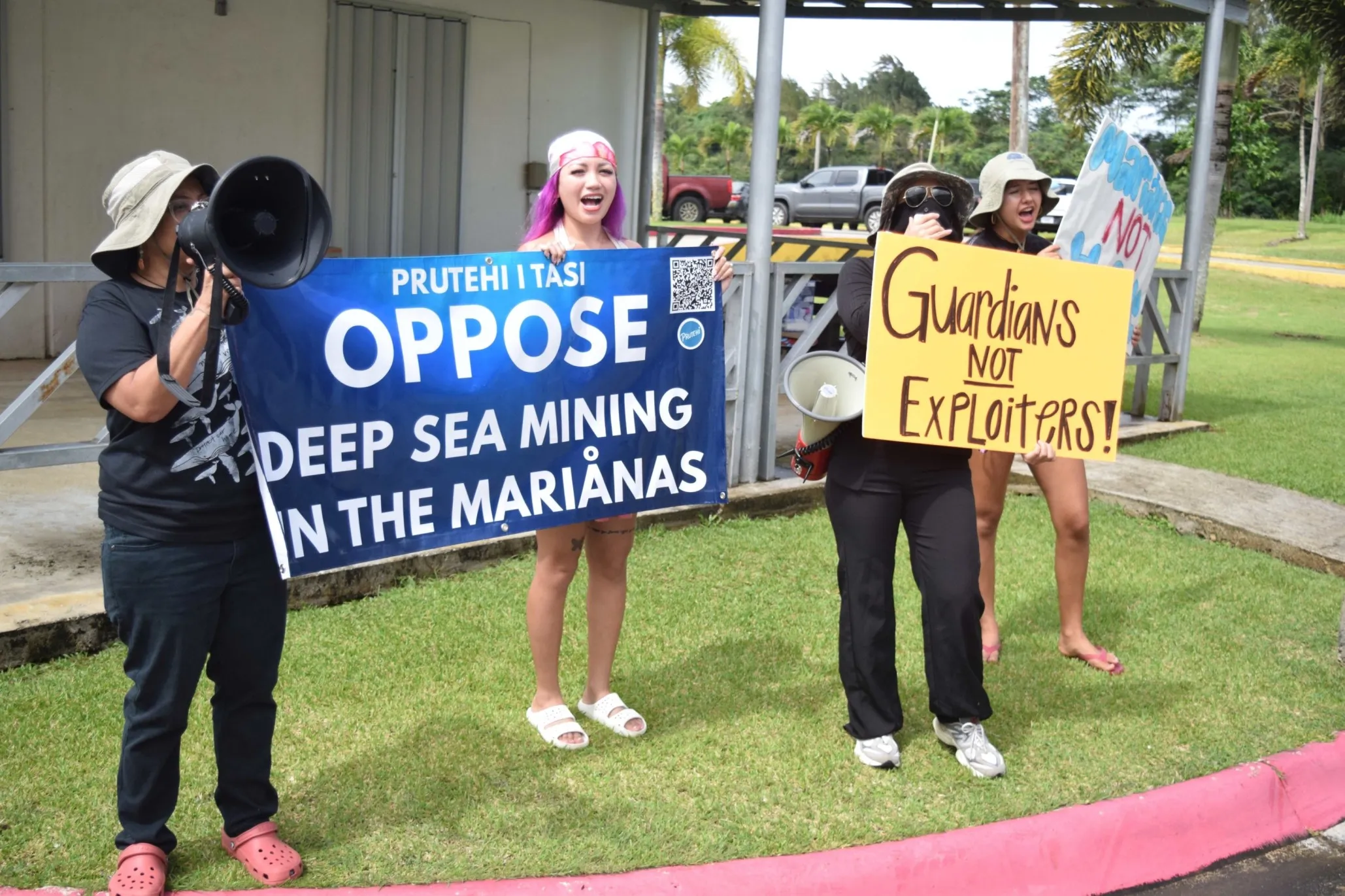
A GROUP of protesters from OurCommonwealth670, Prutehi Guåhan, From Luta for Luta, Marianas for Palestine, and other community organizations gathered outside the administration building on Capital Hill Friday morning, voicing opposition to federal discussions on potential deep-sea mining in waters surrounding the Northern Marianas.
Protesters chanted “Prutehi Marianas!,” “No deep-sea mining in the Marianas!,” and “Our islands are not for sale!” as officials from the Bureau of Ocean Energy Management, or BOEM, and the U.S. Department of the Interior met with Gov. David M. Apatang for what the administration described as initial briefings on the federal deep-sea mining process.
Concerns over secrecy and transparency
Mallory Muna, a representative of OurCommonwealth670, said the groups mobilized because the meetings were not publicly announced and the community had no information about the agenda.
“We’re basically protesting because BOEM is here for secret meetings with the governor’s office,” she said. “These are publicly inaccessible, unadvertised meetings. We don’t know what the content is about. We assume it’s regarding the proposal for deep-sea mining in our waters.”
She said the lack of notice was especially troubling in light of recent remarks by Apatang suggesting the CNMI had islands “to be bought, to be leased.”
“What we’re doing here today is asking for more transparency and for BOEM and the governor’s office to be truthful with us about what these meetings are about,” she said. “We want public input. Right now we have no idea — we didn’t even know they were coming.”
Muna added that the turnout, while modest, does not reflect the depth of community opposition.
“The CNMI government is the number one public employer here, which creates a culture of fear,” she said. “People worry about retaliation or community ostracization if they oppose things like deep-sea mining. A smaller group doesn’t mean there isn’t widespread opposition.”
Early-stage federal process
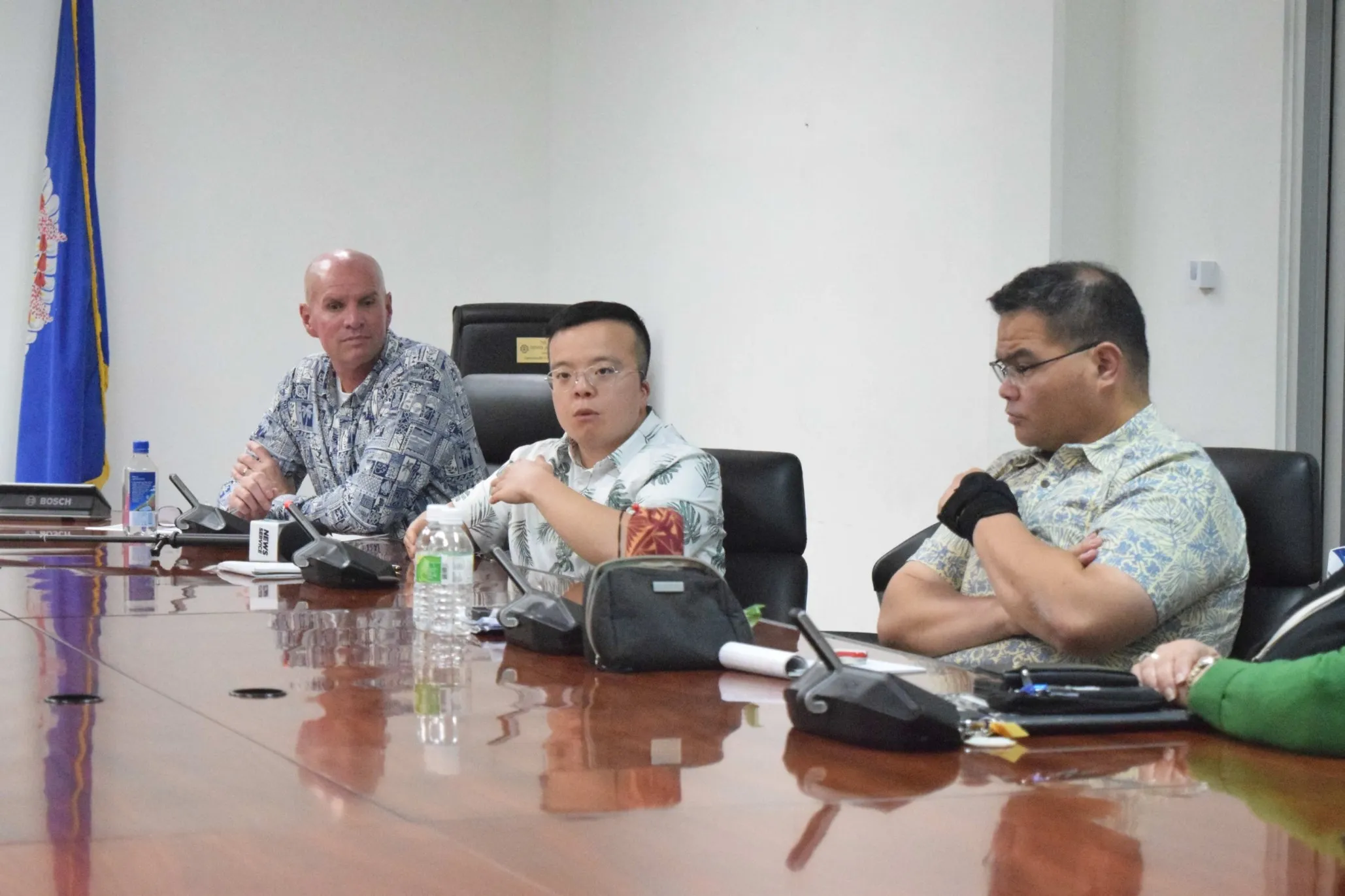
The BOEM delegation included Douglas Boren, Pacific regional director; Jeremy Potter, Pacific studies chief; Natalie Dayal, project coordinator; and Justin Rhee, special adviser with the U.S. Department of the Interior’s Office of Insular Affairs.
BOEM officials are visiting the region to brief territorial leaders on the federal process for a potential deep-sea mining lease sale on the Outer Continental Shelf. The CNMI was added to the OCS framework under the Inflation Reduction Act, which clarified federal authority over submerged lands beyond the CNMI’s territorial waters.
According to the Apatang administration, the briefings covered the early steps toward a possible minerals leasing process, environmental and cultural considerations tied to any future extraction, federal consultation requirements with territorial governments, and plans for broader public engagement in later stages.
A follow-up briefing was held in the afternoon with Cabinet members and elected officials. All meetings on Saipan were closed to the public. BOEM officials also visited Guam earlier in the week.
Respecting free speech
OIA special adviser Justin Rhee said he respects residents’ rights to freedom of speech and emphasized that officials are collecting information from the community.
“We take great value in engaging with fellow Americans in the CNMI,” he said. “OIA also greatly values its partnership with the government of the CNMI.”
Asked about the importance of the discussion, he said, “I think we would not be out here, traveling from so far away, if this wasn’t significant.”
Gov. Apatang noted that a lot of information requests came in, prompting his administration to submit a report to OIA regarding deep-sea mineral leasing. He added, “There are a lot of people who are opposed to it, while some are in favor.”
He said he told BOEM officials they need to hold similar meetings with officials on Tinian and Rota and clearly inform residents about the federal deep-sea mining process.
Seabed minerals
During their presentation, BOEM officials provided a list of seabed minerals, including polymetallic nodules (manganese), cobalt-rich ferromanganese crusts, polymetallic sulfide deposits, heavy mineral sands, and phosphorites.
Bureau of Environmental and Coastal Quality Administrator Floyd Masga said BOEM’s visit demonstrates transparency and active engagement with the community.
“It’s part of the steps the federal agency must follow, along with requests for information,” he said. “Next, there will be more site visits. I applaud BOEM for coming to the CNMI, and I hope the officials will continue community engagement.”
Regarding the protest, Masga said, “I believe it’s their right. They have their own beliefs and concerns, and they are involved in our community. They have every right to be out there and speak up.”
Jurisdictional authority
Under federal law, the United States controls submerged lands and mineral resources seaward of the CNMI’s territorial boundary, while the CNMI retains authority over its near-shore submerged lands.
Although the CNMI does not have veto power over federal OCS leasing, federal agencies must consult with territorial governments — the stated reason for BOEM’s visit. The Apatang administration has said it is pushing for broad community input as the process moves forward.
Growing regional movement
Friday’s protest brought together environmental, cultural, and political advocacy groups from across the Northern Marianas and Guam. Participants said they intend to continue organizing as federal engagement expands.
“Definitely, OurCommonwealth670 is against any kind of seabed mining or extraction of resources from our ocean,” Mallory said. “We are opposed to deep-sea mining in all waters — but especially right now in the Marianas, because that is the serious threat at the moment.”
Community concerns
Monaeka Flores of Prutehi Guåhan noted that federal officials were meeting only with CNMI leaders and not with the public.
“We have a lot of questions that need to be answered, and we have a lot of demands to make. We absolutely resist deep-sea mining in the Marianas,” Flores said. She said the Outer Continental Shelf mineral leasing threatens the Marianas people’s “sovereignty, security, climate resilience, and food security.”
She added that any harm to the waters surrounding the Marianas would affect the wider Micronesian region. “We do not consent. We are here because our friends on Saipan and Rota also want to protest, and we are here to support them,” she said.
Flores explained that deep-sea mining poses several environmental threats, disrupting the entire food system and ecosystem. “It affects every species in the ocean, from coral and sponges to whales, dolphins, and even the fish we bring to our table,” she said. She added that mining could release toxic chemicals, including cobalt and manganese, into Marianas waters, causing permanent damage and desecration of the ocean.
“This is a violation of our human rights and indigenous rights. We are standing together as one Marianas against the destruction, desecration, and contamination of our ocean,” Flores said.
Bryan Manabat was a liberal arts student of Northern Marianas College where he also studied criminal justice. He is the recipient of the NMI Humanities Award as an Outstanding Teacher (Non-Classroom) in 2013, and has worked for the CNMI Motheread/Fatheread Literacy Program as lead facilitator.
Emmanuel “Arnold” Erediano has a bachelor of science degree in Journalism. He started his career as police beat reporter. Loves to cook. Eats death threats for breakfast.
