

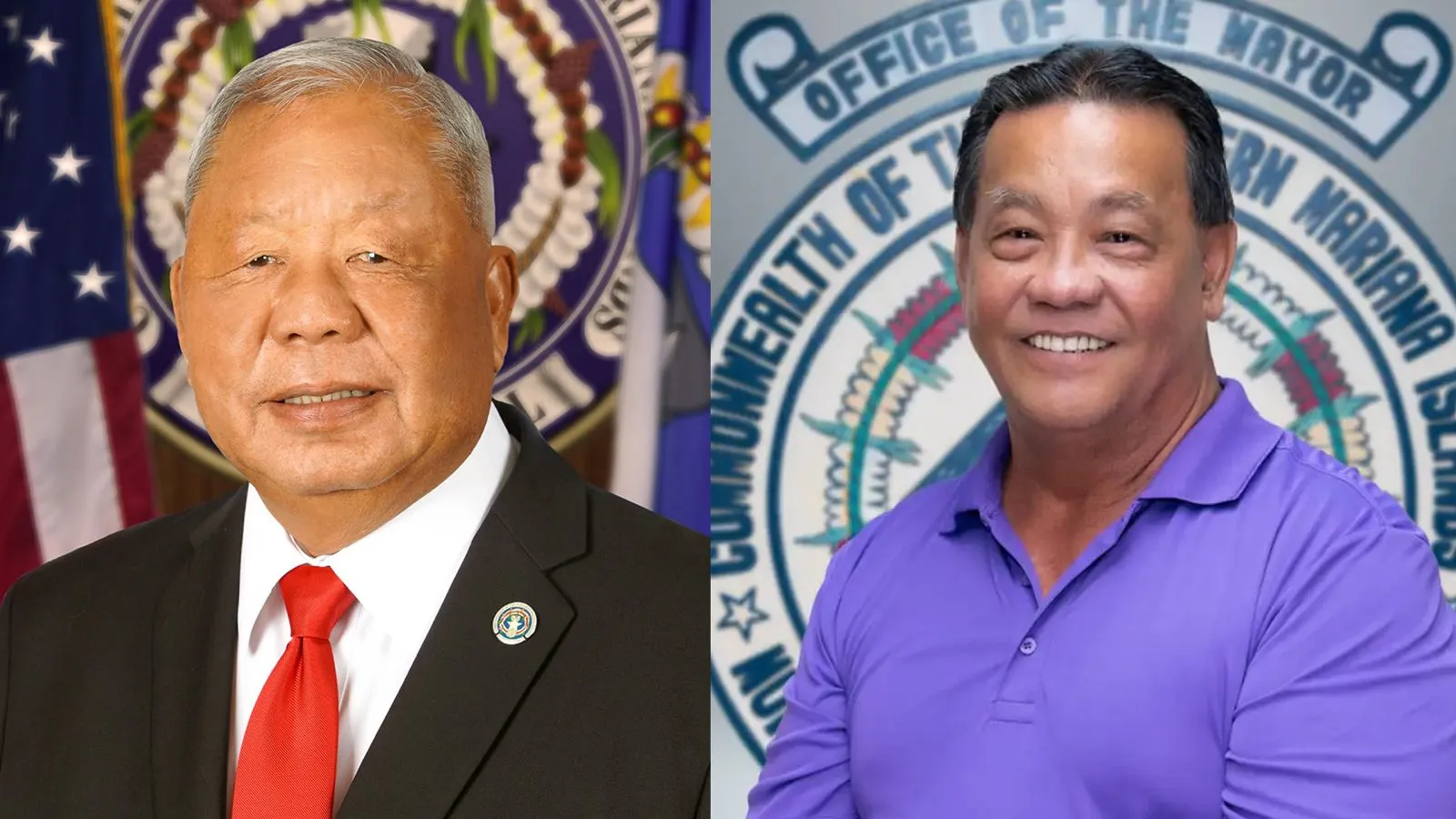



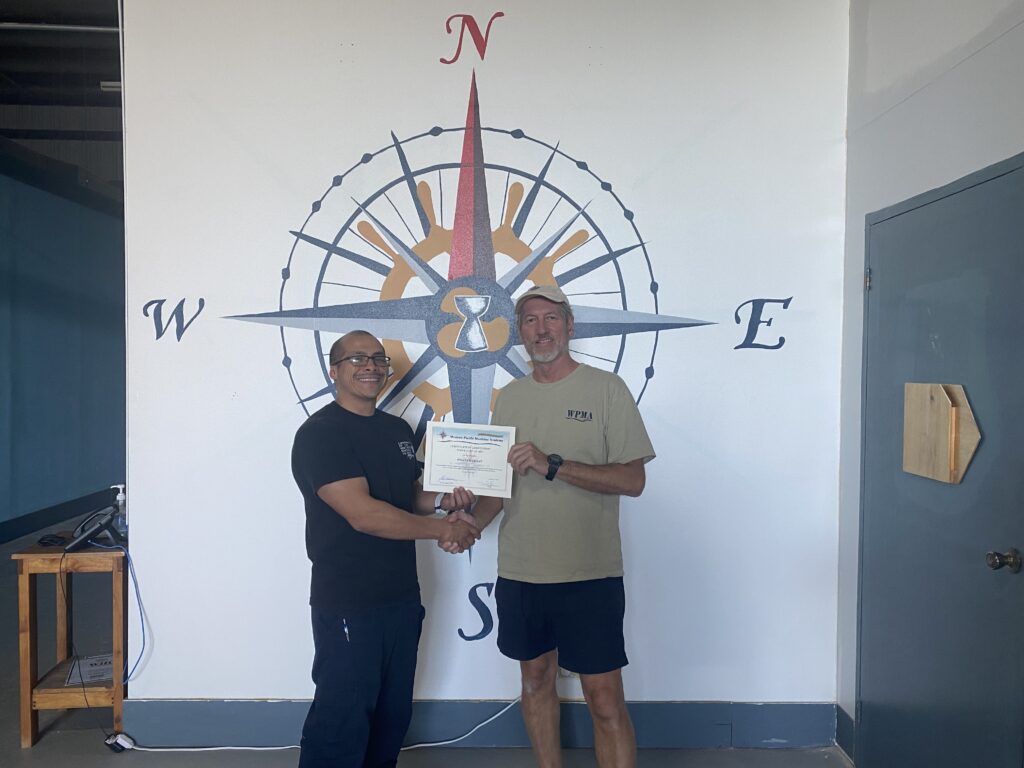
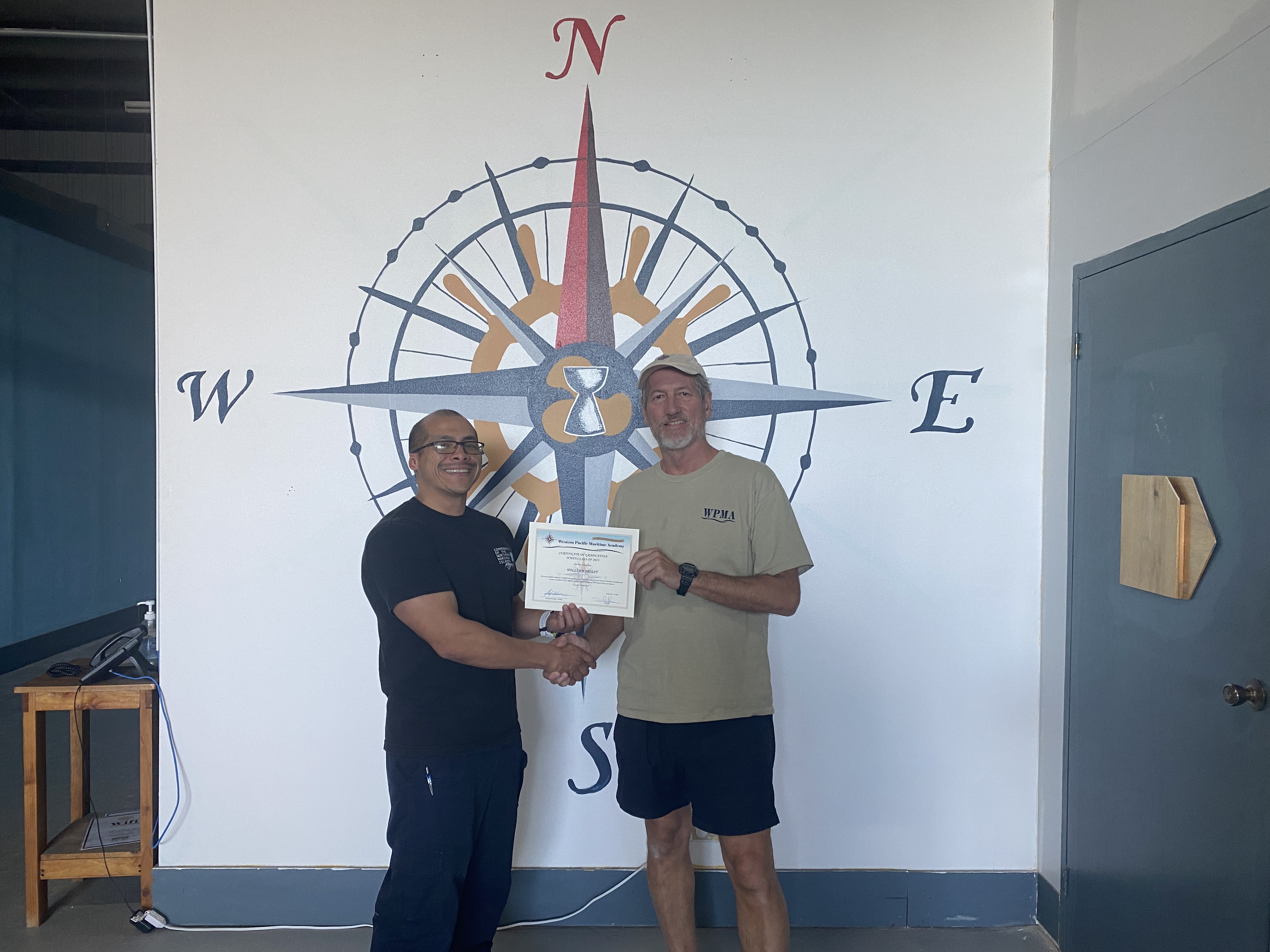
Augustine Diaz, left, and Capt. Michael Bacher.
AUGUSTINE Diaz, a resident of Saipan, will be Western Pacific Maritime Academy’s first candidate to join the Military Sealift Command or MSC as an entry-level civilian mariner, the academy’s executive director, Capt. Michael Bacher, said.
According to the MSC website, it is the provider of ocean transportation for the Department of Defense, and operates around 125 civilian-crewed vessels that “replenish U.S. Navy ships, conduct specialized missions, strategically preposition combat cargo at sea around the world, and move military cargo and supplies used by deployed U.S. forces and coalition partners.”
The average annual salary for an entry-level mariner is from $65,768 to $70,168.
Diaz said the lucrative pay is what drew him to Western Pacific Maritime Training Academy to pursue his Merchant Mariner Credential or MMC.
“I want to do this for my girls,” Diaz said. “I really want to do this for my family.”
At Western Pacific Maritime Training Academy, Diaz took classes in basic personal safety and social responsibility, survival techniques in case of catastrophic events at sea, designated security duties, and more.
Bacher said Western Pacific Maritime Academy is “providing a partial solution to the manning shortfalls affecting the strategic sealift needs of the nation.”
To that end, the academy has partnered with the Public School System, as well as offers classes to the general public, to enable PSS students and residents to enter the maritime trades.
Bacher said Diaz is a “trailblazer” candidate who is on the path to maritime employment opportunities through the Military Sealift Command.
Bacher said around a dozen PSS students who are participating in academy programs are also working toward employment with the Military Sealift Command.
Diaz said he started his employment process in September last year.
The two main challenges he had to overcome involved gaining appropriate security clearances while on Saipan, and finding a vendor that administers a Department of Defense recognized drug test.
Bacher said the academy “worked with the highest levels of manpower” at MSC to overcome these challenges.
He said MSC required an “electronic fingerprinting process” that was not available on island.
But MSC agreed to fly Diaz to Norfolk, Virginia, where an onboarding process is scheduled to take place, and administer the fingerprint recording there.
Bacher said MSC also partnered with a drug testing company on island so that DOD-standard drug tests can be administered locally and then sent out to MSC.
Diaz will leave the CNMI for onboarding on Nov. 25. Afterwards, he will train for his position at sea at the MSC facilities in either New Jersey or California.
“The good news is there’s now a path, because of Augustine, for CNMI residents with an MMC to join the Military Sealift Command directly from here,” Bacher said. “I’m so proud of Augustine because of his can-do-it attitude. He was not going to give up on himself.”
Diaz said aside from taking an opportunity to provide for his family, he’ll also be fulfilling a lifelong desire to be at sea.
“It was something I’ve always wanted to do, but I just wasn’t sure how to go about doing it,” Diaz said. “When I was in high school I said, ‘how do we work out there on those ships?’”
For more information, call Western Pacific Maritime Academy at (670) 323-6609 or go to www.wpma.net/.
