

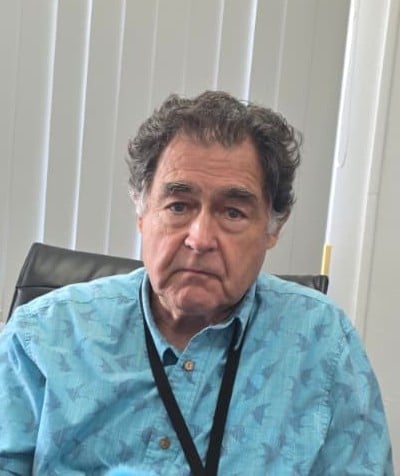






ASSOCIATE Justice Alexandro C. Castro on Friday reinstated Bank of Saipan’s temporary receiver, attorney Randall T. Fennell.
Superior Court Presiding Judge Manibusan, meanwhile, criticized Castro’s “hasty action and lack of judiciousness” when the associate justice removed Fennell as temporary receiver without conducting a hearing.
Manibusan also commended Fennell for doing an “exceptionally good job” as temporary receiver. (See related story on page 3)
“In releasing Fennell from this court’s service, the court confers full judicial immunity upon Fennell,” the presiding judge said.
Following Friday morning’s hearing on acting Commerce Secretary Fermin M. Atalig’s motion to vacate the high court’s May 29 order that removed Fennell, Castro issued an order at 3:50 p.m. reinstating Fennell.
Castro said his May 29 order was stayed, but it would automatically expire upon the Superior Court’s appointment of a new receiver.
“Mr. Fennell is thus reinstated as temporary receiver and shall exercise the powers of that office as provided for by law, except that he may not liquidate bank assets,” Castro said as he urged all concerned parties to work together to fully rehabilitate the bank and return it to solvency, if possible.
In his order filed on Friday at 9:54 a.m. regarding the May 29 receivership hearing, Manibusan said all motions scheduled for hearing were held in abeyance pending the disposition of Bank of Saipan, Inc.’s motion for his disqualification.
“Because the court cannot, at this time, review the receivership, or any motions with regard to the replacement of the receiver, it logically follows that the receiver should continue in his capacity until such time that a review and motions hearing can be held,” Manibusan said.
But Manibusan said Castro in his May 29 order removed the receiver, which placed the Superior Court, Atalig, Bank of Saipan, the receiver and the general public in “a serious quagmire.”
The bank remained in receivership without a receiver, the judge said.
Manibusan said because of the seriousness of Castro’s decision and order and its effects on the proceedings of the trial court, he must address some of the issues raised by the associate justice.
On May 28, Bank of Saipan filed an emergency motion to stay proceedings with the Supreme Court seeking an emergency stay of proceedings and appointment of a “non-conflicted temporary receiver” mandated to work with the board of directors.
Manibusan said the court was concerned with the possible conflict of interest in requiring the receiver to work with the bank’s board of directors when it was the receiver’s responsibility to pursue actions against those who could have committed wrongdoing, including the directors.
Manibusan said on May 29 at 10:10 a.m., during the Superior Court’s hearing, Castro issued an order granting in part emergency motion without thorough review of the trial court’s proceedings.
Manibusan said Castro issued the order ex parte and without a full panel of justices, which appeared contrary to the high court’s own rules.
Castro ordered Fennell and his counsel removed; that the Superior Court proceed with the May 29 hearing and appoint a new temporary receiver with certain duties; and that the Superior Court cease all ex parte communications between any party or attorney in the case.
Manibusan said the high court was eager to overstep its appellate jurisdiction and failed to clarify whether ex parte communications with the Superior Court employees, such as the receiver, who is not a named party, were also barred.
Generally, he said, a judge may have ex parte communications with court personnel.
Moreover, a receiver is considered to be “court personnel” whose function is to aid the judge in carrying out the judge’s adjudicative responsibilities, Manibusan said.
As the respondent to the emergency motion, the Superior Court did not receive a fair and adequate opportunity to reply to the “highly charged and overly exaggerated statements and accusations contained in the motion, nor did it have the opportunity to attend a hearing,” Manibusan said.
Castro’s order contains no reasoning or case law to support the actions, or the authority to take such actions, he added.
Further, the Supreme Court did not explain why it acted ex parte, and proceeded without giving hearing to both sides of the issue, Manibusan said.
“Had the Supreme Court allowed the parties to be heard, it would have discovered that the proceedings were not spiraling out of control and that the Superior Court had not acted inappropriately,” Manibusan said.
The Supreme Court, however, has acted and the Superior Court, understanding its place in the judicial system, will comply with the order, Manibusan said.
Manibusan said the trial court cannot, however, appoint a new temporary receiver as mandated by the Supreme Court due to Bank of Saipan’s motion for disqualification.
Manibusan said the actions of Bank of Saipan, Inc. and Castro stopped the receivership proceedings “dead in their tracks, thus placing Bank of Saipan and its directors, shareholders and depositors in a precarious and unprotected position.”
The motion for disqualification of the judge is set for hearing on July 2 at 9 a.m. before Associate Judge Juan T. Lizama.
Manibusan said Fennell’s actions in preserving assets and protecting the depositors of the bank “were nothing less than professional and exemplary.”
He said Fennell’s actions, observations, conclusions and solutions were based solely on information provided by the bank and were further corroborated by outside, impartial financial consulting sources.
