





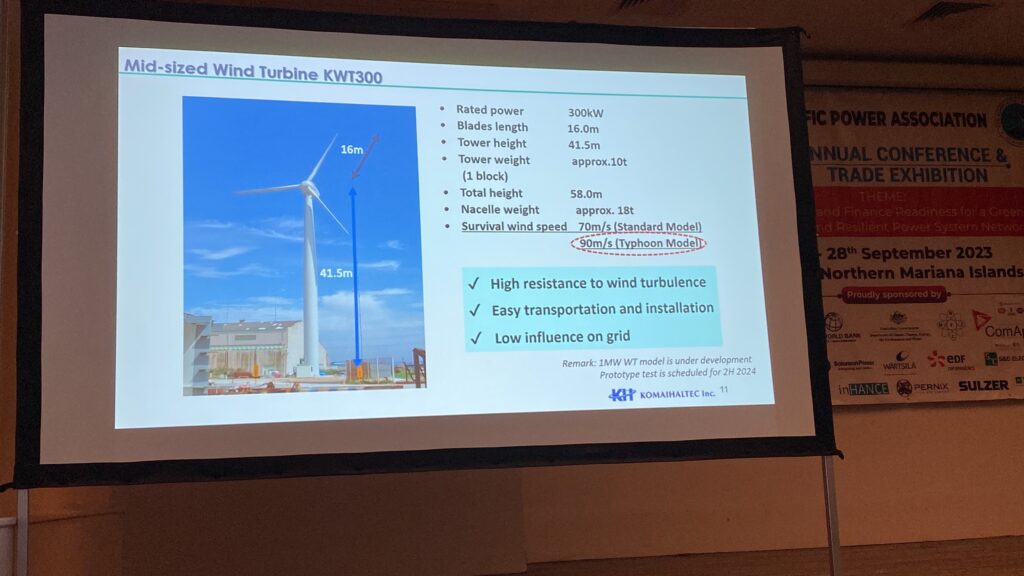
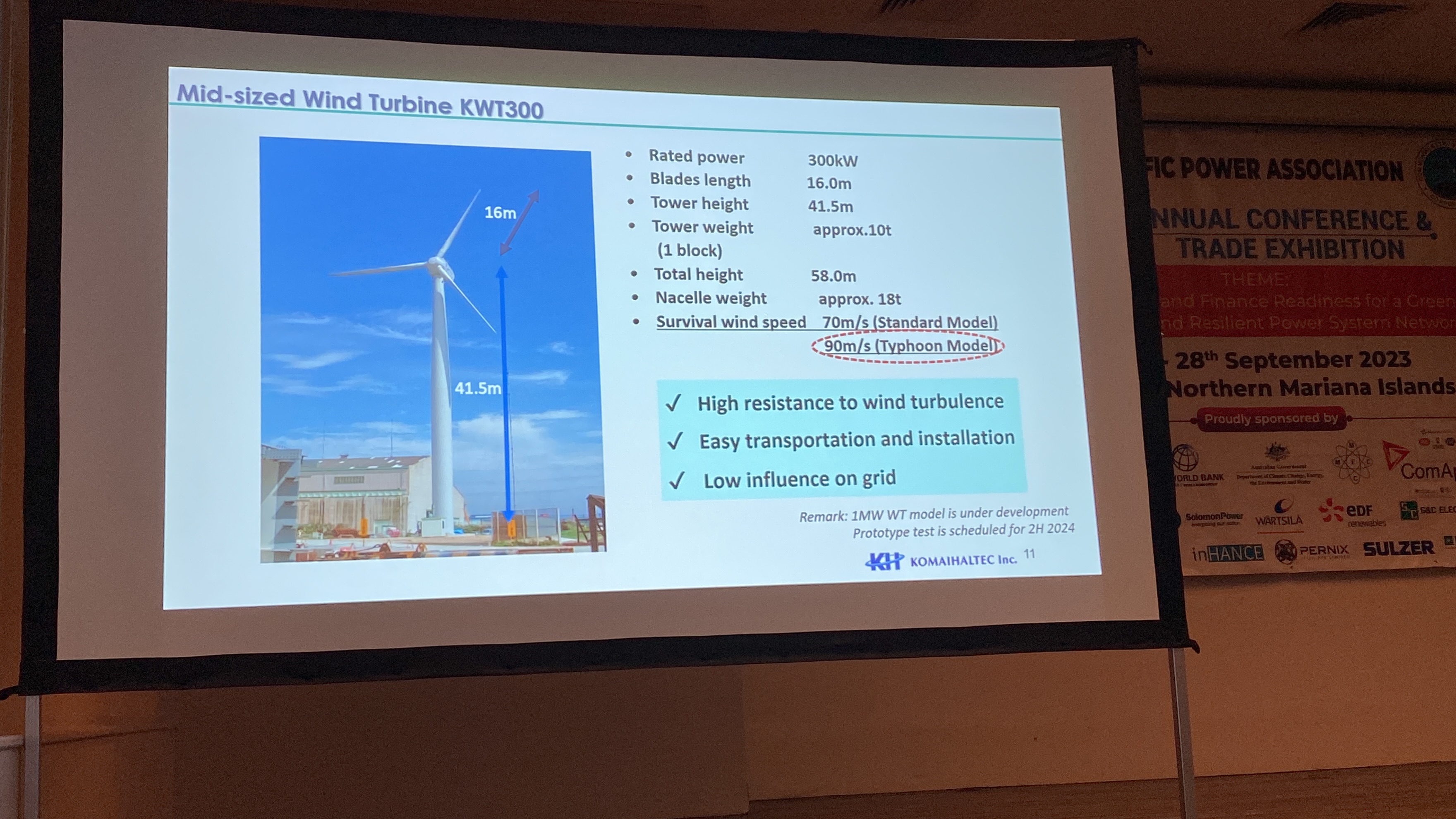
This image shows a 300 KW wind turbine that can withstand typhoon-force winds, according to Ekaterina Zalitko of Komaihaltec Inc.
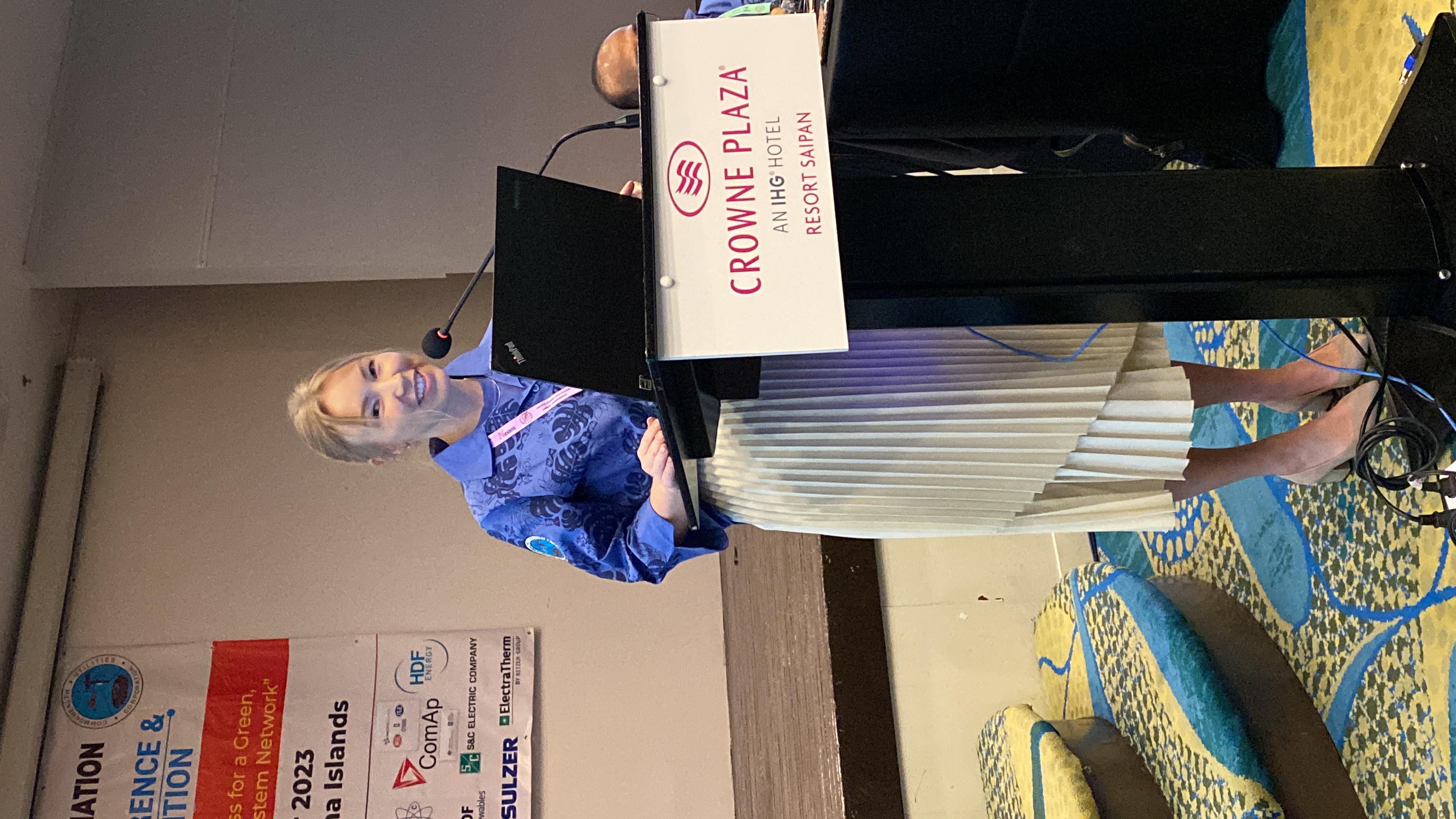
Ekaterina Zalitko of Komaihaltec Inc.
AT the Pacific Power Association’s Annual Conference and Trade Exhibition at Crowne Plaza Resort on Tuesday, Komaihaltec Inc.’s Renewable Energy and Overseas Business Representative Ekaterina Zalitko outlined two ways that Japan and the Pacific islands could partner to bring renewable energy projects to this part of the world.
Zalitko said Komaihaltec is well-known in Japan for its steel bridge and steel frame manufacturing. According to the company’s website, it has facilities in Futtsu, Chiba Prefecture, and Yura, Wakayama Prefecture. The company’s first renewable energy system — a wind turbine project — was commissioned in 2006 at its Futtsu facility.
Zalitko said the Japan-based company produces wind turbines and solar energy systems.
She said Pacific islands can finance her company’s services through energy service agreements or a joint crediting mechanism.
Zalitko said under an energy service agreement, Komaihaltec would front the cost of equipment and perform routine and emergency maintenance. In turn, the partnering country would pay a fee every month, quarter, or other agreed-upon term.
As for a joint crediting mechanism, Zalitko said it is an agreement made on the “intergovernmental level” between Japan and the partnering nation.
Zalitko said details will vary, but essentially, Japan will provide the partnering country with renewable energy technology and, in exchange, Japan gets carbon offset credits.
“There is an option for a utilities company or a [partnering island] to receive the equipment or technologies from Japan free of charge and then settle this cost through carbon credits,” Zalitko said.
She took some time in her presentation to address challenges associated with renewable energy in the Pacific.
She said it is “pretty ambitious” for Pacific countries to be expected to meet carbon neutrality goals set by the United Nations and International Energy Agency.
The IEA has a goal of zero net emissions in the world economy by 2050.
“For the Pacific region this target is quite challenging as well because a lot of people live in remote areas and remote areas are always difficult from the standpoint of funding and project implementation and construction as well,” Zalitko said.
She said her company is open to partnerships that can bring wind and solar energy to the Pacific.
“We are always open to discuss funding options for our clients,” Zalitko said. “The energy transition is always a challenge, but the Japanese government is very interested in cooperation with the Pacific islands, and we would like to bring new technologies and opportunities here as well.”
Zalitko said in terms of wind turbine production, work starts with site selection.
“We select the site to provide measurement services and make model assessments. Then [we] move to agreement, conclusion, and implementation stage, and decide on funding options.”
Zalitko said Komaihaltec can install a 300kw wind turbine.
“Our model is adapted for typhoons,” she added. “The survival speed for our wind turbine is designed at 90 m/s because in Japan we also have remote islands with very strong winds, so this model is developed and tested for these islands as well.”
Apart from wind turbines, Komaihaltec also designs sky solar systems, which are raised above ground and can double as a cover for a parking lot, Zalitko said.
