







By Glen Hunter
Private Citizen
FOR decades, people in the U.S. Pacific territories have lived under an air travel system that was never designed for island communities like ours.
Federal air cabotage rules prevent foreign airlines from carrying passengers between two U.S. points. On the mainland, that policy may be defended as a way to protect domestic carriers. But in the CNMI, Guam, and American Samoa, the practical result has been limited service, high fares, weak competition, and too few options on routes that are essential to daily life.
For years, pushing for change felt like talking to a wall. The airline lobby was strong. The political will was weak. And the burden on our communities was treated as an unfortunate side issue.
That began to change about three and a half years ago.
The late Governor Arnold I. Palacios helped bring this issue directly to Washington. Working with the governors of Guam and American Samoa through the Interagency Group on Insular Areas and the National Governors Association, he helped move air cabotage reform into the national conversation. It was the first time I can remember seeing all three U.S. Pacific territory leaders speak on the issue and with one clear voice.
In Guam, at that time, Ginger Cruz made cabotage waiver reform a major part of her congressional platform. Guam Delegate James Moylan later introduced legislation in Congress and brought former CNMI Delegate Gregorio “Kilili” Sablan on as a co-sponsor. Following Governor Palacios’s passing in office, then-Lt. Governor David M. Apatang assumed the governorship and continued the CNMI’s push for cabotage relief.
This week’s Senate Energy and Natural Resources Committee hearing showed just how far the discussion has come. What once sounded like a distant policy debate is now being tied directly to the real problems our people face every day.
During the hearing, Guam Governor Lou Leon Guerrero put hard numbers to what island residents experience every day: a flight from Guam to California can cost as much as $4,000, while travel to Hawaii can run between $2,000 and $3,000. These are not luxury vacations. For many families, they are lifeline trips for medical care, emergencies, education, military service, government work, and access to the mainland.
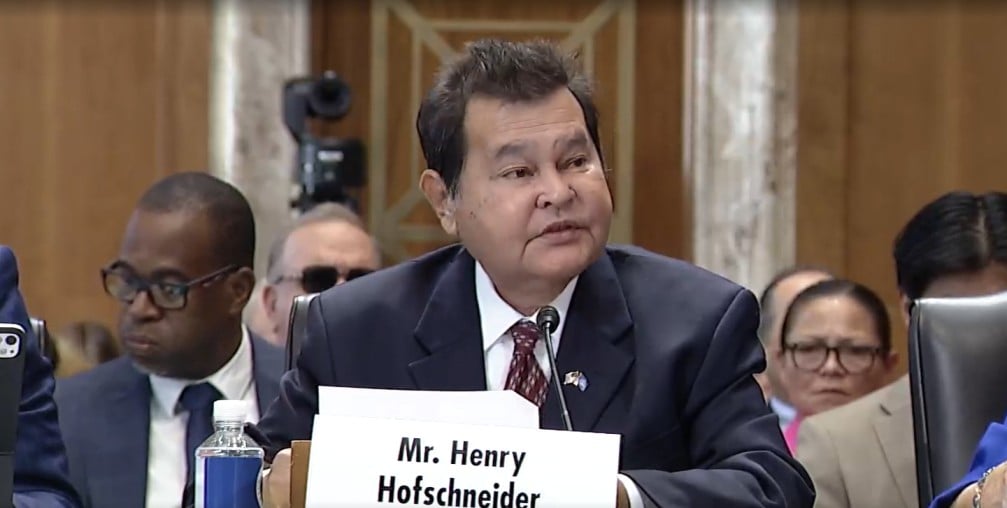
CNMI Governor’s Chief of Staff Henry Hofschneider brought the point home for the Marianas. With United Airlines effectively controlling travel, a simple round-trip flight between Saipan and
Guam costs about $600. That means elderly residents, veterans, patients, and working families are being forced to shoulder unnecessary financial hardship just to access basic medical care and essential services on Guam.
And those problems are not theoretical.
Right now, the CNMI is still recovering from Super Typhoon Sinlaku, one of the most damaging storms in our history. Two months into recovery, large parts of Saipan remain without power. During this critical period, ordinary travelers have been unable to buy a regular seat from Saipan to Guam for travel between June 7 and June 27. The only mainline carrier has restricted availability, reserving seats for passengers connecting through Guam to other destinations, and forcing those purchases at business-class prices.
That matters because this is not normal travel during normal times. We are in a declared disaster area. FEMA is helping residents whose homes were left unlivable. Families are trying to recover. Patients still need care. Businesses still need supplies. Government agencies and relief organizations still need reliable transportation.
Yet people in the CNMI are being cut off from the most basic air connection to Guam, our nearest major hub for relief, medical care, cargo movement, and family support.
Even worse, when local booking availability finally returns, the resident fare that was introduced a couple of years ago is no longer available.
This is what happens when an essential route has no competition.
Before the pandemic, a round-trip flight between Saipan and Guam cost about $250. After travel restrictions eased, we briefly saw how important reliable air access could be for local residents, regional commerce, military travel, and our tourism economy.
Then, a few months into the pandemic recovery, United raised the round-trip fare from Guam to Saipan to $599 overnight, with no meaningful explanation. Local officials pushed back, but nothing changed. Later, United introduced a resident fare between $299 and $399, but it came with serious restrictions: no checked bags, no seat selection, no refunds, and no changes.
That may have helped some local travelers, but it did nothing to support tourism and help our economy. No typical visitor is going to pay $599 for a 40-minute flight between islands.
That is the real problem. The pricing makes no sense unless you understand that our skies are effectively controlled by one carrier.
Today, travelers can sometimes find round-trip fares from Saipan or Guam to South Korea for $200 or less. They can also find round-trip tickets from Saipan to Japan, through Guam and on the same aircraft, for less than $500. That is less than the Saipan-to-Guam leg by itself.
That should tell Washington everything it needs to know.
This is not a normal market. It is a distorted market created by federal policy, geographic isolation, and the absence of meaningful competition.
During the Senate hearing, Governor Leon Guerrero and Chief of Staff Hofschneider spoke plainly about what this means for our people. Families are being priced out of basic travel. Elderly veterans are spending too much money, time, and emotional energy just to get to Guam for medical care. Residents are being asked to absorb mainland-style airline policy in a region where there is no mainland alternative.
For once, Washington seems to be listening.
Senate Energy and Natural Resources Committee Chairman Mike Lee called air cabotage the “Jones Act of the skies.” He acknowledged that the current system unfairly harms our communities and said the old arguments for protecting domestic airlines do not outweigh the burdens placed on the Pacific territories.
That matters. But acknowledgment is not enough.
We cannot wait years for Congress to move at its usual pace while our people continue paying outrageous prices for essential travel or being cut off to air travel completely. We need action now.
The fastest path is immediate federal action. The administration should direct the U.S. Department of Transportation to use every available authority to grant targeted, regional relief from air cabotage restrictions for the U.S. Pacific territories.
That relief should allow qualified foreign carriers that meet U.S. safety, security, and operational requirements to serve routes between the CNMI, Guam, and American Samoa, where domestic competition is inadequately served by one domestic carrier.
This is not about replacing U.S. carriers. It is about giving U.S. island communities access to the same basic market condition that most Americans take for granted: competition.
If a U.S. carrier can provide reliable service at fair prices, it should compete and win. But if a route is essential to public health, disaster recovery, military readiness, tourism, cargo movement, and family life, one airline should not be able to control access to it simply because federal law blocks other capable carriers from entering the market.
More competition would mean lower fares, better service, more reliable cargo movement, stronger tourism, and real relief for families and businesses.
If the administration cannot act immediately under existing authority, then Congress must act. Senator Lee and the Senate Energy and Natural Resources Committee should move quickly on bipartisan legislation granting the Pacific territories the cabotage waiver we have needed for years.
This should not be a partisan issue. It is a fairness issue. It is an economic issue. It is a disaster recovery issue. It is a national security issue. And for families in the CNMI, Guam, and American Samoa, it is a daily-life issue.
The wall that has blocked us for so long is finally starting to crack. Our local and regional leaders have done the groundwork. Washington is finally paying attention.
Now it must act.
It is time to fix the Jones Act of the skies, end monopoly conditions on essential Pacific routes, and give the people of the CNMI, Guam, and American Samoa a fair chance to fly.
