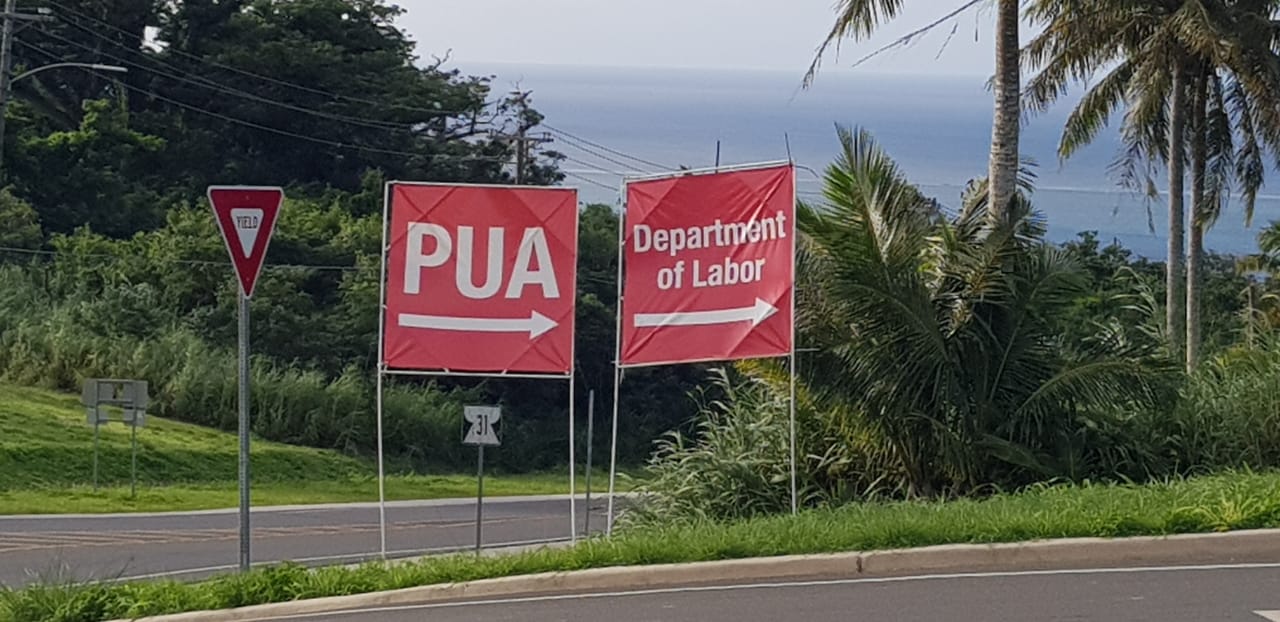


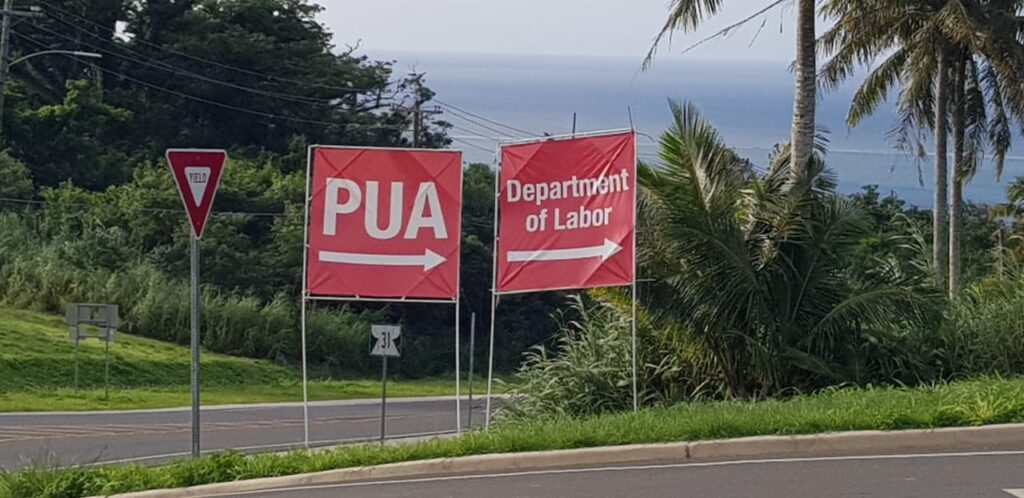
(CNMI DOL) — On Feb. 15, 2022, the local Department of Labor announced that 99.7% of all initial Pandemic Unemployment Assistance claims in the CNMI had been inspected and adjudicated (approved or denied). The department received over 39,000 PUA claims during its application intake process from June 17, 2020 to October 16, 2021.
• Claims received: 39,174
o Non-CNMI jurisdiction/fraud claims: 18,002
o CNMI jurisdiction claims: 21,172
• Claims approved: 9,749
• Claims denied: 29,312 (inclusive of non-jurisdiction/fraudulent claims)
• Claims pending: 113
The remaining claims were those received during the American Rescue Plan Act periods of assistance (March 14 to October 16, 2021) and beyond.
According to CNMI Labor Secretary Vicky Benavente, “While the periods of assistance afforded by the ARPA has ended for several months now, the PUA program has not closed its door to the community at large.”
She added, “The department is still open to serve individuals who wish to submit a claim because we want to ensure that we account for those who were not able to submit claims for the allowable periods of assistance due to exigent circumstances”
Benavente said her department has been “challenged with the increase in the number of staff affected by the Covid-19, which has caused more delays in the processing of PUA claims, but we will continue to help everyone, and expedite claims in accordance with federal rules and guidelines.”
Payment disbursements
Benefit payment disbursements to PUA claimants do occur on a weekly basis. To date, the department reports that $134,695,316 in PUA and $137,652,030 in FPUC benefits, totaling $272,347,346 have been disbursed to eligible claimants.
Overpayments and waivers
As recently as February 7, 2022, the U.S. Department of Labor published further PUA guidance through Unemployment Insurance Program Letter or UIPL Number 20-21, Change 1. A copy of this publication can be found at the CNMI DOL website, www.marianaslabor.net, under “Forms & Publications.”
The UIPL elaborates on the criteria for waiving the recovery of overpayments where an individual is without fault on an individual, case-by-case basis and expands the existing limited scenarios for permissible use of “blanket waivers.” In addition, fraudulent overpayments may never be waived.
Further, two conditions must be met prior to the territory (in this case, the CNMI) waiving any overpayments: (1) Payment of such compensation was without fault on the part of any such individual and (2) such repayment would be contrary to equity and good conscience.
The UIPL also provides seven scenarios for states or territories to use blanket waivers, but only five of the seven apply to the CNMI:
1) The individual answered “no” to being able to work and available for work and the state paid PUA or Pandemic Emergency Unemployment Compensation or PEUC without adjudicating the eligibility issue. Upon requesting additional information from the individual, the individual either did not respond or the individual confirmed that they were not able to work nor available for work for the week in question, resulting in an overpayment for that week.
2) When an individual is eligible for payment under an unemployment benefit program for a given week, but through no fault of the individual, they were instead incorrectly paid under either the PUA or PEUC program at a higher Weekly Benefit Amount or WBA.
3) The individual answered “no” to being unemployed, partially unemployed, or unable or unavailable to work because of the approved Covid-19 related reasons and the state paid PUA anyway. Upon requesting a new self-certification, the individual either did not respond or the individual confirmed that none of the approved Covid-19 related reasons were applicable, and the state’s payment resulted in an overpayment for that week.
4) Through no fault of the individual, the state paid the individual a minimum PUA WBA based on Disaster Unemployment Assistance guidance that was higher than the state’s minimum PUA WBA provided in UIPL No. 03-20, which resulted in an overpayment.
5) The individual complied with instructions from the state to submit proof of earnings to be used in calculating their PUA WBA. However, through no fault of the individual, the state’s instructions were either inadequate or the state incorrectly processed this calculation using self-employment gross income instead of net income or documents from an inapplicable tax year, resulting in an incorrect higher PUA WBA. The state or territory establishes an overpayment for the difference in PUA WBA.
Finally, the UIPL states that when an overpayment does not meet the criteria for recovery to be waived or the state does not exercise the authority to waive certain overpayments, the state must require the individual to repay the amount to which they were not entitled.
According to the CNMI Department of Labor, as of today, all overpayment waivers, whether individual case-by-case or blanket, will go through an appeals process. The department is currently vetting all overpayment cases to determine whether claims meet any of the blanket waiver criteria and will be notifying claimants who are eligible for waivers. The department also recognizes the importance of streamlining its waiver procedures and will be notifying applicable claimants on an individual basis.
To date, the CNMI PUA program’s Benefit Payment Control or BPC unit has identified $32,481,549 in overpayments and has collected $28,896,200.
PUA appeals process
The department establishes a PUA appeals process through its Administrative Hearing Office or AHO. According to the AHO, the following process has been established for PUA cases:
1) Request to appeal: Requests must be filed at the Administrative Hearing Office within ten calendar days after the determination, redetermination, or notice of overpayment is issued.
2) Notice of hearing: A notice of hearing will be issued with a date and time for the hearing including instructions on how to prepare for the hearing.
3) Hearing: The hearing will be held and the hearing officer will consider all relevant evidence to determine if the determination, redetermination, or notice of overpayment was correct.
4) Decision: The hearing officer will issue a written decision regarding the outcome of the appeal case.
5) Request to reopen: In the event the appellant would like to contest the decision, the appellant must file a written request to reopen with legal, factual, or evidentiary reasons as to why the decision was wrong.
6) If request to reopen is granted: If a request to reopen is granted, a second hearing is conducted, and a final decision is issued.
7) If request to reopen is denied: If a request to reopen is denied, the original decision is final.
8) Judicial review: If the appellant disagrees with a final decision, the appellant may seek judicial review within 30 days at the CNMI Superior Court.
The AHOs PUA appeals process can also be found at the department’s website under “Divisions,” then “Administrative Hearing Office,” under “Resources” or https://www.marianaslabor.net/default.asp?secID=24
As a reminder, claimants are responsible for providing true and accurate information, reading the PUA benefit rights information handbook, and complying with requests for information. To maintain program integrity and prevent fraud or overpayments from occurring, PUA program.
For more information, contact the CNMI Department of Labor – PUA Program at tel. 322- 8870/8871/8872/8873/8874 or email [email protected]