

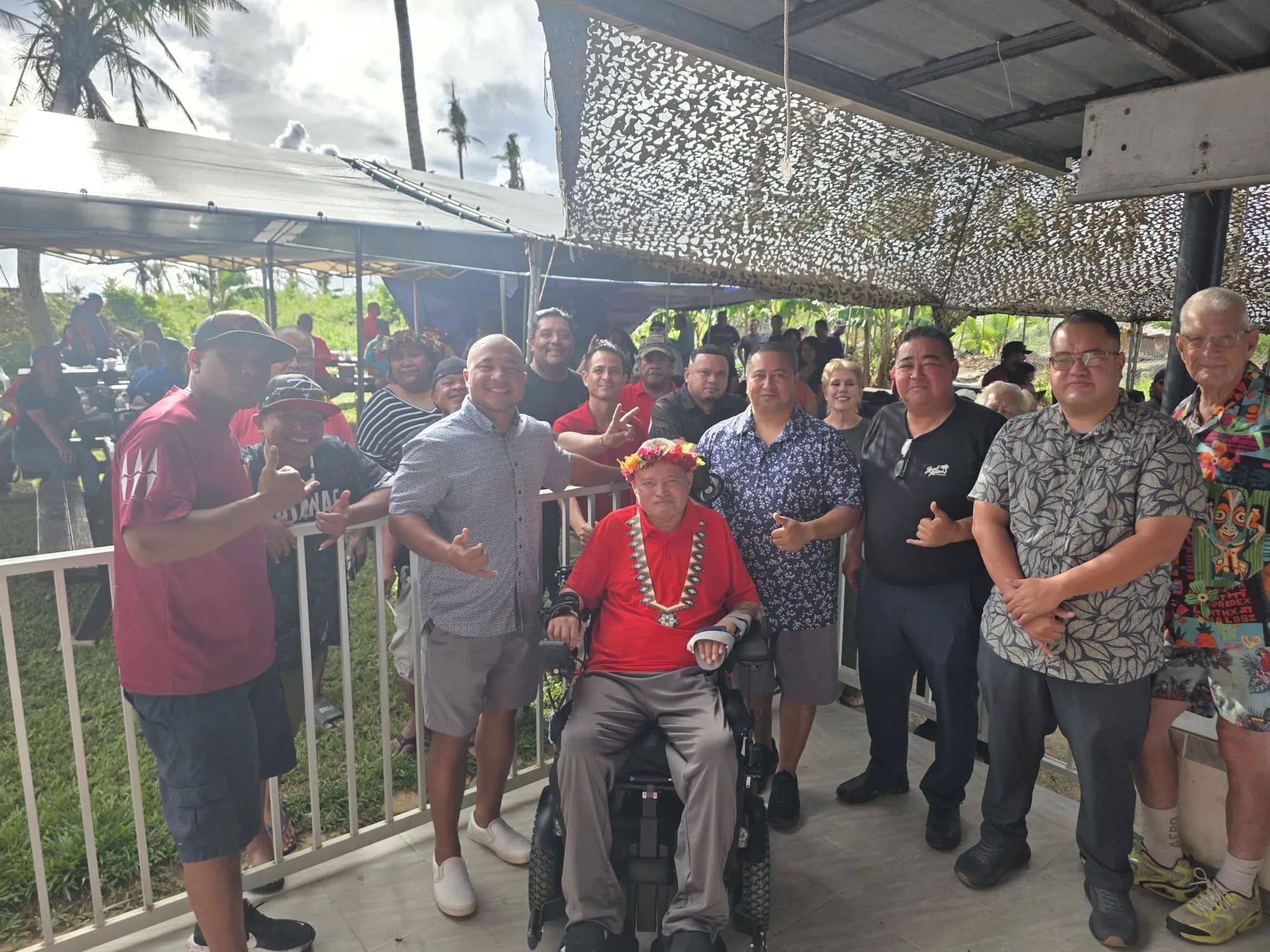



Furthermore, the Aeronautical Dolphins have become the first aviation class from the Northern Marianas Islands to have had the privilege of being escorted inside the gated area of Andersen AFB, by Patricia Gay, public affairs officer, and Colonel Chuck, a retired B-52 pilot.
We started our journey within the gated area on the flight line. The flight line had the following types of aircraft park on the tarmac listed as followed: the F-15 (fighter), the C-130 (Transport), the C-17 (Transport), the KC-135 (Transport and Tanker) and last but not least the B-52 (Bomber).
We spent the majority of our time on the flight line with the B-52 aircraft, because it was undergoing a major inspection. Furthermore, when an aircraft is going through this type of inspection, a large number of maintenance personnel must be in the area to perform specific jobs on specific systems. Thus, the students had access to ask questions to the following types of technicians: Aircraft Electricians, Aircraft Hydraulic Specialist, Aircraft Brake Specialist, Aircraft Fuel Systems Specialist, Aircraft Avionics Specialist, and Aircraft Pneumatic Specialists. Fortunately, when time allowed, students were able to speak to these highly qualified professionals with the premise of gaining some insight to their job/responsibilities.
The crew-chief, pictured to the extreme right of the selected photo, is responsible for coordinating all of the maintenance activities performed on the aircraft. The crew-chief is special, because he must be able to speak and understand the specialize languages of each specialized technician.
Furthermore, the crew-chief, redirected some time out of his busy schedule to show us some of the unique features of the B-52 Aircraft. The Cross Wind Crab was one of the features described. The Crew-Chief said that the Cross Wind Crab System, allowed the landing gear to align with the runway, regardless of the wind direction. The students were appreciative of the Crew Chief; however, due to a tight time schedule, we had to leave for the next destination, which was the Air Traffic Control Tower.
The Control Tower at Andersen AFB is the tallest free standing tower in the Department of Defense. Free standing means that it is not attached to a building. The Control Tower is fifteen stories tall. The first thirteen stories are accessible by an elevator and the top two stories are accessible by a ladder.
When we all made it to the top, we were greeted by Technical Sgt. Jason Trickley. Jason was the air traffic controller on duty. Jason told us that we were not allowed to take pictures because the equipment that was being used is considered highly classified.
At this point, students started asking Jason questions about his job and responsibilities. One question that I recalled was about math knowledge. Jason said that knowledge of vectors, slopes, and an all around strong background in math is a must.
I asked Jason, during peak operations, what was the maximum capacity of aircraft that the base could support? Jason responded by saying around 127 aircraft. He further added that it was the responsibility of himself and his co-workers to maintain proper separation of aircraft in order to prevent midair and ground collisions.
For the record, Jason communicated with an aircraft while we were in the tower. He basically, gave the pilot clearance to proceed through Andersen AFB airspace in order to expedite his/her landing at Guam International Airport.
Again, we had to say goodbye and prepare for our next destination. So everyone said goodbye to Jason and that amazing Air Traffic Control Tower, which by the way, has an excellent view of Rota.
Next on the agenda, was the Air Force Museum which is located next to the terminal? At the museum Colonel Chuck took over. At first, the Colonel allowed us to look around until his model aircraft collection caught our attention. Colonel Chuck has a collection of WWII and Pre WWII model aircraft. His collection is enclosed in a glass case and the models are immaculately constructed. Next to the models was a mock up of an aircraft cockpit, complete with engine throttle levers, instruments, seats and harnesses.
After giving us time to admire the museum, Colonel Chuck gathered us together and told us one of his amazing stories about the B-29’s. Colonel Chuck is an excellent story teller and we all gained inside knowledge about the second B-29 that took off from Tinian and all the events that prevented it from hitting its primary target. Most people are unaware of these details.
Finally, we viewed the B-52 static display, which is located toward the front gate. Colonel Chuck told us about the differences between the older models B-52’s as compared to the newer models. For an example, the outer wing external fuel tanks of the early model is much larger than the newer model.
After viewing the static display we said our goodbyes and parted ways.
Next, year we want to fly on the KC-135, however according to Patricia Gay we must provide a 60 day notice, receive permission from parents, and get a physical. Since, we are now fully aware of these requirements, it will be our future goal to secure a spot on a KC-135 aerial refueling mission.
The Aeronautical Dolphins would like to take this time to thank the following people for their part in making our trip a honor and a success: Congressman Gregorio Kilili Camacho Sablan, Microl Toyota general manager Douglas Brennan, Education Commissioner Rita Sablan, Colonel Chuck, Patricia Gay of AAFB, Brig. Gen, John Doucette, commander 36th Wing/AAFB, USAF Staff Sgt. Frank Hernandez, USAF Technical Sgt. Jason Trickley and the crew-chief, USAF B-52.
Thanks for a good year from the Aeronautical Dolphins.
(The author is the adviser of Marianas High School’s aeronautics class.)
