




By Bryan Manabat
[email protected]
Variety News Staff
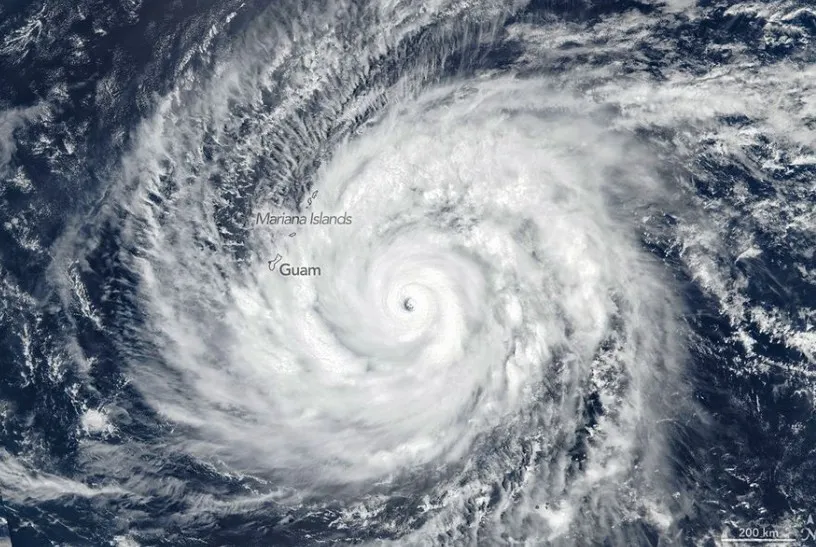
TWIN brothers Brandon and Landon Aydlett, National Weather Service Guam meteorologists who have become familiar voices across the Marianas during major storms, said Typhoon Sinlaku’s slow, punishing passage delivered one of the longest extreme-wind events ever recorded in a U.S. jurisdiction — and may not be the last major system to threaten the region this year.
Brandon Aydlett, meteorologist-in-charge, told Variety on Wednesday that Sinlaku likely reached upper-end Category 4 intensity — around 150 mph or greater — as it crossed Tinian and Saipan. With communications knocked out at the height of the storm, forecasters lost access to surviving sensors on the airfield.
“Most often in these strong typhoons, the wind sensors do not survive,” he said. “In Sinlaku, the equipment survived, but communications failed.”
What set Sinlaku apart, Brandon said, was its agonizingly slow movement, which kept destructive winds over the islands for nearly a full day.
“We had an extreme wind warning issued for 22 hours. I don’t know of any other place in the U.S. where that has happened,” he said.
The storm stalled repeatedly — first over Chuuk for three days, then creeping toward the Marianas at only 5 to 6 mph — allowing weak steering currents to nudge its track northward from Guam to Tinian and Saipan.
The Aydlett twins arrived on Saipan as part of a rare second post-storm mission focused not only on physical damage, but also on social science: how residents received, understood, and acted on warnings.
“We really wanted to continue those conversations,” Brandon said. “The social science, the preparedness of people before the storm, going through the long ordeal of this slow-moving storm, and then assessing things in the aftermath.”
Landon Aydlett, warning coordination meteorologist, said the community’s strong response — including early sheltering and widespread public awareness — contributed to zero on-island fatalities despite the storm’s severity.
“Preparedness was on point where it should be,” he said. “People went to shelters early, and that made a difference. Zero lives lost on the islands is something this community should be proud of.”
Landon said the Weather Service has expanded its communication strategy in recent years, using Facebook Live briefings, direct emails, and more visual products to reach households that may not closely follow formal advisories.
“We’ve been doubling down on how we communicate — visually, on social media, through Facebook Live, and direct emails,” he said. “We want to make sure our information gets down to the outermost village, the outermost household.”
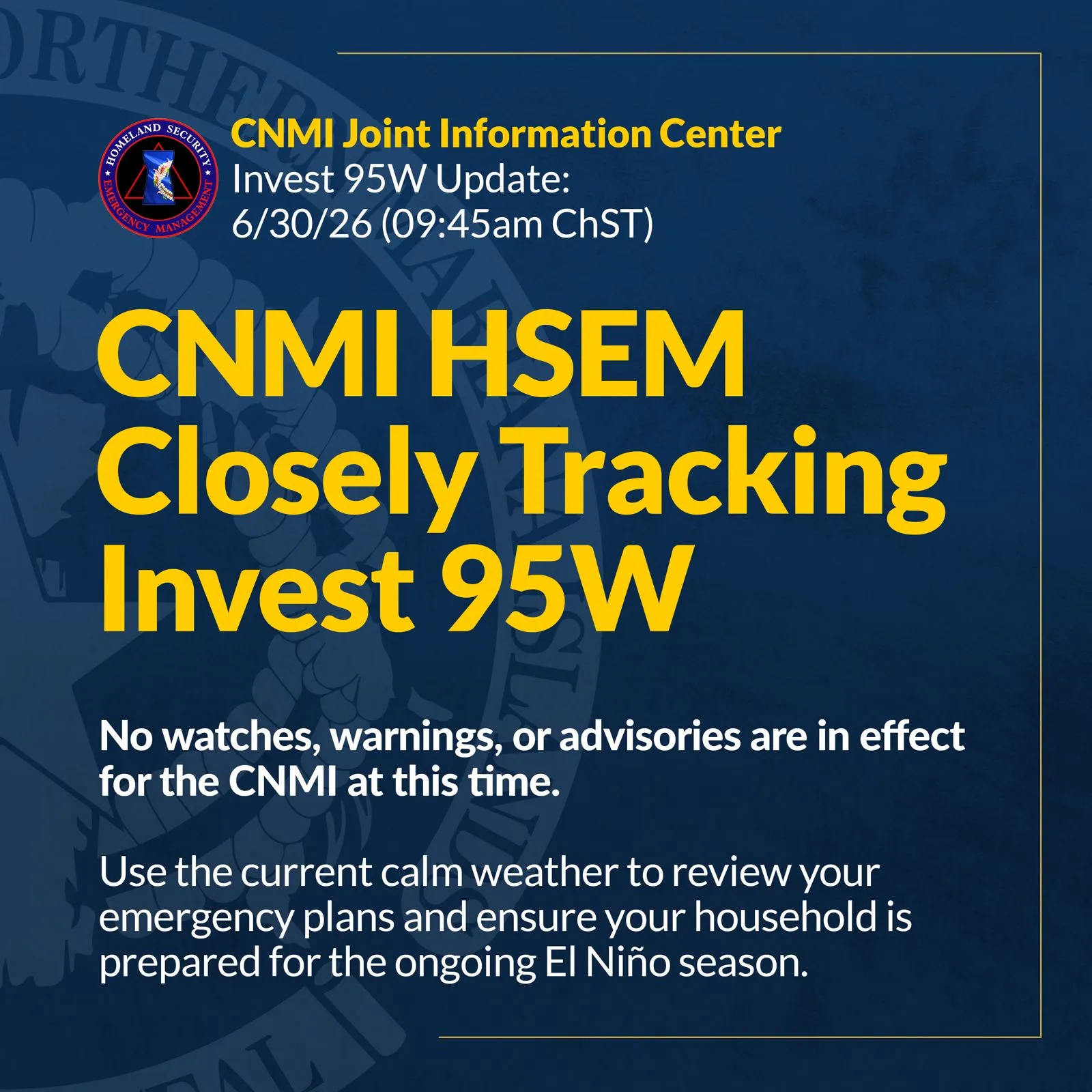
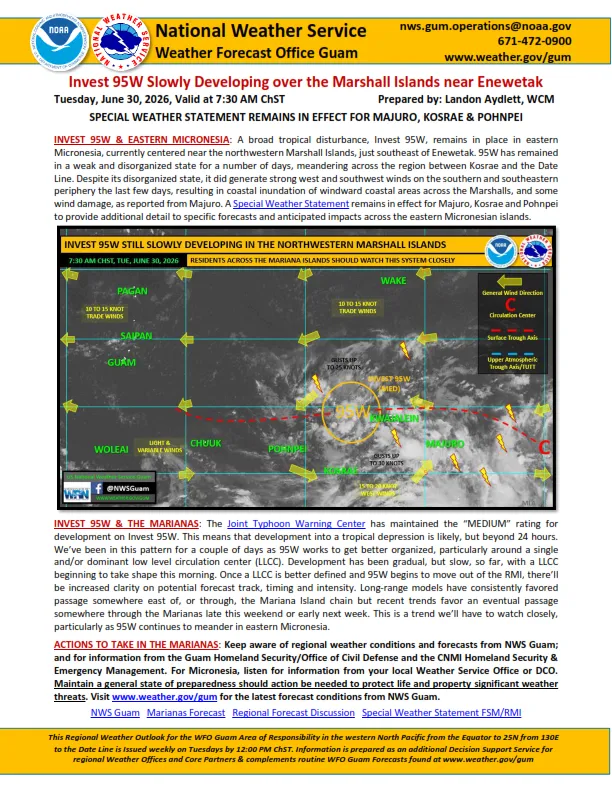
But even as the islands recover from Sinlaku, the twins warned that a strong El Niño is building across the Pacific, shifting tropical cyclone formation eastward into the Marshall Islands and Eastern Micronesia — a pattern that historically places the Marianas directly in the path of developing storms.
“When we have a strong El Niño, Central Pacific waters warm up,” Brandon said. “That’s where tropical cyclones start to generate. When systems form over there, that puts the Mariana Islands in the crosshairs.”
He said the region should prepare for the possibility of another major typhoon this season, especially with infrastructure still weakened by Sinlaku’s widespread damage.
“Sinlaku was a devastating hit to Saipan and Tinian. It may not be our last one,” he said. “We need to make sure we’re fully prepared this year.”
Beyond the heightened storm threat, Brandon said the islands are likely to face a much drier dry season from January through June 2027, raising wildfire concerns as storm debris dries out.
“Think of all the debris, all the vegetation that fell during Sinlaku,” he said. “This is all going to dry out. That increases our wildfire potential when we don’t have rainfall.”
The Aydlett twins — who have guided the Marianas through Yutu, Mangkhut, Mawar, and now Sinlaku — said residents should treat 2026 as a year requiring maximum readiness.
“If there are lessons you wish you had acted on before Sinlaku, make that list now,” Brandon said. “We could be even more vulnerable with our damaged infrastructure.”
Bryan Manabat was a liberal arts student of Northern Marianas College where he also studied criminal justice. He is the recipient of the NMI Humanities Award as an Outstanding Teacher (Non-Classroom) in 2013, and has worked for the CNMI Motheread/Fatheread Literacy Program as lead facilitator.
