




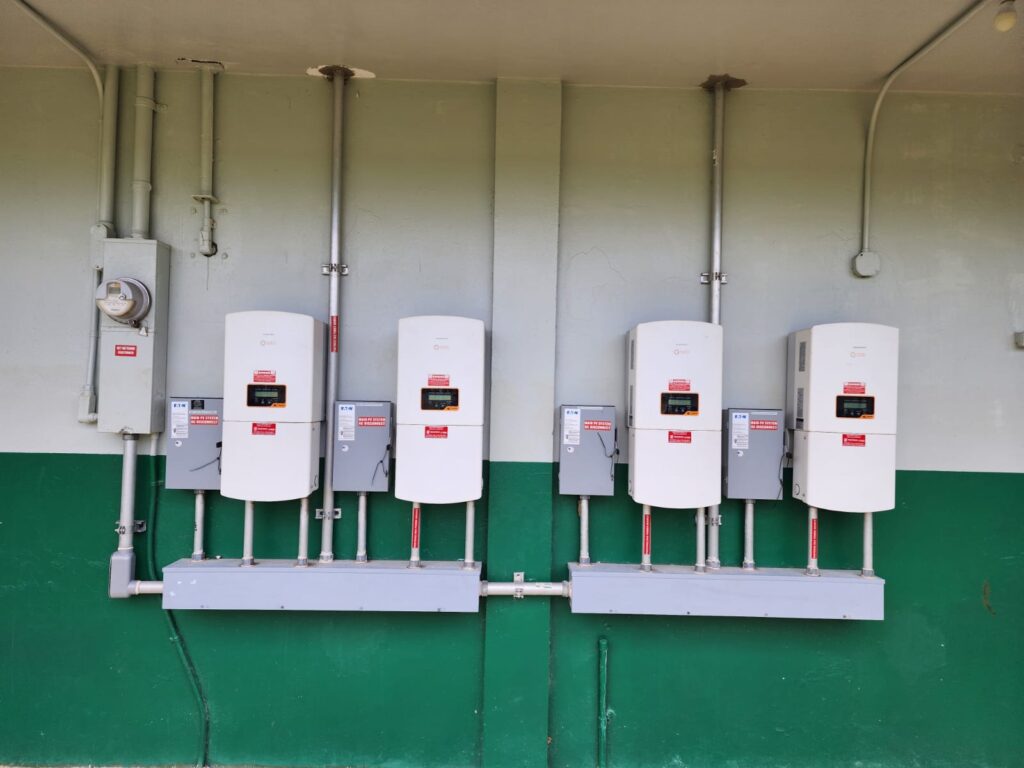
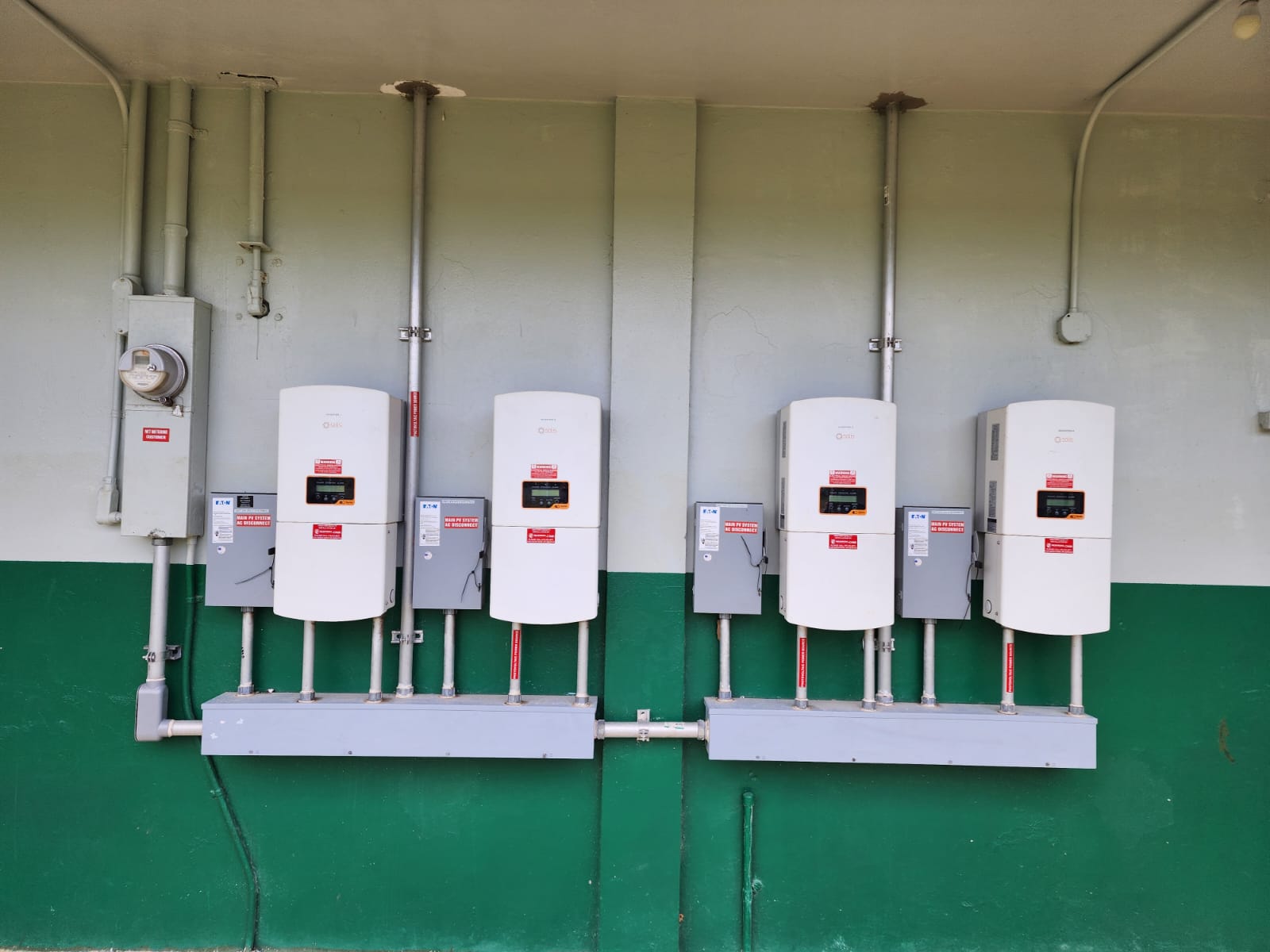
A net metering system has been installed at Koblerville Elementary School.
EDUCATION Commissioner Lawrence F. Camacho and several Saipan residents expressed their opposition to House Bill 23-92, which would suspend net energy metering, during a public hearing conducted by the House Committee on Public Utilities, Transportation and Communications in the House chamber on Friday evening.
Authored by Rep. Vincent S. Aldan, H.B. 23-92 seeks to amend Public Law 18-62, which entitles eligible customers who generate renewable energy to receive net energy metering service and compensation for an excess in electricity generated by their renewable energy system.
Present in the public hearing were the committee chairman, Aldan; vice chairman, Rep. Angelo Camacho; and members, House Floor Leader Edwin Propst, and Reps. John Paul Sablan, Diego Vincent Camacho and Marissa Flores.
Thorough examination
In his testimony, Commissioner Camacho said H.B. 23-92 presents “serious and profound and far-reaching consequences that warrant a thorough examination.”
He said the Public School System has “embarked on a path of sustainable energy utilization with significant investments in solar energy installations, which are also aligned with its long-term financial strategy to reduce operational cost and direct more resources toward enhancing educational quality.”
He said the “abrupt termination of net metering will derail PSS’s strategy, forcing it into the unplanned and costly adaptations such as the installations of battery storage systems.”
These will not only exhaust PSS’s financial reserves but also divert funds crucial for educational initiatives, he added.
Camacho said H.B. 23-92 could lead to increased operational cost and affect PSS’s ability to provide essential services and maintain the quality of education.
Financial cliff
He said this increased cost “is against the backdrop of a financial cliff in 2025 when we would no longer have American Rescue Plan Act funds to act as backstop.”
Camacho said H.B. 23-92 “has been timed to coincide with the connection of many of our facilities,” which has installed solar panels.
“Although the Legislature has been clear that it wants the CNMI to transition away from our old diesel generators to more sustainable renewable energy, the Commonwealth Utilities Corp. has always been opposed and now, instead of supporting this step forward in fulfilling the Legislature’s stated policy goals CUC seems to change those goals to maintain the status quo,” Camacho said.
“We understand that there are significant barriers in cost to moving the CNMI forward in its energy goals, but the answer is not keeping it where it is. As such, we are hopeful that instead of forging deeper ties to diesel and other resources out of our control we move the CNMI forward by tapping into our home-grown natural resources,” he added.
He said PSS’s binding contract with Micronesian Renewable Energy spans two decades, and is based on a legal framework that supports net metering.
Camacho said H.B. 23-92 would disrupt this agreement and expose PSS to potential conflicts and liabilities.
This scenario goes beyond the immediate financial burden, he added. “It shakes the foundation of contractual trust and reliability crucial for stable and effective public administration. The legal entanglements and uncertainties that would ensue could have a chilling effect on future private-public partnerships and investments,” Camacho said.
“The proposed bill … undermines our efforts to transition way from fossil fuels and neglects our contributions to combating climate change,” he added.
“We advocate for a thorough reconsideration of this bill, taking into account its extensive financial, legal, environmental and societal implications, yet we remain committed to constructive dialogue and collaboration to ensure a sustainable and prosperous future for our community across our Commonwealth,” Camacho said.
Data
Annie Santos, a net energy metering customer, asked the committee members, “Is there data … we can read to know why we are taking ourselves out of net metering?”
Santos said she’s paying the renewable energy provider while she also gives CUC “free power.” “How can you explain that to me and how can CUC explain that?” she asked.
She said she prefers to “get out” of CUC’s grid, “but if you take me out [of net metering] by law, and I still have to pay CUC, then I’m sorry. It’s a no-no.”
“Whoever introduced this bill, my question to him is do you have the same system? … Why are you killing it? I have more to say but if this becomes public law, I’m doing a comeback,” she said.
Former Rep. Juan I. Tenorio told the lawmakers, “I trust of all you. You are all well-educated and I trust that your mindset is good. But please be mindful of us, the public.”
He added that with all these economic problems that the people are facing, “we are trying our very best to find ways to minimize our cost in every angle of our daily lives and for that matter, electricity.”
Tenorio asked the committee to please “find ways to make our lives better, more so, on energy. I’m going to start using solar, but with all of this that I am hearing from the public, I’m kind of hesitant now.”
Three other members of the public also expressed their concern regarding the bill, which Rep. Aldan said would remain in committee, adding that “we’re not going to kill net metering, but the price has to be fair. … We cannot afford it. … Yes we can implement net metering, but we have to do it right.”
He also assured current net metering customers that “we cannot retract or renege on an existing contract.”
“So those who have it, you won the lottery,” he said.
